Today we're taking our first look at German manufacturer Be Quiet's all-in-one (AIO) CPU liquid coolers, with a review of their Pure Loop 280mm cooler. True to their design ethos, Be Quiet! has built the Pure Loop to operate with as little noise as is reasonably possible, making for a record-quiet cooler that also hits a great balance between overall performance, an elegant appearance, and price.
AMD has confirmed that new Ryzen processors using the 3D V-Cache tech it revealed back in June will debut early in 2022, with a big performance uplift compared to existing Ryzen 5000 CPUs.
This revelation was made as AMD celebrated the five-year anniversary of the launch of Ryzen chips, in a YouTube video with the firm’s chief marketing officer John Taylor, and director of technical marketing, Robert Hallock.
With the confirmation that new Zen 3 CPUs will be here at the start of 2022 – a refresh of existing models with the aforementioned 3D V-Cache beefing up cache performance – Taylor noted that these processors are set to deliver a 15% performance uplift with the cache alone, adding that it’s “like a generational uplift” in gaming performance.
Indeed, gains to the tune of 15% are what we can typically expect from a whole new range (and architecture) – well, in the ballpark of 15% to 20% anyway – so this seems to suggest that the new CPUs arriving early next year will be Ryzen 6000 models, a whole new generation (rather than just a mere Ryzen 5000 XT refresh).
Hallock also mention AMD’s incoming Zen 4 chips and confirms that these are still on track for later in 2022, with a whole new platform (AM5) featuring PCIe 5.0 and DDR5, as we already knew.
Analysis: The importance of damage control against Alder Lake?
AMD has already let us know that production of 3D V-Cache chips would begin before 2021 was out, suggesting an early 2022 release, and it appears that this potential launch schedule is still on target going by these latest comments.
That’s good news, and crucial for AMD to hold onto its current lead in the desktop CPU market.
That’s why AMD needs a quick response, and a good one too – refreshed chips with a 15% performance boost would likely do the trick, bearing in mind that this sizeable uplift is from the new cache tech alone. That means other advances could augment the gains (pushing clock speeds a bit faster, for example), allowing Team Red to stay more competitive with Intel. Calling the new chips Ryzen 6000 would underline that competitivity in the minds of consumers, so that’s why this could happen, at least by our reckoning.
With Zen 4 chips due late in 2022, though, using Ryzen 6000 for refreshed processors at the start of the year would lead to the unusual situation where Ryzen 7000 would be out in the same year – and that could seem a bit odd.
Still, to stay competitive with Alder Lake – if Intel’s 12th-gen is as promising as it seems – there could be a strong argument for AMD to present 3D V-Cache boosted chips as a new range, from a PR point of view in terms of market perceptions.
Intel’s incoming Core i5-12400 could be a midrange beast of a chip, at least if the latest leak about this Alder Lake processor is on the money.
The spilled benchmark comes from Bilibili as spotted by HXL on Twitter, a common source of hardware leaks, with this one showing the 12400 put through its paces on Cinebench R20 and CPU-Z, with seriously impressive results.
Retail i5 12400Single core up to 4.4Gall core up to 4Ghttps://t.co/9Czi4ToE8p pic.twitter.com/XWR8CQQ4aGOctober 11, 2021
See more
First of all, we should note the spec details revealed here, showing what’s apparently the retail version of the Core i5-12400. It has 6 performance cores, with no power-efficient cores, so in other words, it’s just a normal CPU with no ‘small’ cores as per Alder Lake’s hybrid scheme of things (not every 12th-gen chip will employ the hybrid tech).
As for clock speeds, the Intel CPU is capable of boost to 4.4GHz on a single-core, with 4GHz across all-cores.
In Cinebench R20, the Core i5-12400 flexes its performance core-only muscles to hit 659 in single-threaded, and 4,784 in multi-threaded. As PC Gamer points out, that’s faster than the Ryzen 5 5600X which has 6-cores and managed 597 and 4,438 respectively when our sister site benchmarked the AMD processor. So Intel is 10% and 8% faster in single and multi-threaded here.
Obviously we need to take this with a good deal of caution, though, but it’s quite a startling result if genuine.
As for CPU-Z, the 12400 scored 681 in single-threaded and 4,983 in multi-threaded. In testing on AIDA64, which was also shown here, the Alder Lake CPU didn’t get any hotter than 60C (with a peak power draw of 78W), so that’s good to see, as well.
Analysis: Going for the CPU jugular? Let’s hope so for competitivity’s sake
As ever with pre-release leakage, we should underline again that hefty doses of salt are required, and we’d be foolish to try and draw any firm conclusions comparing to other chips on the market – that’s what full reviews are for when products are launched. But still, it’s hard not to get excited about the promising level of performance which this leak suggests for what should be a wallet-friendly Alder Lake processor.
We say wallet-friendly, but of course what we don’t know is a key piece of the puzzle, and that’s how Intel will pitch pricing. In this case, it should be in line with current midrange pricing, you would hope – perhaps a bit more (or maybe not if Intel really wants to take the fight to AMD and go for the CPU jugular, to try to reclaim some of that desktop territory lost to Ryzen in recent years).
For reference, the current Core i5-11400 (Rocket Lake CPU) retails for $182 (around £135, AU$245), and remember, the Ryzen 5 5600X sells for $299 (around £220, AU$400) – but as we said already, let’s not jump to any conclusions just yet on how much of a potent weapon the 12400 might be in Intel’s armory.
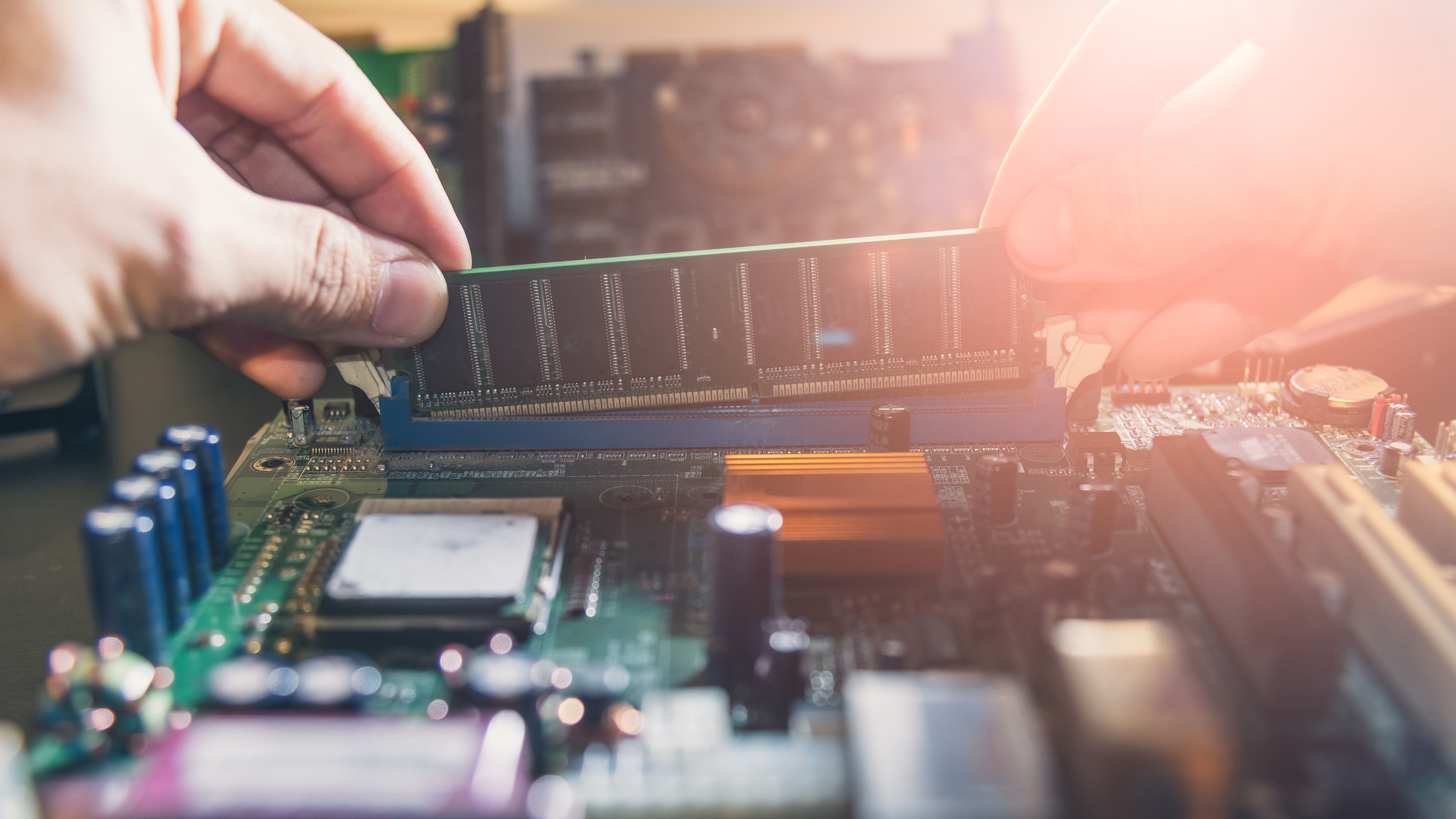
Samsung has announced that it has started mass producing what it claims is the ‘industry’s smallest’ 14-nanometer (nm) DDR5 DRAM, offering drastically improved speeds over the previous generation DDR4 RAM (which is what most of our PCs are currently using).
By utilising the pretty awesome sounding extreme ultraviolet (EUV) technology, Samsung has increased the number of EUV layers in its DDR5 chips, allowing them to be smaller, but with a higher density.
This looks set to bring a range of exciting possibilities. For a start, Samsung says its 14nm DDR5 DRAM will be able to hit speeds of 7.2 gigabits per second (Gbps), which is over twice the speed of DDR4, which peaks at 3.2Gbps.
By being smaller and denser, power consumption could be cut by up to 20%, and Samsung also hopes this will improve overall wafer productivity – essentially meaning it should be able to create more usable chips using this process – particularly important whilst we’re in a midst of a global chip shortage.
In Samsung’s announcement, Jooyoung Lee, Senior Vice President and Head of DRAM Product & Technology at Samsung Electronics, explains that “multi-layer EUV… has enabled extreme miniaturization at 14nm — a feat not possible with the conventional argon fluoride (ArF) process.”
So, Samsung is making RAM that’s drastically faster, more power efficient and should hopefully be in plentiful supply? Sign us up.
For anyone keen to upgrade their PC with Samsung’s new memory, how soon will they be able to? Sadly, it may be a while. In Samsung’s announcement, the company doesn’t give any consumer release dates.
Instead, Lee talks about how this new memory is helping Samsung to address “the need for greater performance and capacity in the data-driven world of 5G, AI and the metaverse.” So, this memory looks like it will be aimed – primarily at least – at data center, supercomputer and servers.
However, we’d love to see this come in some form to consumer RAM as well.
We are starting to see DDR5 RAM hitting the shelves, however, so that RAM upgrade may not be too far off. However, you’ll need to make sure you have a CPU and motherboard that support the new memory – Intel’s Alder Lake processors will be the first to do so, and we hope to see them before the end of 2021.
Of course, with any brand-new technology, it may be worth holding off for a while. DDR5 RAM will initially be very expensive (plus there’s the expense of buying new processors and motherboards to factor in), and by waiting a while you should see prices drop as more options come to market.
It’ll also allow new advancements – such as Samsung’s 14nm process – to arrive, hopefully offering noticeably improved performance over the first wave of products.
When you’re keen to upgrade, having to wait may be hard, but in this case it could really be worth it.
AMD could have Ryzen 7000 processors waiting in the wings, according to the latest from the rumor mill – but we’re not so sure, and this leak, which comes from HP (once again), is likely to be a listing error of some kind.
The full story here is that as @momomo_us highlighted on Twitter (via Wccftech), HP has put up a product listing for future all-in-one PCs which will use either Intel’s incoming Alder Lake chips, or the “AMD Ryzen 7000” series.
12 Gen Intel & AMD Ryzen 7000🤔 pic.twitter.com/1NcpMMOT2fOctober 9, 2021
See more
Obviously that’s pretty odd, because as likely won’t have escaped your attention, AMD’s current processors are Ryzen 5000 models, so logically the next in line is the Ryzen 6000 range – and here the company appears to be looking to skip straight to Ryzen 7000.
Why would this happen? That’s unclear, but the argument, or at least suggestion, is that AMD might just have APUs from the Ryzen 7000 family ready to roll (the 24-inch and 27-inch all-in-ones or AIOs are ‘coming soon’ according to the listing).
As these are AIOs, they would be running an APU (CPU plus graphics) – presumably ‘Rembrandt’ based on Zen 3+ in theory – rather than actual Zen 4 desktop chips (‘Vermeer’). Zen 4 is still a long way out, of course, as next-gen desktop CPUs won’t be here until the end of 2022. (Before that, we’ll get a refresh of current Ryzen processors making use of 3D V-Cache tech early next year).
Analysis: The curious case of the ‘SSE’
Not only does it seem plain unlikely that AMD would skip Ryzen 6000, there are other reasons why this particular leak seems seriously iffy, and more likely to be a listing mistake than anything else.
HP’s other product listings for desktop computers and AIOs refer to Ryzen 5 processors, and Ryzen 9, so it seems like the possibility here is that the listing should read ‘Ryzen 7’, and someone has accidentally labeled it as ‘Ryzen 7000’.
That possibility is backed up by the fact that there is another mistake in the listing, as the SSD is called an ‘SSE’, and if that level of carelessness is anything to go by, it’s easy to imagine another error happening. Even though this sort of thing really shouldn’t get through on a big company’s official website.
We can’t totally rule out the possibility that there is a grain of truth here, though. HP does have a history of leaking hardware before it’s released, and it’s not unthinkable for AMD to skip to Ryzen 7000 somehow – that just really doesn’t seem likely, and we’re not buying it.
Intel’s Core i9-12900K has been spotted in yet more Alder Lake leakage, with another spilled benchmark suggesting that we’ll get promising performance from the 12th-gen flagship.
This comes from Twitter-based hardware leaker HXL (again) who flagged up a couple of purported benchmarks on Bilibili, showing the 12900K put through its paces on Cinebench R20 and CPU-Z.
As observed, the benchmarks were carried out under Windows 11 with DDR4 system RAM, using a QS or qualification sample (meaning it’s the final pre-release version and should be pretty much identical to the retail chip).
In Cinebench R20, the Core i9-12900K’s single-threaded performance proved to be almost 20% faster than the 11900K, and the same story was true in CPU-Z (actually the 12900K was 21% faster here).
In multi-threaded testing with Cinebench, the 12900K was 65% faster than the 11900K, and just a smidge faster than the AMD Ryzen 9 5950X. With CPU-Z, the Alder Lake flagship was 75% better than the 11900K, and very close to the 5950X (the AMD chip was 3% quicker here, so just marginally had the edge).
Analysis: Eye-opening performance once again
We must, of course, apply the usual caveats and caution around any leaked benchmarks, but this is yet another promising set of leaked results for Alder Lake. That single-core performance beating out current-gen Rocket Lake by 20% across two benchmarks is quite an eye-opener, and multi-core speeds roughly equalling the Ryzen 9 5950X are also seriously impressive (single-threaded performance is much better than the Ryzen chip, too, to the tune of 27% and 18% faster in CPU-Z and Cinebench respectively).
Another point to bear in mind here is that the 5950X is a 16-core CPU bristling with 32-threads, compared to the 12900K’s purported configuration of 24-threads (it’ll run with 8 full-power performance cores, and 8 efficiency ones, with the latter not having hyper-threading). So the Ryzen chip has an 8-thread advantage here, and remember, the final retail 12900K chip could do better still, particularly if paired with DDR5 RAM (DDR4 is used in this round of testing as noted).
If there’s one area for a touch of concern at first glance, it’s the power consumption hitting 257W in the stress test here, and temperatures reaching 108C – but that’s to do with the apparently fudged cooling solution (it wasn’t properly mounted) the leaker had to employ here. In other words, take that with a whole lot of condiments, and the thermal performance of the actual finished product will be a whole lot better (likely in the same ballpark as the 11900K).
Overall, this is a very promising leak for Intel, and yet another one which seems to suggest that Alder Lake could be a real headache for AMD and its desktop Ryzen dominance.
Intel’s Core i7-12700K, the next-gen Alder Lake processor which could be out in less than a month, has appeared in a leaked benchmark which points to a promising level of performance.
As spotted by VideoCardz, the CPU-Z benchmark result was posted on Twitter by well-known leaker Tum_Apisak, with the 12700K hitting a single-thread score of 800 and multi-threaded result of 9,423. Remember, the 12700K offers 8-cores (normal performance ones) combined with 4 power-efficient cores, giving it 20-threads in total (the efficient cores don’t have hyper-threading).
Now, before we digest those scores, it’s worth pointing out that we don’t know if this leak could be fabricated, so go pretty heavy on the condiments here. That possibility aside, particularly the single-thread result looks very strong for Intel’s 12700K, which as you’re likely aware, isn’t the flagship (that’s the 12900K).
A tally of 800 for single-thread is a sizable step up from current Rocket Lake chips, looking the best part of 20% faster compared to the 11700K going by previous results from that CPU. It’s also very close to the 12900K’s score, which in a previous leak reached a (purported) 825, and similarly, it compares very well to Ryzen 5000 silicon.
The multi-threaded result of 9,423 is a good deal further behind the 12900K though (which hit 11,900), and also nestles just behind the Ryzen 9 5900X which manages around 9,500 as VideoCardz observes. That said, the 5900X is a 12-core chip with 24-threads in total, so has more raw grunt in terms of pure thread count than the 12700K. All in all, this still seems like a solid result for the Intel Core i7 Alder Lake processor.
Analysis: Exciting hints, for sure – but nothing more than that
Overall, then, this is a promising leak, assuming it’s a genuine benchmark result. There are other caveats here, though, not the least of which is that we shouldn’t put all that much stock in a single pre-release benchmark, and for that matter, CPU-Z isn’t the best benchmarking utility to judge performance by (or the most reliable benchmark metric historically).
We also don’t know anything about the rig which the Core i7-12700K was running in, and whether the 12700K was overclocked at all (which is theoretically possible, even if that’s maybe not typical for leaks of sample chips).
Still, this is an exciting potential glimpse of performance, and we should also bear in mind that it looks like the benchmark was carried out under Windows 10, with Windows 11 offering purported additional performance benefits to Alder Lake. We can but wait and keep our fingers crossed, with AMD perhaps starting to perspire a little as more of these leaks come out suggesting that Intel is really onto something with its 12th-gen silicon.