Monday, 10 January 2022

MSI teases a PCIe 5.0 SSD that’s jaw-droppingly fast

https://ift.tt/eA8V8J

MSI has given us a fleeting teaser of an incoming PCIe 5.0 SSD from the firm’s Spatium range of solid-state offerings.

The Spatium PCIe 5.0 SSD will run with the new Phison PS5026-E26 controller – which was revealed at CES 2022 – and is an add-in board which uses the NVMe 2.0 interface. As Wccftech spotted, MSI gave us a glimpse of the drive on Twitter, but with little info sadly.

See more

As mentioned, we did hear about the Phison PS5026-E26 controller last week at CES, billed as targeted for heavyweight computing and high-end enthusiast gaming, and offering a rated performance of up to 12GB/s for read speeds and up to 11GB/s for writes.

In short, the next Spatium offering from MSI will be blisteringly fast, and it follows the current Spatium drives that were launched last year with PCIe 4.0 support and read speeds of 7GB/s and writes of 6.8GB/s (for the M480).


Analysis: Speed demon SSD, but not one you’ll need in the near future

PCIe 5.0 is still a tech of the future, really, even if drives are now being talked about as readying for launch before too long. Remember, Intel’s Alder Lake is the only platform to support the standard right now – and those 12th-gen chips only came out in November 2021, just a couple of months ago. AMD’s Ryzen silicon won’t support PCIe 5.0 until next-gen Zen 4 CPUs emerge later this year.

However, PCIe 5.0 isn’t something the average user needs to be remotely concerned about right now. The kind of performance on offer is overkill for these folks, and the first PCIe 5.0 SSDs to emerge will doubtless be stupidly expensive anyway. Realistically, PCIe 4.0 is currently plenty fast enough – and still has a good deal of headroom, in fact – for consumer storage drives.

We know Samsung has PCIe 5.0 coming in the form of an enterprise SSD with read speeds of up to 13GB/s, but that’s obviously not for consumers. Basically, in the near future, only serious applications such as AI are likely to feel the benefit of these high-performance SSDs. It’ll be much further out that PCIe 5.0 SSDs will be relevant for your average (or even enthusiast) PC owner, of course, and MSI hasn’t put any release date on its Spatium PCIe 5.0 model yet. It is, of course, promising to see a teaser this early in the year, though…


from TechRadar: computing components news https://ift.tt/32WOi3X
via IFTTT

Sunday, 9 January 2022

Intel Raptor Lake flagship again rumored to be a 24-core CPU

https://ift.tt/eA8V8J

Intel’s 13th-gen processors are due to land at some point later this year, and what is purportedly the flagship Raptor Lake CPU has again been spotted, this time in a leaked Bootlog from the chip giant.

This was spotted by Coelacanth’s Dream (as highlighted by Tom’s Hardware) and it reinforces what has already been rumored about what will presumably be the Core i9-13900K, namely the core configuration and counts.

As detailed in the leak of the Bootlog, this Raptor Lake chip will have 24-cores, with 32-threads in total. That suggests the 13900K has 8 performance cores – mirroring Alder Lake, as expected, because the 13th-gen is a simple refresh of the current CPUs – and 16 efficiency cores (the latter don’t have hyper-threading, hence the thread count of 32).

Compared to Alder Lake, this means the flagship could run with the same amount of performance cores, but double up on the efficiency cores; a major boost on that front.

The clock speed of the engineering sample leaked – 1.8GHz – is obviously not what the finished processor will run at, and this is par for the course with a chip in development that’s still some way off release.

Also of interest here is that Raptor Lake doesn’t support AVX-512 instructions, but then neither does Alder Lake – officially, anyway – so this is no surprise, again remembering that the next-gen chips will essentially be the same as current 12th-gen models at heart (so rumor has it), just revamped and honed for better performance.


Analysis: More evidence of how much bite to expect from Raptor Lake flagship

The configuration of 8 performance cores and 16 efficiency cores has been seen before in leaks of the purported Raptor Lake flagship, which most recently included a spilled benchmark. So this latest sighting – even though we must take it with caution, as ever – adds to the evidence pile that this will be the configuration of the top-end 13th-gen processor.

Performance will be boosted in the next-gen flagship CPU not just due to it potentially having a lot more efficiency cores, but also with Intel likely being able to push clock speeds just a little more, and moreover the architectural refinements that’ll deliver more IPC (Instructions per Clock).

Of course, this Bootlog sighting is also a sign of Intel’s progression moving ahead nicely with Raptor Lake, which will hopefully be here sooner than we think in 2022 – the rumor mill has indicated that a Q3 launch is possible.

During CES 2022 earlier this week, Team Blue confirmed that Raptor Lake is on track, but as we don’t have an official launch timeframe beyond it happening later this year, we still don’t know for sure whether that might be Q3 or Q4.


from TechRadar: computing components news https://ift.tt/3zMIZQn
via IFTTT

Friday, 7 January 2022

Intel Teases NUC12 Extreme Dragon Canyon: Socketed Alder Lake and 10GbE in Q1 2022

https://ift.tt/3f2ErM8

Intel provided a teaser of their upcoming NUC12 Extreme product at CES 2022. Complete specifications have been promised closer to launch, but the components layout in their virtual presentation points to a follow-up very similar to the Beast Canyon NUC in terms of form-factor and sizing.

The key update from the Beast Canyon seems to be the use of a socketed processor, which should allow for a wider range of processor choices for the end user. The vapor chamber / CPU blower continues to be the cooling system for the components in the Compute Element 'add-in card'. The allowed TDP range for the supported processors is something that would be interesting to note while building systems based on the Dragon Canyon platform. Other aspects such as the use of DDR4 SODIMMs and a separate front panel connector board seem to be similar to the Beast Canyon NUC platform introduced last year.

From the I/O perspective, we have Thunderbolt 4 (as expected with Alder Lake) and Wi-Fi 6E. Networking enthusiasts should be quite happy with Intel's promise of delivering 10GbE LAN in the product. The absence of USB 3.2 Gen 2x2 appears to be a slight dampener in what otherwise seems to be an exciting SFF platform expected to launch in the next few months.


from AnandTech https://ift.tt/31yQUUG
via IFTTT

CES 2022: AMD’s Next-Gen AM5 Platform to Have Long Term Support

https://ift.tt/3n1j6Y4

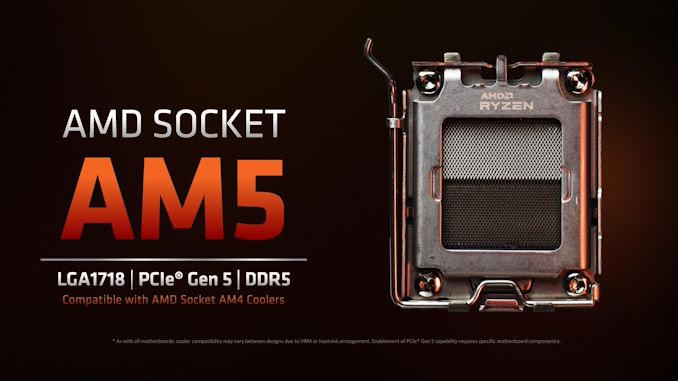
One of the key aspects of AMD’s offering in the consumer desktop space is the longevity of its socket and platform. Throughout the years, AMD has leveraged a single socket for multiple generations, providing users the ability to keep the same motherboard year in and year out, while the competition changes the socket every couple of generations at best. To keep that mantra, AMD has stated that its next-generation platform coming later this year, AM5, will also be a multi-generational platform.

Going back in AMD’s history we can see just how long various platforms have lasted, from first processor launch to last processor launch:

  • Socket 939 from 2004 to 2006
  • AM2/2+ socket from 2006 to 2009
  • AM3/3+ socket from 2009 to 2013
  • FM2/2+ socket from 2012 to 2015
  • AM4 socket from 2016 to 2021
  • AM5 socket from 2021 to ...

Within that time there have been chipset updates to allow for better IO, however usually the socket change has happened because of DDR version changes, interconnect, and PCIe. In this instance, the move from AM4 to AM5 comes with a change from DDR4 to DDR5 and PCIe 4.0 to PCIe 5.0.

In a roundtable with Dr. Lisa Su, the question was asked about how long AM5 would be around – now that AMD has a sustainable position again in the desktop, and by many measures a leading position, would AMD continue its tradition of longer-lived desktop platforms. Dr. Su stated that AM4 ‘has been good for the community and … it’s been good for us as well’. She confirmed that a change was required with the new standards, but on strategy it was put that ‘I don’t have an exact number of years but I would say that you should expect that AM5 will be a long-lived platform as AM4 has been’. Dr. Su also stated that even with the introduction of AM5, the company expects AM4 to stay in the marketplace for some years, with overlap between the two depending on the market.

For users wondering how far AM5 can go before it needs to change again, it’s worth looking at roadmaps for the two usual elements that cause socket updates: memory and PCIe. We’re only just on the transition to DDR5, and DDR6 is a long way away – in a recent Samsung presentation, for example, it listed DDR6 as a 2028 technology. Similarly with PCIe 5.0, the same presentation puts PCIe 6.0 as a 2026 technology, and PCIe 7.0 as a 2029 technology. So unless AMD wants to increase the pin count on the CPUs for more memory channels or more PCIe lanes, the PCIe 5.0+DDR5 combination looks set until at least 2026.


from AnandTech https://ift.tt/3qQQe5M
via IFTTT

Thursday, 6 January 2022

CES 2022: GIGABYTE Revamps Aorus 17 Gaming Laptop With 12th Gen Intel & RTX 30 Series

https://ift.tt/3G0WRbT

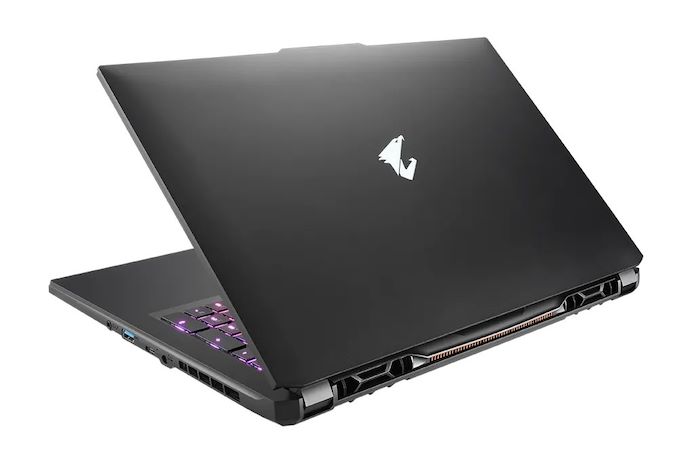
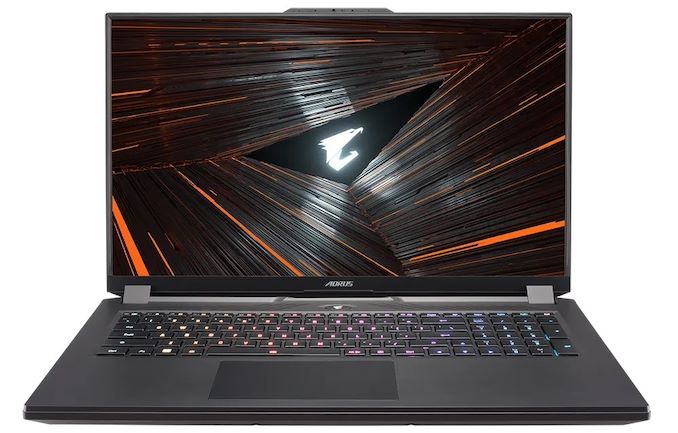
GIGABYTE has unveiled its latest 17-inch gaming laptop, the Aorus 17 YE5. Updated for 2022 with the latest Intel 12th generation mobile processor and NVIDIA GeForce RTX 30 series graphics, the Aorus 17 YE5 boasts a new 360 Hz 1080p display, with support for the latest DDR5 memory, as well as incorporating thinner bezels for a sleeker yet powerful gaming solution for gamers on the go.

With Intel announcing its latest Alder Lake-H series of mobile processors, many vendors have announced its latest gaming laptop ranges during CES 2022. One of these is the GIGABYTE Aorus 17 YE5, with an Intel Core i7-12700H 12-core (6P + 8E cores) processor, as well as boasting NVIDIA's latest GeForce RTX 3080 Ti mobile graphics with 16 GB of GDDR6 memory, a boost clock of up 1395 MHz, and a maximum graphics power output of 130 W. GIGABYTE also lists space for two DDR5-4800 16 GB memory sticks and room for two PCIe 4.0 x4 M.2 slots, but the full configuration is likely to be region-specific.

Updated for 2022 with a host of new design characteristics and features, the GIGABYTE Aorus 17 YE5 includes a 17.3-inch IPS display with an anti-glare coating, 72% NTSC color gamut, and a blisteringly fast 360 Hz refresh rate at 1920 x 1080p resolutions. Due to thinner bezels around the screen, GIGABYTE claims a 90% screen-to-body ratio, with a 13% smaller footprint over last year's model, and also manages to fit an HD webcam on the top bezel. The Aorus 17 YE5 has dimensions of 398 x 254 x 270 mm (WxDxH) with a weight of 2.7 KG and includes a 99 Wh lithium polymer battery and 240 W adapter for charging. GIGABYTE also claims that this is the world's first Microsoft Azure AI notebook.

Looking at IO support, GIGABYTE includes a single Thunderbolt 4 Type-C and two USB 3.2 G2 Type-A ports. There is a mini-DisplayPort 1.4 and HDMI 2.1 video output pairing for external displays, with an unspecified Ethernet port and a single 3.5 mm audio jack. The Aorus 17 YE5 also includes an Intel AX211 Wi-Fi 6E interface that features support for BT 5.2 devices.

At the time of writing, GIGABYTE hasn't specified when the Aorus 17 YE5 will be available to purchase or how much it might cost.

Source: GIGABYTE


from AnandTech https://ift.tt/3G6zjm7
via IFTTT

Wednesday, 5 January 2022

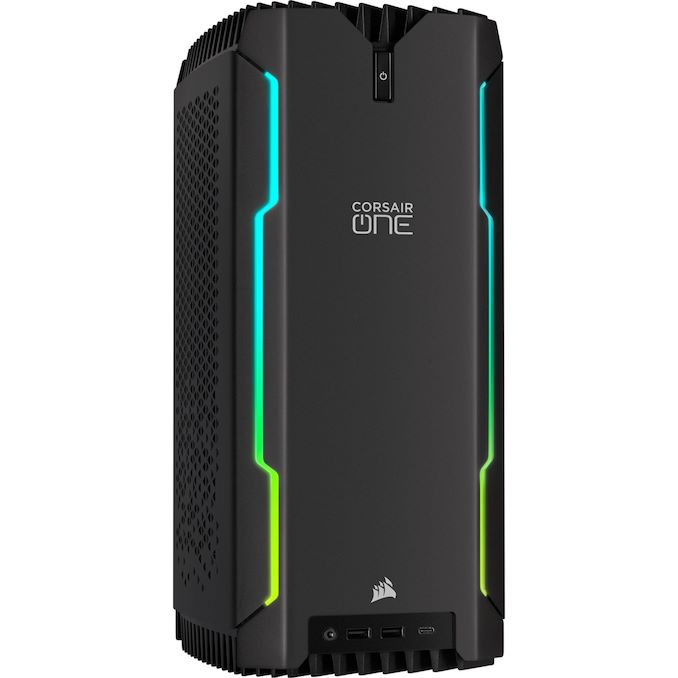
CES 2022: Corsair Launches One i300 Gaming PC with Intel Core i9-12900K and DDR5

https://ift.tt/3zvgLtu

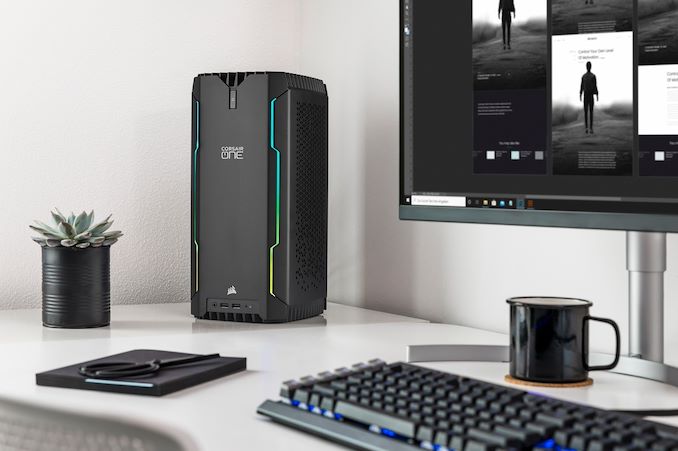
During CES 2022, Corsair has unveiled its latest compact gaming PC, the Corsair One i300. Equipped with the latest components available, it includes an Intel Core i9-12900K processor, Corsair Vengeance DDR5 memory, Wi-Fi 6 and 2.5 GbE networking, as well as up to and including a liquid-cooled NVIDIA GeForce RTX 3080 Ti for a premium gaming experience.

Weighing in at just over 7 KG, the Corsair One i300 gaming PC is designed around the premise that not all high-performance gaming PCs need to be super-sized. The chassis itself measures at 15 x 6.8 x 7.9 inches (HxWxD), with a volume of just 12 liters making it the ideal small form factor-sized gaming PC for any user struggling with space. Each Corsair One i300 system comes equipped with an unspecified mini-ITX motherboard, while the system is powered by a Corsair 750 W 80-Plus Platinum SFX power supply.

The Corsair One i300 gaming PC is customizable and is the first system in its range to feature the latest DDR5 memory. It also includes Intel's flagship Core i9-12900K processor and gives users the option to have either 64 GB (2x32) of Corsair Vengeance DDR5-4400 or 32 GB (2x16) of Vengeance DDR5-4800 memory. Other customizable options with this model include a choice between two graphics cards, either an NVIDIA GeForce RTX 3080 or RTX 3080 Ti, both of which come water-cooled with this system. There's a 2 TB M.2 NVMe SSD for storage, while the latest Windows 11 Pro operating system comes preinstalled on it, although Corsair doesn't provide information on what cooler it is using for the CPU.

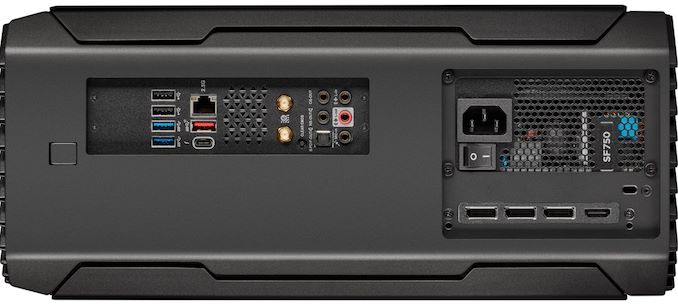
In terms of input and output, the Corsair One i300 has two Thunderbolt 4 Type-C, two USB 3.2 G2 Type-A, and four USB 3.2 G1 Type-A ports on the rear, with an additional USB Type-C and two USB 3.2 G1 Type-A ports on the front panel. For networking, there's a single 2.5 GbE port and Wi-Fi 6E, while audio options consist of five 3.5 mm audio jacks and S/PDIF optical output. There's also one HDMI and three DisplayPort video outputs for the graphics card.

Corsair states that the One i300 Gaming PC comes with a two-year warranty and is available to purchase as of now from authorized retailers and distributors.

Source: Corsair


from AnandTech https://ift.tt/3t0rZF5
via IFTTT

Tuesday, 4 January 2022

Intel Announces 12th Gen Core Alder Lake: 22 New Desktop-S CPUs, 8 New Laptop-H CPUs

https://ift.tt/32Jlpbk

When Intel launched its 12th Generation Core family of processors late last year, it was only a small set of overclockable parts for desktops that came to market. Featuring Intel’s new hybrid core design, the hardware proved competitive and cost effective, making it a very interesting time to be a consumer. However, the main battle for volume sales is typically in the mid-range and notebook segments which power millions of devices, and Intel is launching these processors today. These include the 35 W and 65 W desktop processors, new desktop coolers, and a handful of 45W+ laptop offerings for the creator and gaming markets.


from AnandTech https://ift.tt/3mWZtAi
via IFTTT
Related Posts Plugin for WordPress, Blogger...