Thursday, 10 March 2022

Apple M1 Ultra solves a multi-GPU problem that’s been plaguing AMD and Nvidia

https://ift.tt/K1wOIGl

It looks like Apple may have solved a multi-GPU problem that has been plaguing AMD and Nvidia for years thanks to the UltraFusion interface it unveiled earlier this week, which allows two M1 Max chip to connect together to make a single M1 Ultra chip.

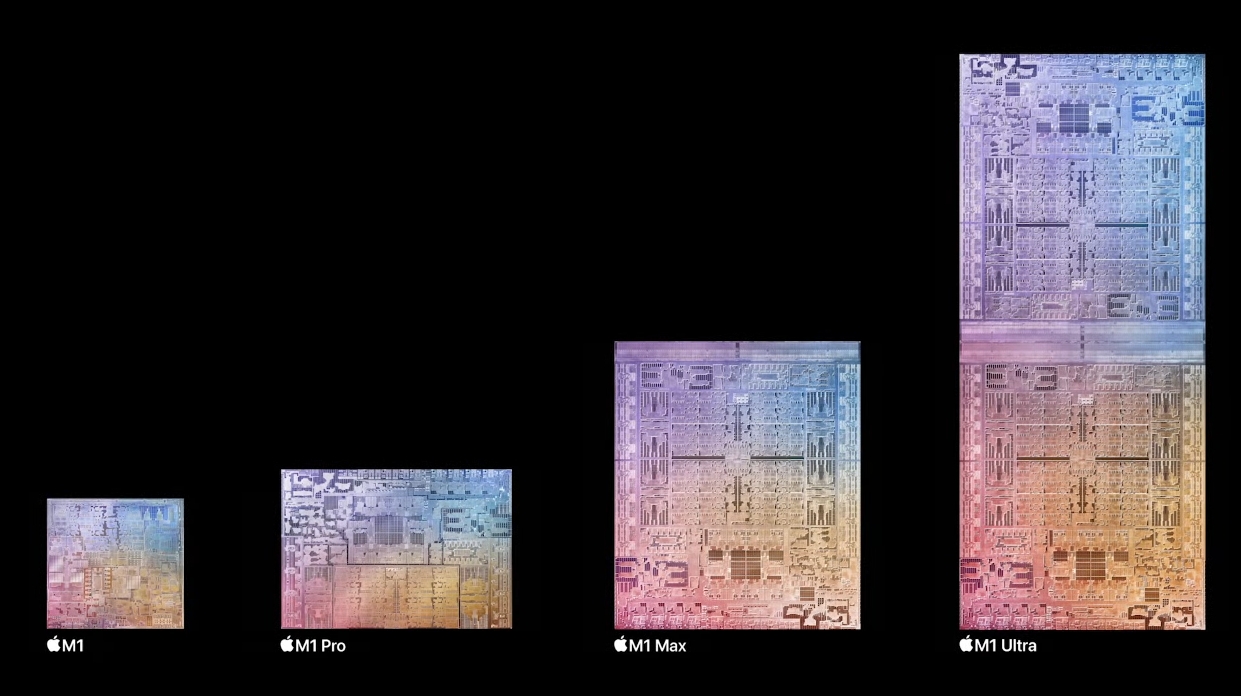
When Apple announced the M1 Max last year, it rather cunningly didn’t reveal that there was a hidden secret built into the chip. This secret was revealed earlier this week at Apple’s March Event, where the company revealed that it can combine two M1 Max chips, turning them into an M1 Ultra with double the power – including twice as many GPU cores.

Of course, Apple isn’t the first company to harness the power of two GPUs. For many years, Nvidia graphics cards supported SLI (Scalable Link Interface) – a high-speed link that allowed you to connect multiple GPUs at once for increased performance. AMD had a similar tech with CrossFire that did the same.
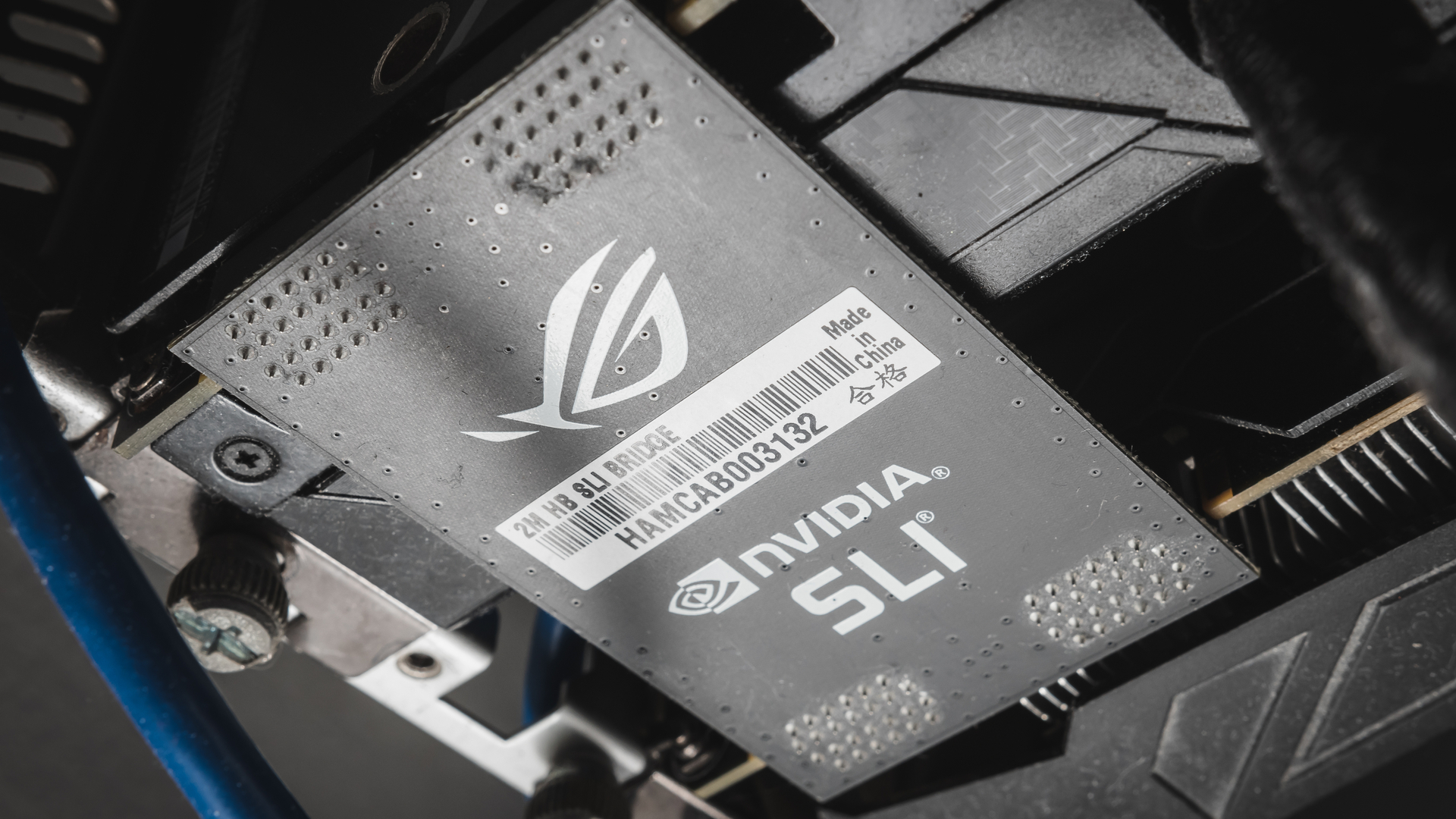
Close up of an SLI bridge connector

(Image credit: KenSoftTH / Shutterstock)

Cracking the problem

The problem with SLI and CrossFire was that they weren’t good enough to multiply the power of the PC by the number of GPUs installed. So, if you had two Nvidia GPUs in SLI, you didn’t get twice the performance.

Best case scenario would be a 90% improvement, but in many cases, it was more around a 50% improvement – and that performance diminished the more GPUs you added. The return in investment just wasn’t worth it for many people, then, especially if you paid for three GPUs, but got around the power of 2.5 GPUs instead.

Both SLI and CrossFire also added overheads to the PC, especially with the CPU, which impacted performance. There was then also an increase in power consumption, and therefore running costs and cooling considerations, and the amount of space needed inside a PC chassis and motherboard to accommodate multiple GPUs.

Finally, there was also an issue with applications, and especially games, offering poor – or non-existent – support for SLI and CrossFire. In some cases, a game would only use a single GPU, no matter how many you had installed.

So, it’s perhaps little surprise that CrossFire and SLI ended up being extremely niche features, and you won’t hear either AMD or Nvidia talk about them. In fact, Nvidia essentially killed off SLI a few years ago in favor of NVLink for its RTX cards. However, price and the fact that it’s hard enough trying to buy one Nvidia GPU let alone multiple GPUs, has meant this has remained unloved.
Apple March Event 2022

(Image credit: Apple)

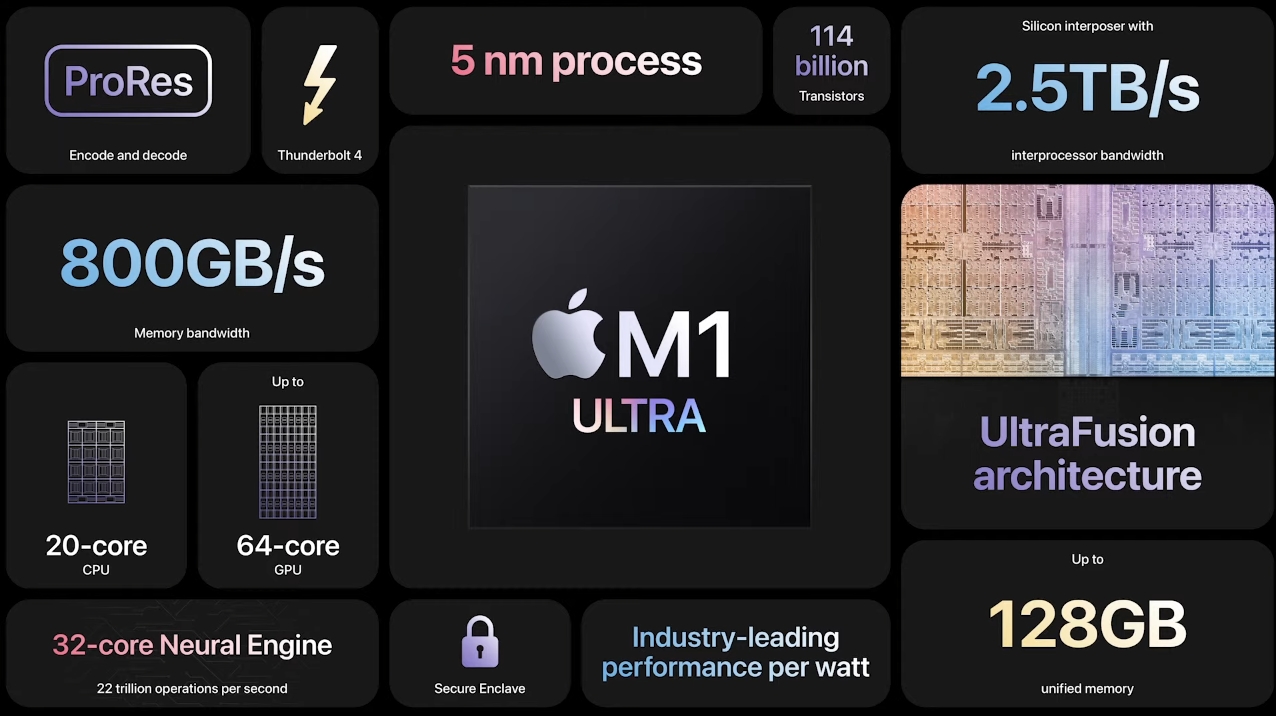
With the M1 Ultra, though, Apple appears to have addressed many of these issues. For a start, the UltraFusion connection has been designed to offer extremely low latency (essentially a delay in the transfer of data, and the lower the better) between the two M1 Max chips – with a bandwidth of 2.5TB/s. This is incredibly fast, and much higher than SLI or CrossFire ever offered.

The speed of UltraFusion brings numerous benefits, the most obvious being when it comes to performance, which is why Apple feels confident in claiming the M1 Ultra will offer twice the performance of the M1 Max.

By turning two M1 Max chips into a single M1 Ultra chip, Apple has also avoided the performance overheads that multi-GPU setups usually encounter. While the M1 Ultra is now the largest chip Apple has ever made, it’s still smaller than having  physical discrete graphics cards, allowing it to be used inside the compact Mac Studio, which was also announced at Tuesday’s event.

The M1 family of chips have also been acclaimed for their performance per watt, being much more power efficient than rival chips. This has allowed MacBooks with M1 chips to have longer battery lives, while keeping cool even when working hard, and the M1 Ultra continues this. According to Apple, the M1 Ultra’s GPU offers better performance than Nvidia’s mighty RTX 3090, while consuming 200W less power.
Apple March Event 2022

(Image credit: Apple)

That’s certainly a bold statement, but in these days of rising energy costs, the power efficiency of our components is going to be an important consideration. Rumors suggest that Nvidia’s next generation of GPUs, such as the RTX 4080, will be even more power-hungry, which could make Apple’s approach look far more appealing.

Finally, Apple’s approach looks like it will pay dividends when it comes to software support as well. Applications will see the M1 Ultra as a single chip, meaning that no extra coding is required – support will be out of the box, allowing applications to take advantage of the extra power. This is a key difference that could prove to be a game-changer.

Speaking of which, while Macs aren’t traditionally thought of as games machines, games should also see the M1 Ultra as a single chip, allowing them to use the extra power. With the M1 Ultra apparently out-performing the RTX 3090, could Apple have just made a fantastic gaming GPU?

We’ll have to wait to test Apple’s claims ourselves, but it certainly sounds promising. Apple’s wins here could also spur Nvidia and AMD to revaluate their multi-GPU technology, which could lead to increasingly impressive performance for both gaming and professional use. We can’t wait.


from TechRadar: computing components news https://ift.tt/BL9Guzn
via IFTTT

Wednesday, 9 March 2022

Interview with Intel’s Raja Koduri: Zettascale or ZettaFLOP? Metaverse what?

https://ift.tt/u0s9Mqi

We currently live in a sea of buzzwords. Whether that’s something to catch the eye when scrolling through our news feed, or a company wanting to latch their product onto the word-of-the-day, the quintessential buzzword gets lodged in your brain and it’s hard to get out. Two that have broken through the barn doors in the technology community lately have been ‘Zettascale’, and ‘Metaverse’. Cue a collective groan while we wait for them to stop being buzzwords and into something tangible. That’s my goal today while speaking to Raja Koduri, Intel’s SVP and GM of Accelerated Computing.

What makes buzzwords like Zettascale and Metaverse so egregious right now is that they’re referring to one of our potential futures. To break it down: Zettascale is talking about creating 1000x the current level of compute today but in the latter half of the decade, to take advantage of the high demand for computational resources by both consumers and businesses, and especially machine learning; Metaverse is something about more immersive experiences, and leveling up the future of interaction, but is about as well defined as a PHP variable.

The main element that combines the two is computer hardware, coupled by computer software. That’s why I reached out to Intel to ask for an interview with Raja Koduri, SVP and GM, whose role is to manage both angles for the company towards a Zettascale future and a Metaverse experience. One of the goals of this interview was to cut through the miasma of marketing fluff and understand exactly what Intel means with these two phrases, and if they’re relevant enough to the company to be built into those future roadmaps (to no-one’s surprise, they are – but we’re finding out how).


from AnandTech https://ift.tt/Akunrw3
via IFTTT

Apple M1 Ultra reveals a secret even the leakers didn't find

https://ift.tt/BLU78xn

How did Apple do it? How did the most closely-watched tech company in the world ship a product almost six months ago and hide a crucial technical detail in plain sight?

When Apple unveiled on Tuesday what may be the last in its M1-class Apple Silicon line, the M1 Ultra, Apple SVP of Hardware Technologies Johny Srouji said that it was based on the M1 Max. More specifically, he said Apple's most powerful SoC, the 57-billion transistor M1 Max "has a secret, a hidden feature we haven’t talked about until now, a ground-breaking interconnect technology.” It's something called a silicon interposer that makes the M1 Ultra possible.

Wait a minute, I thought, an in-market product hid a feature? This is different than Apple saying, "We took a look at the M1 Max and realized we could repurpose the interconnect to build a new M1 chip." 

No, the silicon interposer was part of the original M1 Max. It was built in anticipation of this next step and nobody noticed (not even the teardown experts). Obviously, if Apple never lit up this portion of the SoC, it was probably easy to miss, but the feature is more than just a plug that lets Apple daisy-chain a couple of M1 Max processors.

As Apple described the interconnect on Tuesday, it lets two dies, really two M1 Max chips, operate as one. It calls the process "UltraFusion."

To be clear, we're not talking about two redesigned M1 Max chips. These are original M1 Max chips, with the hardware, and the code macOS uses to work with the new chip, is the same.

An Avatar connection

The M1 Max was built, for lack of a better word, with a port that would let it connect directly to another M1. We doubt this is a wall outlet and plug situation and more like the connection characters in the movie Avatar make with direhorses (neural ponytail to horse neural tail). In the film, they called the symbiotic, neural connection "Tsaheylu." It made a giant blue person and a horse-like thing into one. That's the interposer connection, it makes two M1 Max chips one and allows the system that runs on it (Mac Studio) and applications its driving to see those two dies as a single entity.

It sounds brilliant but may also be part business savvy. We're currently in the middle of a chip shortage. What better way to spin out a new chip than by using two you already have in hand? But I'd like to give Apple a little more credit than that.

If they built the interconnect into a chip it likely designed 12-to-18 months before launching it in October 2021, it knew nothing of future supply shortages, and simply wanted to build its most powerful chip ever in the most efficient way possible.

The big picture

That kind of planning is evidence of a large silicon master plan that I think I better understand now.

First, there's the rebranding of every piece of silicon that Apple touches, from the A-series to the M1 class as all being Apple Silicon. This is a repositioning of the mobile and laptop desktop system-class CPUs. When Apple launched the M1 two years ago, it was part of something new: Apple Silicon. When Apple launched the A4 in 2010, it was the start of Apple's bespoke silicon; chips built by Samsung, but designed by Apple.

Now all of Apple's SoCs, from the A13 Bionic to the M1 Ultra are called Apple Silicon. It's more than lip service. These chips are now clearly designed to work together (A13 Bionic in the Studio display and M1 Ultra in the Mac Studio), which means it's the fruition of an even longer-term plan.

The go-forward part is what remains: the powerful Mac Pro, which still runs an Intel Xeon Processor. As it stands, the M1 Ultra-powered Mac Studio offers more raw power but lacks the upgradeability of the Mac Pro. The reason the Mac Pro didn't get one or two M1 Ultras is clear to me. Apple is building the next generation of Apple Silicon, which will probably not be two or more M1 Max chips slammed together. It'll be something even more powerful and maybe at the top of the line of an all-new M2 series.

Maybe.

Whatever Apple does, you have to give it credit. It kept a secret and triggered the next stage of its already impressive Apple Silicon strategy. All I can think is... what else is Apple hiding?


from TechRadar: computing components news https://ift.tt/124qOYM
via IFTTT

Tuesday, 8 March 2022

The Apple "Peek Performance" Event Live Blog (Starts at 10am PT/18:00 UTC)

https://ift.tt/L4dDPvF

Join us a bit later today for Apple's spring product launch event, which for this year is being called "Peek Performance".

The presentation kicks off at 10am Pacific (18:00 UTC) and should be packed with a barrage of Apple product announcements. In previous years these events have covered new Macs, iPads, and even iPhones, and this year should be much the same. So it should be interesting to see what Apple has in store, especially as the company continues its multi-year transition in the Mac from x86 CPUs to their own Arm-based Apple Silicon chips.

Join us at 10am PT for more details!


from AnandTech https://ift.tt/k0iNM2p
via IFTTT

AMD Announces Ryzen Threadripper Pro 5000 WX-Series: Zen 3 For OEM Workstations

https://ift.tt/i4aTMyI

In 2020, AMD released a new series of workstation-focused processors under its Threadripper umbrella, aptly named the Threadripper Pro series. These chips were essentially true workstation versions of AMD's EPYC server processors, offering the same massive core counts and high memory bandwidth as AMD's high-performance server platform. By introducing Threadripper Pro, AMD carved out an explicit processor family for high-performance workstations, a task that was previously awkwardly juggled by the older Threadripper and EPYC processors.

Now, just under two years since the release of the original Threadripper 3000 Pro series, AMD is upgrading that lineup with the announcement of the new Threadripper Pro 5000 series. Based on AMD's Zen 3 architecture, the newest Threadripper Pro chips are designed to up the ante once more in terms of performance, taking advantage of Zen 3's higher IPC as well as higher clockspeeds. Altogether AMD is releasing five new SKUs, ranging from 12c/24t to 64c/128t, which combined with support for 8 channels of DDR4 across the entire lineup, will offer a mix of chips for both CPU-hungry and bandwidth-hungry compute tasks.


from AnandTech https://ift.tt/shtkZbI
via IFTTT

Saturday, 5 March 2022

AMD could unleash a trio of new Ryzen CPUs to take on Alder Lake

https://ift.tt/zfmFOpt

AMD could have a clutch of new processors debuting later this month alongside the Ryzen 7 5800X3D, which is rumored to go on sale late in March.

This comes from the Chiphell forum via well-known leaker HXL on Twitter, who claims that AMD is set to produce a Ryzen 7 5700X model, as well as Ryzen 5 5600 and 5500 CPUs.

See more

Wccftech, which spotted the tweet, claims its sources are saying the same thing: that we can expect this trio of fresh processors at some point in March.

The theory is that the Ryzen 7 5700X is set to run with 8-cores (16-threads) with a 65W TDP and could square off against Intel’s Core i5-12600K, with similar pricing pitched at around the $299 mark in the US (about £225, AU$405), or maybe a bit less. Supposedly the box will include the Wraith Stealth cooler.

Both the Ryzen 5 5600 and 5500 are rumored to be 6-core CPUs with a 65W TDP, and the former will have SMT (Simultaneous Multithreading, for 6-cores and 12-threads) whereas the latter may not (meaning it’d just be a straight 6-core chip).

Wccftech says it isn’t sure on whether the 5500 will dispense with SMT, but it makes sense and elsewhere we’ve seen chatter (via VideoCardz) that this will indeed be the case.

As ever with the rumor mill, take all of the above with a large helping of skepticism.


Analysis: Holding the fort against Alder Lake

Unleashing a few new Ryzen 5000 models to take on Intel’s Core i5 and i3 processors does make sense in terms of AMD holding the fort against Alder Lake until Zen 4 arrives, and shoring things up elsewhere away from the top-end, where the Ryzen 7 5800X3D is set to enter the fray.

The obvious presumption would be that these must be competitively priced against Alder Lake, of course, as Wccftech theorizes. If the Ryzen 7 5700X does come in at $299 (about £225, AU$405) as mentioned above, though, that would no doubt require adjusting the price of the 5600X which currently has that same MSRP – though interestingly we note at Newegg in the US it’s now dropped down to $269 (about £205, AU$365). Some rejigging of overall pricing may be required throughout the Ryzen range, of course, with all these new entrants inbound – if they happen.

The other point to bear in mind here is that even if these three rumored Ryzen processors do come to fruition alongside the 5800X3D, some models might be OEM-only, meaning that you won’t be able to buy them directly – they’ll only be included with prebuilt PCs. As ever, we’ll have to wait and see, but we shouldn’t have to wait long as these chips should, in theory, be out in a few weeks.


from TechRadar: computing components news https://ift.tt/dpKMXA4
via IFTTT

Thursday, 3 March 2022

ASRock Industrial's NUC1200 BOX Series Brings Alder Lake to UCFF Systems

https://ift.tt/nQ1aXdp

Intel recently updated their low-power processors lineup with the Alder Lake U and P Series 12th Gen Core mobile SKUs. With support for a range of TDPs up to 28W, these allow ultra-compact form-factor (UCFF) PC manufacturers to update their traditional NUC clones. Similar to the Tiger Lake generation, ASRock Industrial is again at the forefront - launching the NUC1200 BOX Series within a few days of Intel's announcement.

The new NUC1200 BOX Series retains the chassis design and form-factor of the NUC1100 BOX Series. The NUC BOX-1165G7 left a favorable impression in our hands-on review, and the NUC1200 BOX Series seems to be carrying over all those aspects. The company is launching three models in this series - NUC BOX-1260P, NUC BOX-1240P, and NUC BOX-1220P. The specifications are summarized in the table below.

ASRock Industrial NUC 1200 BOX (Alder Lake-P) Lineup
Model NUC BOX-1260P NUC BOX-1240P NUC BOX-1220P
CPU Intel Core i7-1260P
4C + 8c / 16T
(C) 2.1 - 4.7 GHz
(c) 1.5 - 3.4 GHz
20 - 64W (28W)
Intel Core i5-1240P
4C + 8c / 16T
(C) 1.7 - 4.4 GHz
(c) 1.2 - 3.3 GHz
20 - 64W (28W)
Intel Core i3-1220P
2C + 8c / 12T
(C) 1.5 - 4.4 GHz
(c) 1.1 - 3.3 GHz
20 - 64W (28W)
GPU Intel® Iris Xe Graphics (96EU) @ 1.4 GHz Intel® Iris® Xe Graphics (80EU) @ 1.3 GHz Intel® UHD Graphics for 12th Gen Intel® Processors (64EU) @ 1.1 GHz
DRAM Two DDR4 SO-DIMM slots
Up to 64 GB of DDR4-3200 in dual-channel mode
Motherboard 4.02" x 4.09" UCFF
Storage SSD 1x M.2-22(42/60/80) (PCIe 4.0 x4 (CPU-direct))
DFF 1 ×  SATA III Port (for 2.5" drive)
Wireless Intel Wi-Fi 6E AX211
2x2 802.11ax Wi-Fi (2.4Gbps) + Bluetooth 5.2 module
Ethernet 2 × 2.5GbE port (Intel I225-LM)
USB Front 1 × USB 3.2 Gen 2 Type-A
2 x USB 3.2 Gen 2 Type-C (USB4 Certification Pending)
Rear 2 × USB 3.2 Gen 2 Type-A
Display Outputs 1 × HDMI 2.0b
1 x DisplayPort 1.4a
2 × DisplayPort 1.4a (using Front Panel Type-C ports)
Audio 1 × 3.5mm audio jack (Realtek ALC233)
PSU External (19V/90W)
Dimensions Length: 117.5 mm
Width: 110 mm
Height: 47.85 mm
MSRP ? ? ?

According to the products' datasheet, ASRock Industrial plans to get the two Type-C ports in the front panel certified for USB4. Since the certification plan is still pending, they are being advertised as USB 3.2 Gen 2 for now. Going by our experience with the NUC-BOX1165G7, at least one of the front Type-C ports should be able to support Thunderbolt 4 peripherals.

The key updates over the NUC1100 BOX series seem to be the integration of dual 2.5GbE ports (compared to 1x 1GbE + 1x 2.5GbE), addition of 6GHz Wi-Fi support, and the presence of Alder Lake processors with their hybrid architecture comprising of both performance and efficiency cores.

Since the units target the embedded market also, they have the usual bells and whistles including an integrated watchdog timer and an on-board TPM. Pricing is slated to be announced in the coming months.


from AnandTech https://ift.tt/sUOxL8o
via IFTTT
Related Posts Plugin for WordPress, Blogger...