Tuesday, 22 March 2022

AMD Releases Instinct MI210 Accelerator: CDNA 2 On a PCIe Card

https://ift.tt/FmMXhKk

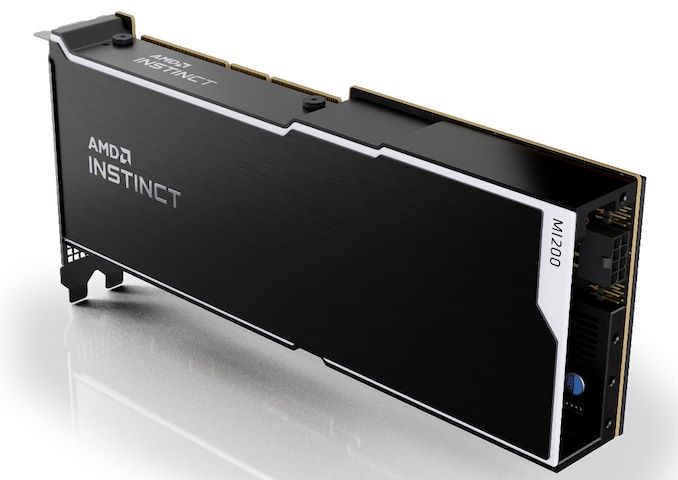
With both GDC and GTC going on this week, this is a big time for GPUs of all sorts. And today, AMD wants to get in on the game as well, with the release of the PCIe version of their MI200 accelerator family, the MI210.

First unveiled alongside the MI250 and MI250X back in November, when AMD initially launched the Instinct MI200 family, the MI210 is the third and final member of AMD’s latest generation of GPU-based accelerators. Bringing the CDNA 2 architecture into a PCIe card, the MI210 is being aimed at customers who are after the MI200 family’s HPC and machine learning performance, but need it in a standardized form factor for mainstream servers. Overall, the MI200 is being launched widely today as part of AMD moving the entire MI200 product stack to general availability for OEM customers.

AMD Instinct Accelerators
  MI250 MI210 MI100 MI50
Compute Units 2 x 10⁴ 104 120 60
Matrix Cores 2 x 416 416 480 N/A
Boost Clock 1700MHz 1700MHz 1502MHz 1725MHz
FP64 Vector 45.3 TFLOPS 22.6 TFLOPS 11.5 TFLOPS 6.6 TFLOPS
FP32 Vector 45.3 TFLOPS 22.6 TFLOPS 23.1 TFLOPS 13.3 TFLOPS
FP64 Matrix 90.5 TFLOPS 45.3 TFLOPS 11.5 TFLOPS 6.6 TFLOPS
FP32 Matrix 90.5 TFLOPS 45.3 TFLOPS 46.1 TFLOPS 13.3 TFLOPS
FP16 Matrix 362 TFLOPS 181 TFLOPS 184.6 TFLOPS 26.5 TFLOPS
INT8 Matrix 362.1 TOPS 181 TOPS 184.6 TOPS N/A
Memory Clock 3.2 Gbps HBM2E 3.2 Gbps HBM2E 2.4 Gbps HBM2 2.0 Gbps GDDR6
Memory Bus Width 8192-bit 4096-bit 4096-bit 4096-bit
Memory Bandwidth 3.2TBps 1.6TBps 1.23TBps 1.02TBps
VRAM 128GB 64GB 32GB 16GB
ECC Yes (Full) Yes (Full) Yes (Full) Yes (Full)
Infinity Fabric Links 6 3 3 N/A
CPU Coherency No N/A N/A N/A
TDP 560W 300W 300W 300W
Manufacturing Process TSMC N6 TSMC N6 TSMC 7nm TSMC 7nm
Transistor Count 2 x 29.1B 29.1B 25.6B 13.2B
Architecture CDNA 2 CDNA 2 CDNA (1) Vega
GPU 2 x CDNA 2 GCD
"Aldebaran"
CDNA 2 GCD
"Aldebaran"
CDNA 1 Vega 20
Form Factor OAM PCIe (4.0) PCIe (4.0) PCIe (4.0)
Launch Date 11/2021 03/2022 11/2020 11/2018

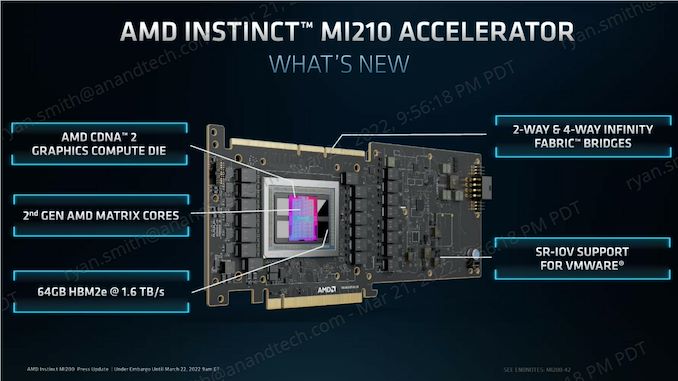
Starting with a look at the top-line specifications, the MI210 is an interesting variant to the existing MI250 accelerators. Whereas those two parts were based on a pair of Aldebaran (CDNA 2) dies in an MCM configuration on a single package, for MI210 AMD is paring everything back to a single die and related hardware. With MI250(X) requiring 560W in the OAM form factor, AMD essentially needed to halve the hardware anyhow to get things down to 300W for a PCIe card. So they’ve done so by ditching the second on-package die.

The net result is that the MI210 is essentially half of an MI250, both in regards to physical hardware and expected performance. The CNDA 2 Graphics Compute Die features the same 104 enabled CUs as on MI250, with the chip running at the same peak clockspeed of 1.7GHz. So workload scalability aside, the performance of the MI210 is for all practical purposes half of a MI250.

That halving goes for memory, as well. As MI250 paired 64GB of HBM2e memory with each GCD – for a total of 128GB of memory – MI210 brings that down to 64GB for the single GCD. AMD is using the same 3.2GHz HBM2e memory here, so the overall memory bandwidth for the chip is 1.6 TB/second.
In regards to performance, the use of a single Aldebaran die does make for some odd comparisons to AMD’s previous-generation PCIe card, the Radeon Instinct MI100. While clocked higher, the slightly reduced number of CUs relative to the MI100 means that for some workloads, the old accelerator is, at least on paper, a bit faster. In practice, MI210 has more memory and more memory bandwidth, so it should still have the performance edge the real world, but it’s going to be close. In workloads that can’t take advantage of CDNA 2’s architectural improvements, MI210 is not going to be a step up from MI100.

All of this underscores the overall similarity between the CDNA (1) and CDNA 2 architectures, and how developers need to make use of CDNA 2’s new features to get the most out of the hardware. Where CDNA 2 shines in comparison to CDNA (1) is with FP64 vector workloads, FP64 matrix workloads, and packed FP32 vector workloads. All three use cases benefit from AMD doubling the width of their ALUs to a full 64-bits wide, allowing FP64 operations to be processed at full speed. Meanwhile, when FP32 operations are packed together to completely fill the wider ALU, then they too can benefit from the new ALUs.

But, as we noted in our initial MI250 discussion, like all packed instruction formats, packed FP32 isn’t free. Developers and libraries need to be coded to take advantage of it; packed operands need to be adjacent and aligned to even registers. For software being written specifically for the architecture (e.g. Frontier), this is easily enough done, but more portable software will need updated to take this into account. And it’s for that reason that AMD wisely still advertises its FP32 vector performance at full rate (22.6 TFLOPS), rather than assuming the use of packed instructions.

The launch of the MI210 also marks the introduction of AMD’s improved matrix cores into a PCIe card. For CDNA 2, they’ve been expanded to allow full-speed FP64 matrix operation, bringing them up to the same 256 FLOPS rate as FP32 matrix operations, a 4x improvement over the old 64 FLOPS/clock/CU rate.

AMD GPU Throughput Rates
(FLOPS/clock/CU)
  CDNA 2 CDNA (1) Vega 20
FP64 Vector 128 64 64
FP32 Vector 128 128 128
Packed FP32 Vector 256 N/A N/A
FP64 Matrix 256 64 64
FP32 Matrix 256 256 128
FP16 Matrix 1024 1024 256
BF16 Matrix 1024 512 N/A
INT8 Matrix 1024 1024 N/A

Moving on, the PCIe format MI210 also gets a trio of Infinity Fabric 3.0 links along the top of the card, just like the MI100. This allows an MI210 card to be linked up with one or three other cards, forming a 2 or 4-way cluster of cards. Meanwhile, backhaul to the CPU or any other PCIe devices is provided via a PCIe 4.0 x16 connection, which is being powered by one of the flexible IF links from the GCD.

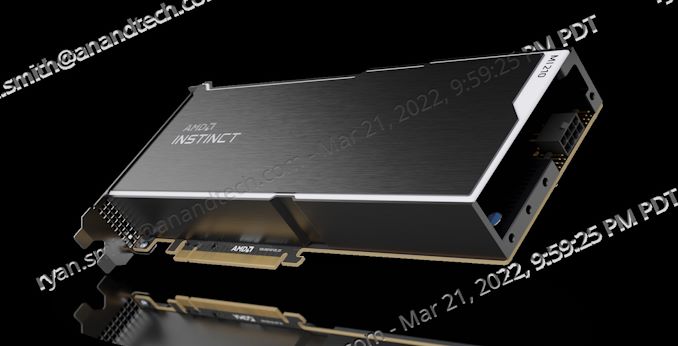
As previously mentioned, the TDP for the MI210 is set at 300W, the same level as the MI100 and MI50 before it – and essentially the limit for a PCIe server card. Like most server accelerators, this is fully passive dual slot card design, relying on significant airflow from the server chassis to keep things cool.  The GPU itself is powered by a combination of the PCIe slot and an 8 pin, EPS12V connector at the rear of the card.
Otherwise, despite the change in form factors, AMD is going after much the same market with MI210 as they have MI250(X). Which is to say HPC users who specifically need a fast FP64 accelerator. Thanks to its heritage as a chip designed first and foremost for supercomputers (i.e. Frontier), the MI200 family currently stands alone in its FP64 vector and FP64 matrix performance, as rival GPUs have focused instead on improving performance at the lower precisions used in most industry/non-scientific workloads. Though even at lower precisions, the MI200 family is nothing to sneeze at with tis 1024 FLOPS-per-CU rate on FP16 and BF16 matrix operations.
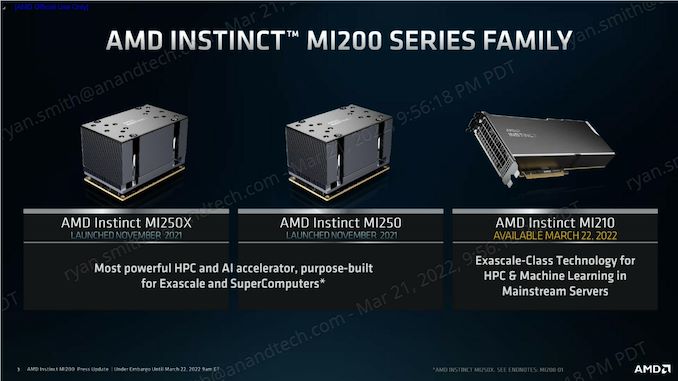
Wrapping things up, MI210 is slated to become available today from AMD’s usual server partners, including ASUS, Dell, Supermicro, HPE, and Lenovo. Those vendors are now also offering servers based on AMD’s MI250(X) accelerators, so AMD’s more mainstream customers will have access to systems based on AMD’s full lineup of MI200 accelerators.


from AnandTech https://ift.tt/y6mKhdb
via IFTTT

Monday, 21 March 2022

AMD Releases Milan-X CPUs With 3D V-Cache: EPYC 7003 Up to 64 Cores and 768 MB L3 Cache

https://ift.tt/b3kFeO2

There's been a lot of focus on how both Intel and AMD are planning for the future in packaging their dies to increase overall performance and mitigate higher manufacturing costs. For AMD, that next step has been V-cache, an additional L3 cache (SRAM) chiplet that's designed to be 3D die stacked on top of an existing Zen 3 chiplet, tripling the total about of L3 cache available. Now AMD's V-cache technology is finally becoming available to the mass market, as AMD's EPYC 7003X "Milan-X" server CPUs have now reached general availability.

As first announced late last year, AMD is bringing its 3D V-Cache technology to the enterprise market through Milan-X, an advanced variant of its current-generation 3rd Gen Milan-based EPYC 7003 processors. AMD is launching four new processors ranging from 16-cores to 64-cores, all of them with Zen 3 cores and 768 MB of stacked L3 3D V-Cache.


from AnandTech https://ift.tt/KUtYWJH
via IFTTT

Sunday, 20 March 2022

Intel Core i9-12900K vs AMD Ryzen 9 5900X

https://ift.tt/F76lQhr

Ever since the first AMD Ryzen processors hit the market all the way back in 2017, Intel has kind of been on the defensive. It was stuck on a 14nm process for so long, and while it was able to keep up in single-core performance, it quickly lost the lead in multi-core performance - something that is getting more important every single year. 

However, with its 12th-generation Alder Lake processors, led by the Intel Core i9-12900K, Intel finally gained a fighting chance against the AMD Ryzen 9 5900X - a processor that was untouchable when it came out in late 2020.

And because both processors are trying to do pretty much the same thing, albeit in very different ways, we thought it was about time to take a closer look at these two processors. After all, picking out the best processor isn't just about the numbers on the box or the color theme of the brand. 

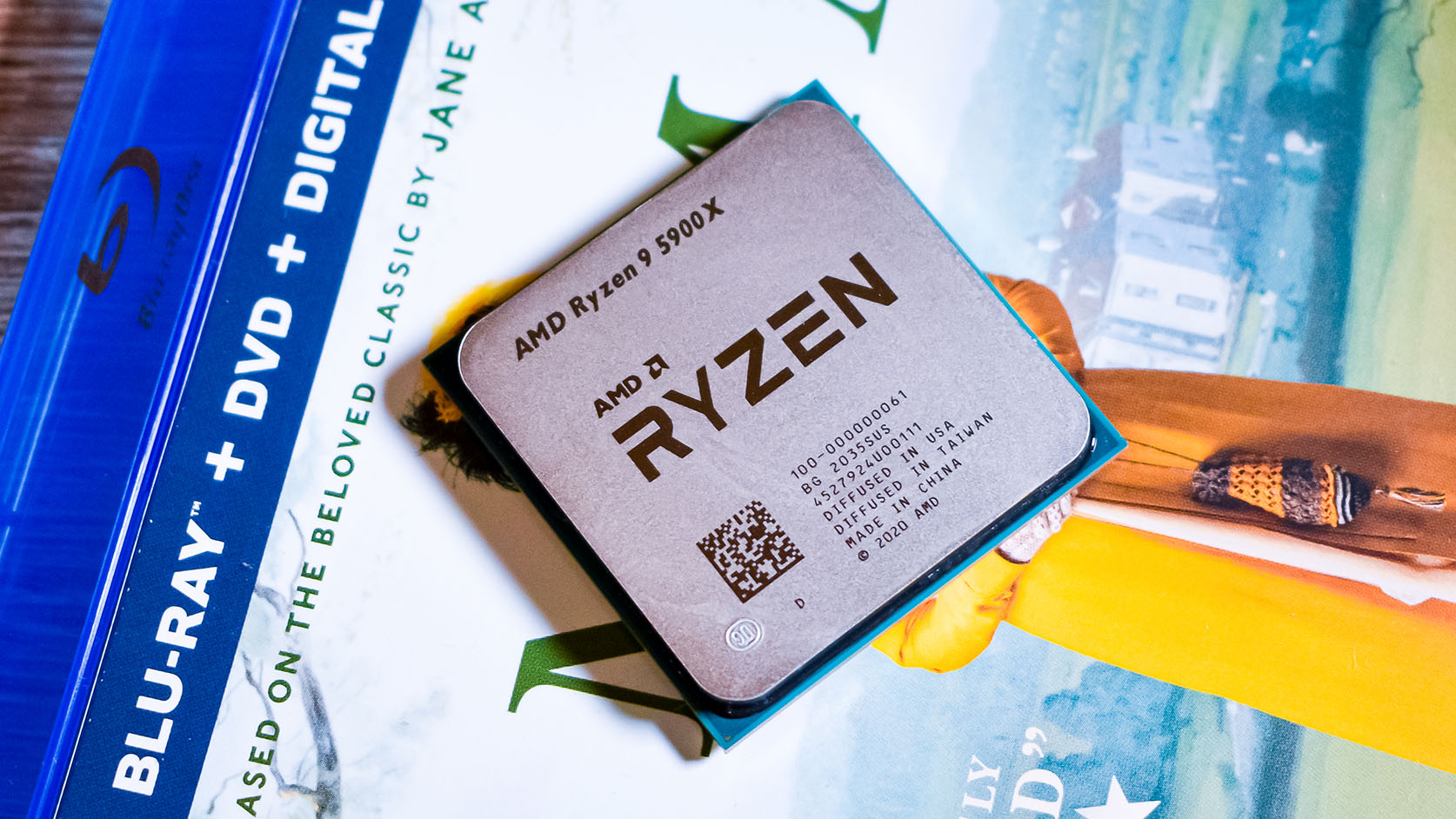
AMD Ryzen 9 5900X

(Image credit: Future)

Intel Core i9-12900K vs AMD Ryzen 9 5900X: price

There's no way of getting around the fact that both the Intel Core i9-12900K and the AMD Ryzen 9 5900X are expensive processors. Looking to build or buy a system with either of these chips likely means you're going for a high-end device. So, it shouldn't be too surprising that they have high price tags. 

The Intel Core i9-12900K is the most recently released one, and it is still at full price pretty much everywhere. You'll find this 16-core processor at around $612 / £559 / AU$949. This is a bit higher than Intel's recommended price of $589-$599, but not by much. We imagine that prices will start to go down as the processor ages, and you should be able to find good deals on it soon. 

The AMD Ryzen 9 5900X, however, has been out for about a year and a half, and as such is starting to see lower prices. You can find it starting at $499 / £409 / AU$739, which is much more affordable than the Intel Core i9 at the moment. It does have fewer cores, though. But if you want an AMD 16-core chip, you could fork over around $599 / £548 / AU$919 for the Ryzen 9 5950X, instead. 

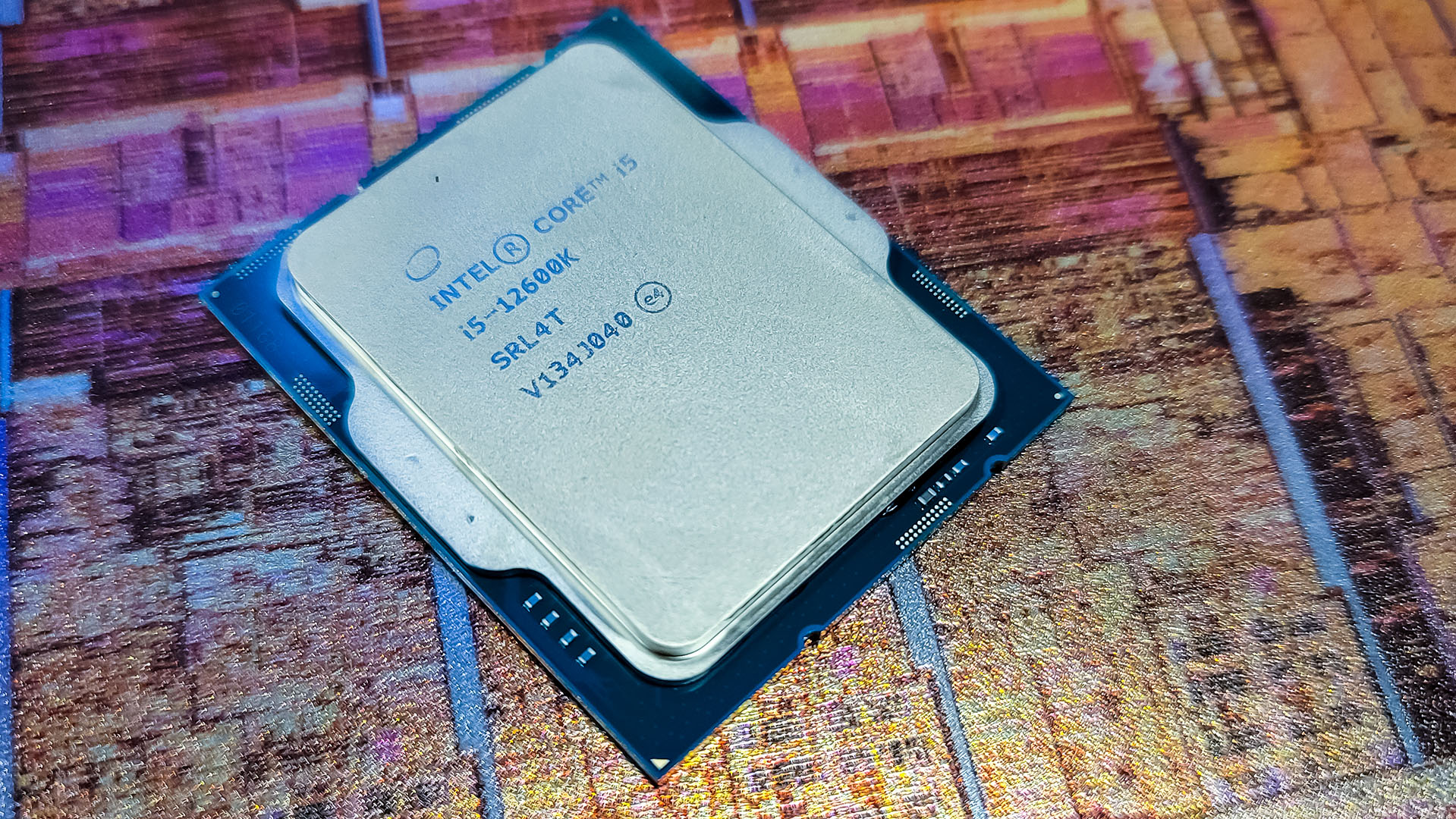
intel Alder Lake, processors on motherboard and on table

(Image credit: Future)

Intel Core i9-12900K vs AMD Ryzen 9 5900X: specs

Both the Intel Core i9-12900K and the AMD Ryzen 9 5900X are high-end CPUs, but they're quite different from one another. 

The AMD Ryzen 9 5900X will look pretty familiar to anyone with passing knowledge of desktop PC CPUs. It's a 12-core, 24-thread processor with a max boost of 4.8GHz. It also comes with a whopping 70MB of Cache, split between L2 and L3, and a TDP (thermal design power) of 105W. 

The Intel Core i9-12900K is a 16-core processor, but the way those cores are laid out is quite a bit different than the AMD chip. Unlike the Ryzen processor - and Intel's previous CPUs, no less - the 12900K is using a hybrid chip design. Specifically, it follows the big.LITTLE design philosophy popularized by Arm. 

Basically, it has 8 Performance cores and 8 Efficient cores. The Performance cores are dual-threaded, just like the Ryzen Threads, but the Efficient cores are not. So, while this chip has more cores altogether, it has the same amount of threads, 24, as the Ryzen 9 5900X. 

Both Intel and Apple have moved to a hybrid chip design like this, and AMD is the only CPU manufacturer that is still using a monolithic chip layout. We're not sure how much longer AMD will stick with this design philosophy, but it seems to be working for the company for now.

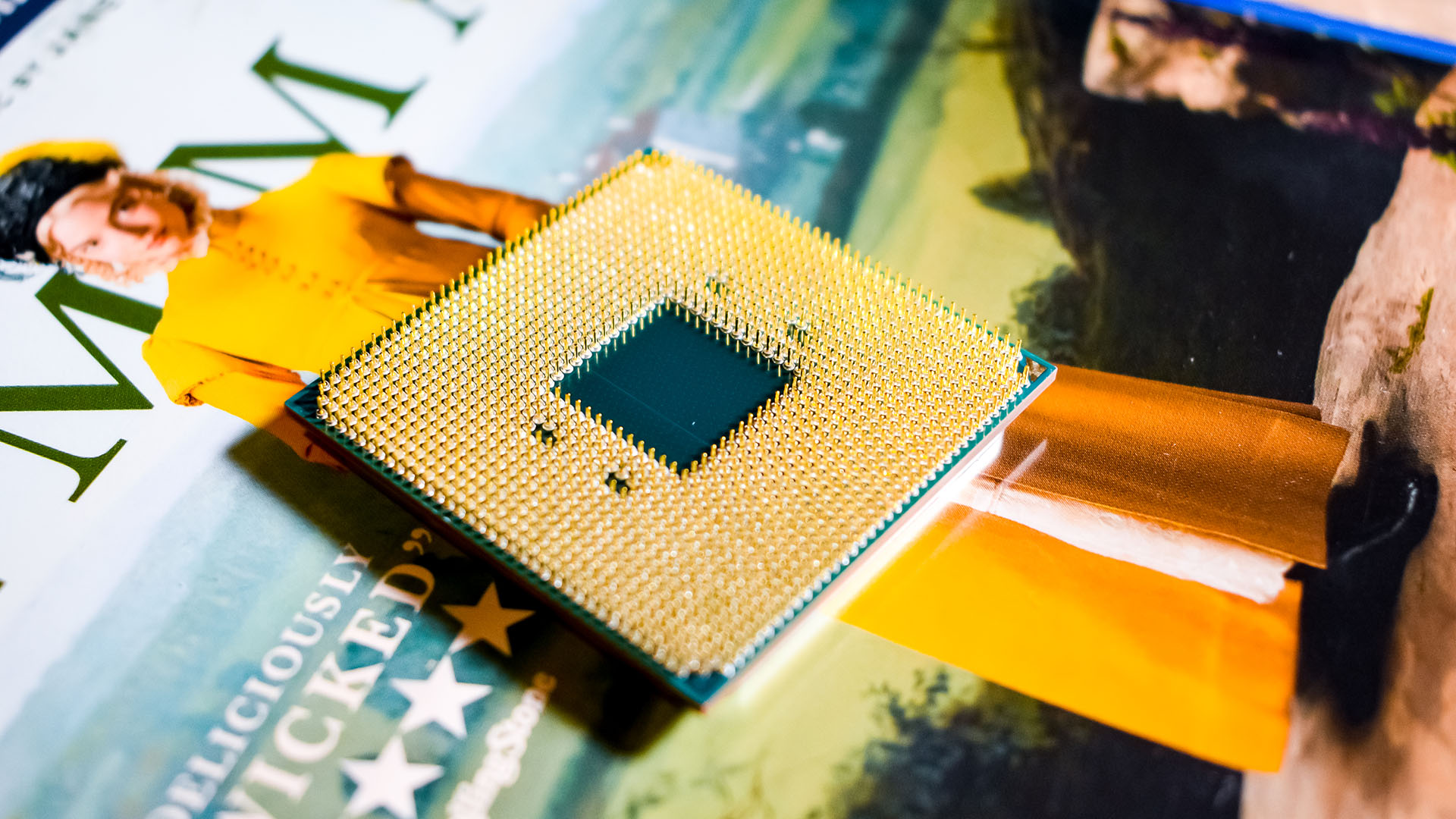
AMD Ryzen 9 5900X

(Image credit: Future)

Intel Core i9-12900K vs AMD Ryzen 9 5900X: performance

While AMD and Intel have been trading blows for the last few years, the release of the Intel Core i9-12900K sees Team Blue pulling ahead again - but this time the difference is pretty significant. 

In our review, we found that the Intel Core i9-12900K is about 21% faster than the Ryzen 9 5900X in single core workloads, particularly Cinebench. It's odd, because Cinebench has been the workload that has seen the most success on AMD processors, but Intel really pulled away this time. 

And it's not just single-core. In the Cinebench multi-core test, Intel is 23% faster, ending AMD's reign as the multi-threaded champ. This is repeated in pretty much every benchmark we ran in our review, with the 5900X not gaining a lead in any of our creative workloads. 

The closest it got was in Blender where the Ryzen 9 5900X was just 10% slower than the Core i9-12900K. But even then, that's still a pretty major loss. 

In gaming, Intel is still winning, especially in the CPU-intensive Total War: Three Kingdoms. We ran the game on low settings, to make sure it was leaning as much on the CPU as possible, and the Core i9-12900K got 480 fps to the Ryzen 9 5900X's 380 fps. 

However the tables turned in Metro: Exodus where the AMD Ryzen 9 5900X beat Intel with 251 fps to Team Blue's 246 fps. That's a small victory, but it's still a victory. 

Either way you slice it, the Intel Core i9-12900K is faster than the Ryzen 9 5900X. Whether that makes up for the price difference is up to you, though. However, Intel's support of DDR5, PCIe 5.0 and Thunderbolt may make up the difference to you. 


from TechRadar: computing components news https://ift.tt/nA8GEwN
via IFTTT

Wednesday, 16 March 2022

Chinese CPUs could soon give Intel a run for its money

https://ift.tt/oM0V8jO

If Intel's venture into the graphics card market has you wishing for more variety for processors too then you might be in luck.  According to a report from Taiwan's DigiTimes, an Intel exec claims that Chinese CPU makers will become "strong competitors" to Intel within the next three to five years. 

These comments were made by Rui Wang, SVP of Intel Corporation and chair of Intel China at the 2022 National Party Congress on March 11, though no specific maker of Chinese processors was named. Tom's Hardware also notes in its own report that this could simply be Wang trying to be polite given the event was hosted by the Chinese Communist Party given the lack of data provided alongside the predictions.

In fact, the only real support we can see provided for this prediction comes from China's Minister of Information and Technology, Xiao Yaqing, who asserted that the domestic chip industry had grown by a third since this time last year.

"So far there has not been any local companies that are able to deal a substantial threat to Intel, but in 3-5 years, it will become clear that local companies will emerge as strong rivals," claimed Wang, though she also added some precaution that beating the mighty Team Blue in such a short time is far from an easy task given they make some of the worlds best processors, stating "Intel won't be polite, and will exert its power to compete fairly."

It wasn't made clear if Wang's claims referred to Chinese brands dominating the global market or simply taking the lead in China. Even if specific manufacturers of processors such as Zhaoxin or Loongson were mentioned, chances are they're unfamiliar in the west so there's little chance of recognizing them unless you're more involved with the world of computing.

Still, China's IT infrastructure is growing at an incredible rate, so while these claims may seem like nothing but appeasement, there is a chance that they could prove true if we see hardware that was previously exclusive to the region released globally. Right now, China provides around a quarter of Intel's annual revenue alone though, so whatever rival processors are hoping to bring the heat, they will need to start on home turf first.


Opinion: Is this good or bad for consumers?

It's pretty obvious that Intel getting dethroned by unrecognized brands from China is bad news for Team Blue, but adding more competition to the wider CPU market could actually be a good thing for everyday consumers. 

More competition on the market will encourage brands to keep their products reasonably priced in a bid to appeal to a wider market than rival manufacturers, which could result in computing hardware becoming more affordable and with greater variety, providing they don't meet the same fate as many other Chinese brands in the West.

Huawei has been affected by U.S sanctions on Chinese technology due to concerns that smartphones from the brand would be used to spy on behalf of the Chinese government to provide just one example, though computing components may not face the same issues.

China also has its own graphics card (Fenghua) and RAM manufacturers, so we could see other technologies outside of CPUs start to make their way overseas. It's likely that even if these Chinese processors don't usurp Intel, they'll make more of an impact and become more recognizable in the west within the next few years.


from TechRadar: computing components news https://ift.tt/adVAb6D
via IFTTT

Intel Core i9-12900KS could be about to spoil AMD’s Ryzen 7 5800X3D launch

https://ift.tt/oM0V8jO

Intel’s Core i9-12900KS processor is already in a customer’s hands, according to a new report – so the assumption is that it’s set to launch very soon.

Tom’s Hardware spotted that French tech site Overclocking.com has received images of a purchased 12900KS, sent to them by a reader, Daginatsuko. The pics look authentic – though we must be cautious around any such leak, of course – and show the box, chip itself, and the golden wafer (which accompanies the 12900K).

The box is labeled ‘Special Edition’ indicating that this is the ‘KS’ variant, which is a higher-binned (slightly better performing) 12900K, and it’s a darker blue color in comparison to the box of the existing Alder Lake flagship processor.

The owner of the purported 12900KS also provides a screen shot of overclocking the CPU (using the Asus tuning utility, in a PC with a ROG Strix Z690-F motherboard), and this shows an all-core boost of 5.2GHz and maximum single-core boost of 5.5GHz (matching what we saw with Intel’s reveal of this incoming CPU at CES 2022, when the chip was demoed with Hitman 3).


Analysis: A pre-emptive strike in the battle against AMD?

This looks like a genuine leak, and really, it’s believable that the CPU is already out there, given that we’ve seen retailers jump the gun and ‘accidentally’ (or mistakenly) sell hardware just before the official on-sale date – and that we know Intel’s Core i9-12900KS is imminent anyway (it’s expected before the end of March, so within the next two weeks). Indeed, we’ve already seen leaked online retailer listings for this processor, too.

Furthermore, it makes sense that Intel would want this revamped Alder Lake flagship out there pronto, given that we now know AMD is unleashing its new Ryzen 7 5800X3D on April 20. During Team Red’s initial reveal, which happened yesterday, the new 3D V-cache CPU was shown to outperform the 12900K across a range of games in 1080p – although AMD just made a broad assertion that its chip was faster, rather than providing any nitty-gritty details in terms of actual benchmarks and frame rates.

Intel will want ammunition to fire back at the Ryzen 7 5800X3D, naturally, and if it does emerge this month, the Core i9-12900KS will effectively be a pre-emptive strike. However, exactly how effective the new Alder Lake top dog will prove rather depends on pricing.

The thing is that the 12900K is already quite a lot more expensive than the 5800X3D – at least comparing recommended pricing, Intel’s CPU is around 30% dearer (going by US price tags).

That’s an appreciable chunk, and of course, the ‘KS’ will be a fair bit more costly than that, no doubt. It’s a special edition after all, and while the 9900KS – the last such effort from Intel – didn’t actually raise the bar for pricing all that much, it still notched things up a little, and in these days of silicon shortages, we can’t imagine that Team Blue won’t be attaching a bit more of a premium.

The upshot being that in theory, the 5800X3D could hold its ground very nicely against the 12900KS in terms of its value proposition. But there are other considerations here, most obviously the availability of the Ryzen 7 5800X3D, and how AMD might cope with demand if it does turn out to be a favorable buy as predicted – and the specters of scalping and price inflation, naturally.

As ever, it’s a case of waiting and seeing how this upcoming high-end battle unfolds in the real world when the respective CPUs hit the shelves (or indeed, disappear off the shelves in the blink of an eye). However, it does look like Intel may beat AMD to the punch by some distance in terms of launch timing if this early sighting of the 12900KS in the wild does indeed indicate that the Alder Lake special edition chip is about to be released.


from TechRadar: computing components news https://ift.tt/BWZQrEG
via IFTTT

Tuesday, 15 March 2022

AMD strikes back against Alder Lake with Ryzen 7 5800X3D

https://ift.tt/tV9mwsp

AMD has revealed a whole bunch of new processors to launch throughout April headed up by the long-awaited Ryzen 7 5800X3D, which comes alongside fresh models in the 5000 series and some from the 4000 range too.

The 5800X3D is the first processor to employ AMD’s 3D V-cache tech – hence the ‘3D’ in the model name – and it’s the big hitter going up against Intel’s Alder Lake flagship, launching on April 20 priced at $449 (around £340, AU$625).

AMD boasts that it’s a cutting-edge 8-core (16-thread) CPU which offers 15% better gaming performance than current Ryzen champ, the 5900X.

Team Red further benchmarked the 5800X3D across a selection of six games running at Full HD resolution (with high graphics settings), and said that the CPU is faster than Intel’s Core i9-12900K (without providing further details). That’s when both are paired with an RTX 3080, and roughly equivalent components elsewhere (though there was actually more system RAM in the Intel rig).

The other processors launched will be out from April 4, and include the Ryzen 7 5700X, arriving with 8-cores and 16-threads, plus boost up to 4.6GHz with a base clock of 3.4GHz. It’ll retail for $299 (around £230, AU$415).

That’s backed up by the Ryzen 5 5600, a 6-core (12-thread) part with base and boost clocks of 3.5GHz and 4.4GHz respectively, priced at $199 (around £150, AU$276), coming along with the Ryzen 5 5500 which has the same core and thread count, but clocked at 3.6GHz and 4.2GHz. The latter processor also drops the cache from 35MB to 19MB, and the price tag down to $159 (around £121, AU$220).

Those are the launches from the Ryzen 5000 family, but AMD has also floated a trio of new Ryzen 4000 models – the 4600G, 4500 and 4100, which are Zen 2 rather than contemporary Zen 3 processors.

The Ryzen 5 4600G has 6-cores (12-threads) and is clocked at base and boost speeds of 3.7GHz and 4.2GHz, and the Ryzen 5 4500 offers the same core configuration but clocked at 3.6GHz and 4.1GHz. Pricing is $154 (around £118, AU$214) and $129 (around £99, AU$179) respectively.

Bringing up the rear with a $99 price tag (around £76, AU$137) is the Ryzen 3 4100, a quad-core (8-thread) CPU clocked at 3.8GHz with boost to 4GHz. All of these processors have a TDP of 65W, and all of them are bundled with a Wraith Stealth cooler (except for the 5700X which doesn’t have the cooler).


Analysis: Attacking Intel on two fronts - flagship and budget

The emergence of these multiple Ryzen chips is something the rumor mill was spot-on about, and as we commented when this was just speculation, it represents a major salvo of AMD processors being fired at Intel.

The Ryzen 7 5800X3D is an obvious point of excitement, target Intel’s top dog Core i9-12900K, and apparently outdoing Team Blue’s CPU, at least in being the ‘fastest 1080p gaming’ processor – while undercutting by a decent chunk price-wise (Intel’s flagship officially retails from $589, which is £450 / AU$815).

As noted above, AMD didn’t provide any further details on how much faster the 5800X3D is, and as we know with official benchmarking for big reveals like this, the tests picked are bound to be ones that show off the silicon in its best light.

So, with those obvious caveats, we’re looking forward to testing the power of 3D V-cache for real ourselves in the near future, and we won’t know the real score of how the 5800X3D fits into the current CPU landscape until that happens.

Also, bear in mind that Intel isn’t standing still either, and has the 12900KS – a supercharged version of the Alder Lake flagship – in the pipeline and supposedly imminent, or that was the last we heard from the grapevine. But then again, the price of that processor will be even higher than the 12900K, so there’ll be a greater disparity on the value front between the 12900KS and 5800X3D (with gaming performance differences not likely to stack up to that gap).

Away from the high-end, the peppering of more wallet-friendly CPUs from AMD is equally, if not more welcome. The budget end of the market has been neglected by AMD in recent times, so to see fresh options around $150 – like the Ryzen 5 5500 – and moreover models dipping down to the $100 mark – with the Ryzen 4500 and 4100 – is going to be a cause for celebration for those looking at budget PC builds.

Intel has some very compelling cheaper Alder Lake chips in these price brackets, so it’s great to see some competition there – assuming, and that’s the case for all these launches, that AMD can come good on the stock front (and demand doesn’t end up inflating the wallet-friendly pricing).

With so many new chips coming out, and the component shortage still very much being felt, the other major point of interest here will be how much supply Team Red can crank out in these early days. We shall see…


from TechRadar: computing components news https://ift.tt/flkKw0W
via IFTTT

Friday, 11 March 2022

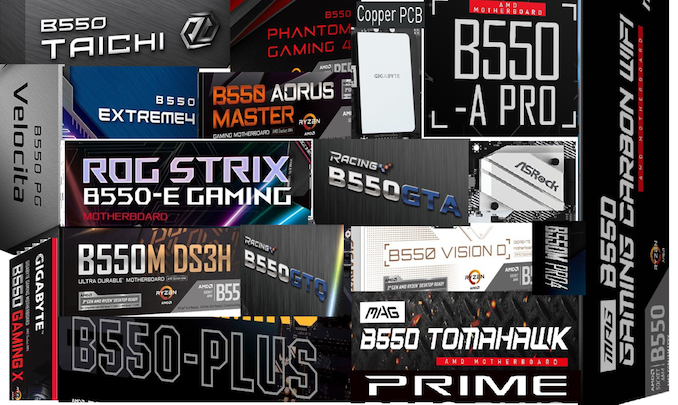
Best AMD Motherboards: March 2022

https://ift.tt/y8nx1kv

As we continue the journey through 2022, we find that AMD's current AM4+ platform is in middle of its stride. On top of AMD's current stack of Zen 3 processors, AMD CEO Lisa Su confirmed during CES 2022 that AMD's next Zen 3 desktop CPU, the V-cached equipped Ryzen 7 5800X3D, will launch this spring. So with a new chip to come and AMD's existing Zen 3-based offerings remaining highly competitive today, there remains a sizable market for AM4+ motherboards.

With varying levels of motherboards available, from the more affordable B450 chipset to the flagship X570 chipset and latest X570S models, there's something available for users on all kinds of budgets. Here are our AMD-based selections for March 2022 in our latest motherboard buyers guide.


from AnandTech https://ift.tt/hA2L1jT
via IFTTT
Related Posts Plugin for WordPress, Blogger...