Tuesday, 10 May 2022

Intel Launches Alder Lake-HX Series Core Processors: 55W and PCIe 5.0 For High-End Mobile

https://ift.tt/kTE2D7X

Intel today is announcing a new range of mobile 12th Gen Core family processors designed for enthusiast and desktop-replacement class laptops, the Alder Lake-HX series. Focusing on the more performance-driven high-end models, the Alder Lake HX series transfers its hybrid desktop design (ADL-S) into a thinner BGA package with up 16 cores (8P+8E) that's more suitable for mobile devices. And since it's based on that desktop hardware, Alder Lake-HX also brings with it some additional features that were previously limited to the desktop, such as support for PCIe 5.0, as well as a more desktop-like base TDP of 55 Watts.

In January of this year, Intel launched its first Alder Lake 12th Gen Core mobile processor, the Alder Lake-H family. In February, it then announced more for the lower-powered market through its Alder Lake-P and Alder Lake-U series with up to 14 cores with a mixture of its Performance (P) and Efficiency (E) cores. Intel has now officially launched the more premium of its 12th Gen Core series for mobile, the Alder Lake-HX series with up to 16 cores (8P+8E), and its new memory and core overclocking technology.

The latest in Intel's arsenal is designed for premium and enthusiast laptops, with seven new chips ranging from sixteen cores and twenty-four threads, all the way down to an eight-core and twelve thread SKU. According to Intel, the Alder Lake-HX series completes its Alder Lake mobile family, with options spanning many different markets using its hybrid 12th Gen Core architecture to deliver a significant range in mobile performance for enthusiasts, gamers, and workstation use cases.


from AnandTech https://ift.tt/dJyEDv0
via IFTTT

Intel’s jaw-dropping launch decision means you won’t get Arc desktop GPU for months

https://ift.tt/Kl6WLZb

Intel’s desktop Arc GPUs have been the subject of much speculation regarding a potential delay of their launch, and now we have news from the chip giant itself that the discrete graphics cards won’t arrive any time soon for regions outside of China.

This is disappointing, of course, but not exactly a surprise given that over the past couple of weeks, it’s been looking more and more likely that Arc Alchemist desktop products were going to slip going by the rumor mill. What’s really dismaying here is how far they may have potentially slipped for regions outside of Asia.

The news came from a blog post penned by Lisa Pearce, Vice President and General Manager for the Visual Compute Group at Intel.

Pearce wrote: “We will release our entry-level Intel Arc A-series products for desktops (A3) first in China through system builders and OEMs in Q2. Etail and retail component sales will follow shortly in China as well. Proximity to board components and strong demand for entry-level discrete products makes this a natural place to start. Our next step will be to scale these products globally.

“Roll-out of Intel Arc A5 and A7 desktop cards will start worldwide with OEMs and system integrators later this summer, followed by component sales in worldwide channels.”

“This staggered approach gives us confidence at each step that we can effectively serve our customer base.”


Analysis: A substantial delay that Intel can ill afford

Where does this leave us? It’s pretty bad news regarding an expected timeframe for the arrival of Arc Alchemist desktop graphics cards in the US and Europe, that much is clear. And indeed where does it leave Intel? Not in a good place, we’d suggest.

There’s bound to be some anger and frustration from gamers (outside of China) who are keenly awaiting an alternative to AMD and Nvidia – along with a surge of even more GPU stock, exerting further downward pressure on pricing – and who’d been promised a Q2 launch for these discrete Arc GPUs. And yes, Intel again underlined its commitment to a Q2 launch as recently as just over a week ago.

The fact is, of course, that Intel will have a Q2 launch, just one that’s solely in Asia, and there was no mention of such an approach, or a staggering on a regional basis (or a staggering of OEMs then standalone cards, for that matter).

There are a few interesting points to highlight in the blog post, including that sentence about ‘proximity to board components’, with the choice of China apparently being based on production concerns to some extent, then?

Pearce also says the following as a kind of excuse for the delay: “Unlike notebook designs, desktop systems have a vast set of combinations, including memory, motherboards, and CPUs. To initially limit some of this variation, we will launch working with system builders and OEMs with specific configurations.”

While that’s true enough, it’s not like Intel suddenly realized this, at this point in the Arc desktop development process. So why all the bluster about a Q2 launch – which was taken as read as being global – always being in the cards if the company knew the complexities around making the desktop products were continuing to be a thorny problem.

We – and many others – have speculated for a while now that Intel is needing extra time to nail the drivers, and there’s also a mention of software issues in the post, albeit relating to sluggish availability of laptop GPUs. Again, the situation with those mobile Arc graphics cards was that they launched in Q1 (just), but have only been available in Korea thus far – sound familiar? – with Pearce noting that Intel has “had some software readiness delays” which have contributed to delaying wider global availability of Arc-powered notebooks (plus Covid lockdowns are in the mix here, too).

Tracing a timeline...

All in all, this is grim-sounding news given how far out Arc Alchemist desktop GPUs look to have been pushed, if we try to trace out a rough timeline based on what we’re told here (Pearce doesn’t give any dates at all, save that Q2 availability will happen, just in China).

So, while the discrete Arc GPUs will be out in China from Q2 onwards, presumably late June, they will just be supplied to OEMs, meaning the cards will only be purchased as part of a prebuilt PC. Retail sales of standalone graphics cards will “follow shortly”, so let’s say that’ll be late July (or maybe early August).

The next step will be the rollout of Intel Arc A5 and A7 desktop GPUs worldwide, but only to OEMs, and that will happen “later this summer” – so late August, we can guess, is when these first Alchemist offerings will be available in the US and Europe (presumably).

And that’ll be “followed by component sales in worldwide channels”, and we note that there’s no mention of ‘shortly’ or ‘soon’ here, which seems to suggest there could be a little bit of a wait after the launch of Arc GPUs in prebuilt desktops. If the latter is happening late in August, then, we can guess September would be labeled as ‘soon’, so we’re most likely looking at October as a best-case scenario of standalone Arc GPUs actually being on shelves outside of Asia. Potentially, things could slip even further than that…

Even if Intel doesn’t suffer any further issues and hits this October release, there’s a big problem with discrete Arc Alchemist coming that late in the year – AMD and Nvidia have next-gen GPUs which are also due around that time.

This means that Intel’s Arc products will be going up against RTX 4000 and RDNA 3 graphics cards, most likely – these ranges are rumored for Q3, or early Q4, so September or October time – and both are expected to make some serious performance leaps. (Nvidia is purportedly ramping up frame rates massively, admittedly with equally big power demands in theory, and AMD is rumored to be running with an all-new MCM or multi-chip module design, a radical change which could have huge benefits for its higher-end models).

To sum up the situation in a nutshell, this means the Intel Arc desktop flagship – which might be one of the later models to arrive in the Alchemist line-up anyway, or so we’ve heard – is currently rumored to trade blows with Nvidia’s RTX 3070 Ti, and so it might end up squaring off against more like the RTX 4060, which, er, isn’t a good look for Team Blue (in terms of flagship equals mid-range).

Surely, if that’s the case, pricing will then become the only viable way Intel can attack the market, particularly considering it’s looking like GPU availability issues are easing already – meaning prices are normalizing – and inventory issues could have largely evaporated completely as we roll towards the end of 2022 (so gamers won’t be scrabbling for any vaguely palatable stock they can get their hands on in certain price segments).

And if this scenario plays out, will Intel be willing to go for the throat with some truly bargain-basement price tags? Well, sadly, the buzz on the grapevine thus far doesn’t seem to suggest that’s the case…

Via VideoCardz


from TechRadar: computing components news https://ift.tt/mUoXnCg
via IFTTT

Monday, 9 May 2022

AMD Ryzen 7000 CPUs could arrive in September to steal Intel’s Raptor Lake thunder

https://ift.tt/luQA1Ft

AMD’s next-gen CPUs based on Zen 4 – presumably Ryzen 7000 models – could be launched as soon as September, if the latest rumor turns out to be correct.

This comes from DigiTimes which cites the usual unnamed industry sources, and so keep your skeptical head on, naturally – the tech site is a bit hit and miss when it comes to the accuracy of its rumor-mongering.

Still, this doesn’t seem like an unreasonable prospect, with the grapevine already having suggested the possibility of a Q3 launch for Zen 4, and Wccftech, which flagged this up, also floats the idea that AMD may reveal Ryzen 7000 desktop processors at Computex, which takes place at the end of May (a rumor which has been around before, too).

That means we could soon have a much better idea of how Team Red’s next-gen silicon shapes up, with the CPUs expected to deliver a beefy upgrade, being based on a whole new architecture (Zen 4, built on TSMC 5nm) and coming with DDR5 and PCIe 5.0 support.

Apparently we can expect to be treated to at least a glimpse of Ryzen 7000 performance and some in-depth demos at Computex, so that’s something to look forward to in just a couple of weeks, in theory.


Analysis: Racing with Raptor Lake

Zen 4 processors are officially pegged with an H2 2022 launch, a vague timeframe which could mean anything from July onwards. However, there are certainly reasons why AMD might want Ryzen 7000 CPUs to be out of the door sooner rather than later in the second half of the year.

Indeed, in many ways this is a vital generation for AMD, as it’s playing catch-up with Intel at this point, because Team Blue’s Alder Lake processors already offer DDR5 and PCIe 5.0 support, so Team Red needs to get these features out there, at the very least to avoid the perception of not being at the cutting-edge along with Intel (regardless of how much real-world impact those technologies have right now).

Moreover, Ryzen 5000 chips are in danger of feeling a bit dated, as Alder Lake has come and gone, and Intel’s next-gen Raptor Lake is on the horizon now, carrying a bunch of further performance improvements. And if the latter 13th-gen Core processors turn up answered, before Ryzen 7000, then that’s not a great look for AMD. 

Again, Team Red will seem to be lagging behind (and indeed, it could well be seriously lagging behind – depending on exactly how much more performance Raptor Lake can muster, but it could be a good upgrade for gamers if various rumors are to be believed, including the potential of hitting a staggering 5.8GHz with clock speeds).

Raptor Lake has been rumored to launch in Q3 2022, and we’ve previously suggested that September 2022 could be the most likely date Intel’s looking at – so it would make sense that AMD wants to make sure that Ryzen 7000 is also around to take on the 13th-gen silicon. Ideally, Team Red would want to beat Intel to the punch, but obviously Zen 4 products have to be ready – and maybe that’s not possible.

At any rate, we’d be foolish to attempt to draw any conclusions about which next-gen CPU family will come to market first, as it could be either – but really, AMD needs to get in there first if at all possible.


from TechRadar: computing components news https://ift.tt/ZT6R1uo
via IFTTT

Thursday, 5 May 2022

AMD Announces Ryzen 5000 C-Series For High-End Chromebooks

https://ift.tt/BxthblZ

In September 2020, AMD released its Ryzen 3000 C-series for Chromebooks, a line up of budget-priced chips based on the 12nm Picasso (Ryzen+) architecture that featured up to 4 cores and 8 threads and up to 11 Radeon Vega compute units. Nearly two years on and AMD has just announced four new Ryzen 5000 C-series SKUs designed to bring the performance benefits of its Cezanne (Zen 3) architecture to the Chromebook space.

The four new Ryzen 5000 C-series processors range from 8C/16T to 2C/4T, all with a 15 W TDP and designed to improve productivity and battery life over existing Ryzen 3000 C-series processors and Intel's 11th Gen Tiger Lake chips.

Aimed at the premium area of the Chromebook market, the new AMD Ryzen 5000 C-series looks to offer OEMs and users premium options for the latest generation of Chromebooks with some higher-end features such as fast charging and Wi-Fi 6E networking capability.

AMD Ryzen 5000 C-Series For Chromebooks (Zen 3)
AnandTech Core/
Thread
Base
Freq
1T
Freq
L2/L3
Cache
iGPU iGPU
Freq
TDP
Ryzen 7 5825C 8 16 2000 4500 20 MB Vega 8 Up to 1.8 GHz 15 W
Ryzen 5 5625C 6 12 2300 4300 19 MB Vega 7 Up to 1.6 GHz 15 W
Ryzen 3 5425C 4 8 2700 4100 10 MB Vega 6 Up to 1.5 GHz 15 W
Ryzen 3 5125C 2 4 3000 3000 9 MB Vega 3 Up to 1.2 GHz 15 W

Looking at the specifications of the Ryzen 5000 C-series line-up, the top model is the Ryzen 7 5825C with an impressive 8 cores and 16 threads which is double that of the previous top-tier Chromebook Ryzen processor, the AMD Ryzen 7 3700C. It has a base core frequency of 2 GHz, with a boost core clock of up to 4.5 GHz on a single core, which is bolstered by its Radeon Vega 8 integrated graphics with a maximum boost frequency of up to 1.8 GHz.

The second model in the new line-up is the Ryzen 5 5625C, which has 6 cores, 12 threads, and integrated Radeon Vega 7 graphics with a maximum boost frequency of up to 1.6 GHz. The 6 cores feature a base frequency of 2.3 GHz, while one of these cores can boost up to 4.3 GHz for applications that demand additional performance.

Focusing on the two entry-level models in the line-up, the Ryzen 3 5425C benefits from 4 cores and 8 threads with a base frequency of 2.7 GHz, with a boost frequency on one core of up to 4.1 GHz, as well as AMD's Radeon Vega 6 graphics that can boost up to 1.5 GHz. The Ryzen 3 5125C is the lowest in the new C-series stack with just 2 cores and 4 threads, has a consistent core clock speed of 3 GHz, and has 3 Vega graphics compute cores with a maximum boost frequency of up to 1.2 GHz.

As we go from top to bottom, each model in the line-up increases in base core frequency, while the boost clocks bar the Ryzen 3 5125C, which has a set core clock speed of 3 GHz, experience a drop in frequency. All the Ryzen 5000 C-series models feature a 15 W TDP envelope, so core frequency on both the Zen 3 cores and the Radeon Vega cores will depend on the application, task, or game being used to optimize the relative power envelope to fit within the 15 W TDP threshold.

While we don't typically concern ourselves with vendor-given performance data, perhaps the most impressive of AMD's claims is battery life. AMD is claiming that the Ryzen 5 5625C has up to improve battery life by 94% when directly compared to Intel's Core i5-1135G7 processor, which, if true, is very impressive. One of the main benefits of the Chromebook series is usability, and having an improved battery life can increase overall productivity and lifespan when using it while traveling between charges.

So far, AMD has announced two of its partners already on board with its Ryzen 5000 C-series for Chromebooks, including HP and Acer. Both are launching new models due later on in the year, but AMD highlighted two new models:

HP Elite C645 G2 Chromebook

The first of the new Chromebooks to feature AMD's Ryzen 7 5825C processor is the HP Elite C645 G2. HP is expected to offer multiple display options, including various configurations of its 14" 1080p touchscreen panel and plenty of impressive features. These include support for up to 16 GB of LPDDR4X memory with up to 512 GB of PCIe storage. Other features include the latest Wi-Fi 6E wireless and BT 5.2 connectivity and an optional 4G LTE version. The HP Elite C645 will also have a 5 MP integrated webcam, a SmartCard terminal for a CAD-capable keyboard, and an SEC fingerprint sensor for added security.

The HP Elite C645 G2 Chromebook is expected to hit retail shelves in Q2 2022, with pricing currently unknown.

Acer Chromebook Spin 514

The second of the new Ryzen 5000 C-series Chromebooks is the Acer Chromebook Spin 514, which is a 2-in-1 convertible with a 14" touchscreen. Acer is using the AMD Ryzen 7 5825C processor in this model, and it can support up to 256 GB of PCIe Gen 3 storage and support the latest Wi-FI 6E routers with BT 5.2 connectivity. Acer has specified that the Chromebook Spin 514 includes military-grade MIL-STD 810 durability with a Corning gorilla glass touchscreen panel that supports sRGB 100% color.

At the time of writing, Acer says the Chromebook Spin 514 will be available in Q3 2022, with expected pricing not disclosed.

It is expected that more vendors will adopt AMD's Ryzen 5000 C-series processors for Chromebooks in the coming months, although these are OEM only, and pricing is currently unknown on each of the models.

Source: AMD


from AnandTech https://ift.tt/IzLac62
via IFTTT

Wednesday, 4 May 2022

Qualcomm Launches Wi-Fi 7 Networking Pro Series for 10Gbps Access Points

https://ift.tt/ob6jrTd

The last few months have seen multiple vendors launch products in the Wi-Fi 7 (802.11be) space. Mediatek demonstrated working 802.11be-compliant silicon under the Filogic lineup earlier this year. Concrete technical details and part numbers were not announced during the event. Last month, Broadcom introduced a comprehensive Wi-Fi 7 portfolio, detailing multiple 802.11be radios for access points, a networking SoC built keeping 802.11be bandwidth in mind, and a client radio for mobile applications.

Wi-Fi 7 / 802.11be Background

The 802.11 Working Group's focus with 802.11be has been on extremely high throughput. This has been achieved primarily through a combination of three different aspects:

  • Support for up to 16 spatial streams
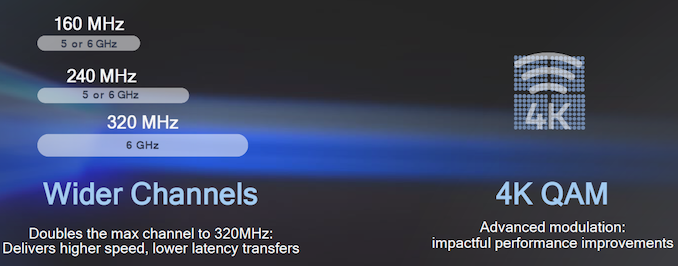
  • Support for channel widths up to 320MHz (with operation in 2.4 GHz, 5 GHz, and 6 GHz bands)
  • Support for 4096-QAM (4K-QAM) resulting in better utilization of available spectrum (a faster modulation / coding scheme).

It must be noted that wider channels are available only in the 5 GHz and 6 GHz bands.

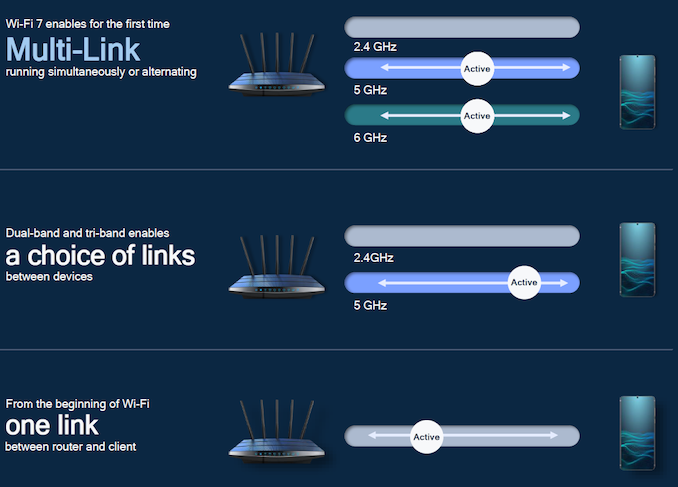
Theoretically, these aspects allow for up to around 46 Gbps of wireless throughput. 802.11be also aims to enable usage of Wi-Fi for real-time applications by including features for low-latency communications such as Multi-link operation (MLO). This allows a client and an access point to simultaneously communicate over multiple channels that might even belong to different bands.

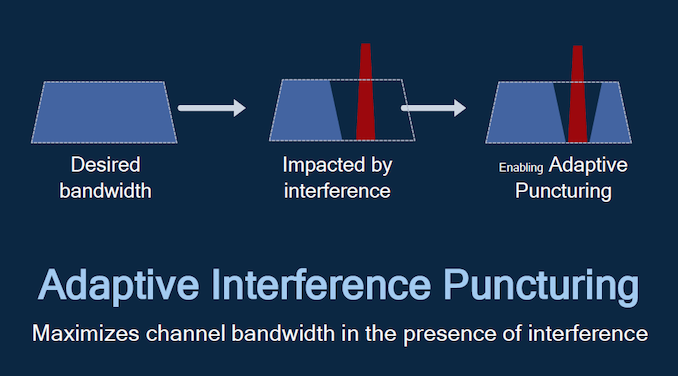
The 802.11be specifications also allow for better performance in environments with heavy interference by permitting adaptive puncturing - the desired channel need not be necessarily contiguous. This improves on the preamble puncturing feature already available as part of the 802.11ax specifications.

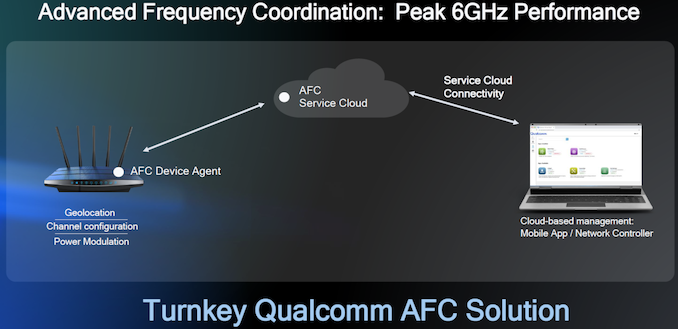
Interference and co-existence with non-Wi-Fi users of the same spectrum is handled using automatic frequency coordination (AFC). Unlike the Open AFC initiative (of which Broadcom is a part), Qualcomm is opting to provide its own turnkey solution for its customers.

As expected, AFC will require the device agent to be connected to the Internet for channel configuration and power modulation purposes.

Qualcomm's Wi-Fi 7 Portfolio

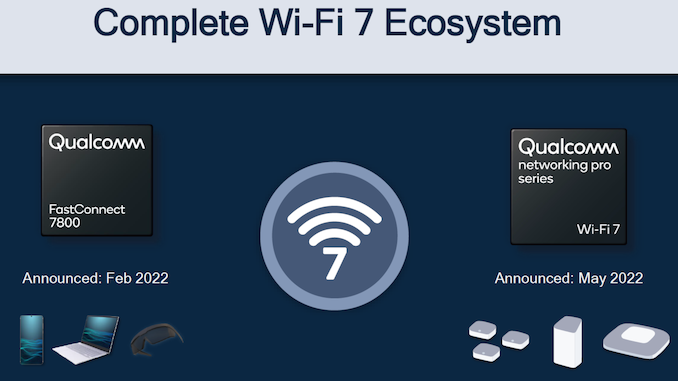
At MWC 2022, Qualcomm had provided details of their 802.11be client silicon targeting mobile devices. The FastConnect 7800 is expected to become available in H2 2022, and integrates Bluetooth 5.3 support with key Wi-Fi 7 features. Today, the company is introducing its Wi-Fi 7 Networking Pro Series access point platforms to expand its Wi-Fi 7 portfolio.

Qualcomm started marketing its Wi-Fi solutions under the Networking Pro and FastConnect monikers back in 2019, with the launch of its Wi-Fi 6 solutions. The 2nd generation products catered to the Wi-Fi 6E ecosystem, and it comes as no surprise that today's 3rd Gen. launch focuses on Wi-Fi 7.

The introduction of the Networking Pro tag has contributed to opaqueness in the composition of the router / AP platforms from a end-consumer perspective. Unlike Broadcom's public announcement of core details of the networking SoC, and characteristics of the various radio options for its reference designs, Qualcomm provides these details only to their customers. Eventually, these details do become public after market availability of the products. For example, the Networking Pro 800 platform's breakdown is available here - we see a core WiSoC with integrated MAC and baseband coupled with discrete radios. Therefore, it is disappointing that Qualcomm has not given us much to analyze in today's announcements beyond basic product specifications. These high-level feature specifications match the features in Broadcom's products announced last month.

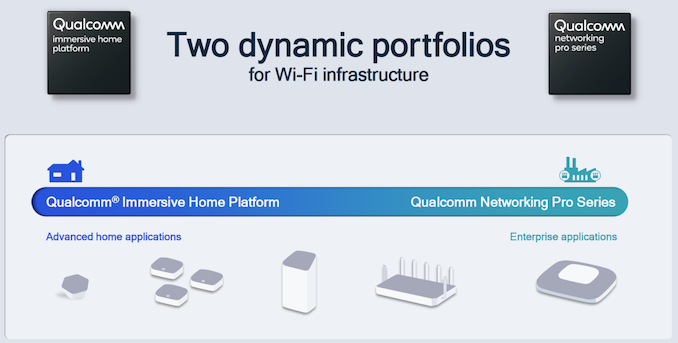
It must be noted that Qualcomm also provides the 'Immersive Home' platform for entry-level Wi-Fi routers. These are typically similar to the 'Networking Pro' platforms, except for cut-down stream counts and reduced WiSoC capabilities in terms of CPU core counts and frequencies. Given that Qualcomm refused to provide any details of CPU core counts or frequencies for the Networking Pro series being launched today, we need to wait for an official announcement related to their Wi-Fi 7 portfolio for the cost-sensitive segment.

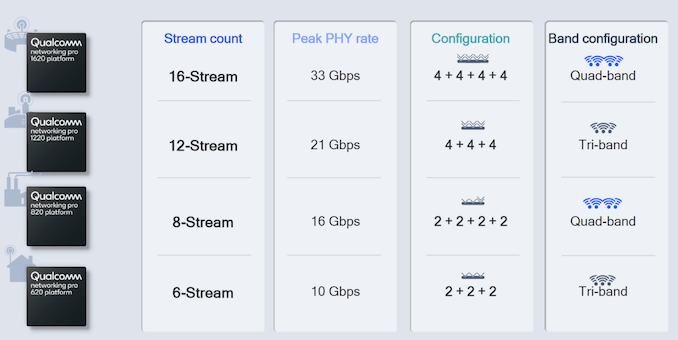
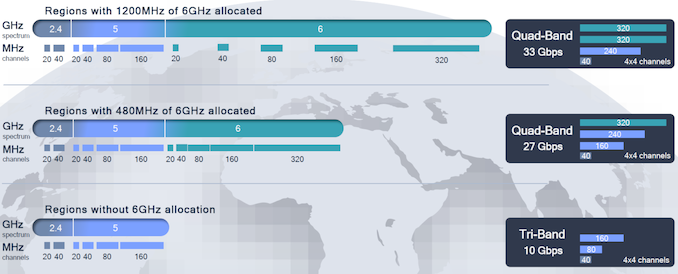
The 3rd Gen. Networking Pro series consists of four members, with stream counts ranging from 6 in the Networking Pro 620 to 16 in the Networking Pro 1620. Radio options exist for two or four streams in each of the 2.4 GHz, 5 GHz, and 6 GHz bands.

Qualcomm claims peak system PHY rates of up to 33 Gbps, and per-channel wireless PHY rates of more than 10 Gbps, with the capability of supporting more than 500 users in each channel.

The availability of 6 GHz spectrum for Wi-Fi is not universal. Qualcomm indicated that different configurations of the Networking Pro 3rd Gen series are possible, based on the allocation.

Qualcomm's Wi-Fi 7 Networking Pro series will allow its customers to create a wide range of enterprise-class and premium wireless access points / routers. The platforms are already sampling - we should be seeing market availability of BE10000, BE16000, BE21000, and BE33000 Wi-Fi routers based on them in a few quarters.

5G-based fixed wireless access is fast becoming an attractive option for many consumers - sometimes even as the primary broadband connection. Qualcomm's strengths in 5G will act as an asset from a bundling perspective for integrated Wi-Fi 7 / 5G platforms. However, Broadcom has significant presence with service providers for 10G PON and DOCSIS 4.0. It is likely that those high-speed ISPs will find Broadcom's possible bundled offerings attractive for their Wi-Fi 7-capable consumer gateways. While we wait for Mediatek and MaxLinear (to whom Intel sold their Home Gateway Platform Division) to reveal their Wi-Fi 7 cards fully, it appears that initial battle will be between products based on Qualcomm's 3rd Gen. Networking Pro series and those using Broadcom's Wi-Fi 7 portfolio.


from AnandTech https://ift.tt/XvEc2RH
via IFTTT

Friday, 29 April 2022

Intel: Meteor Lake Chiplet SoC Up and Running

https://ift.tt/TS29OmQ

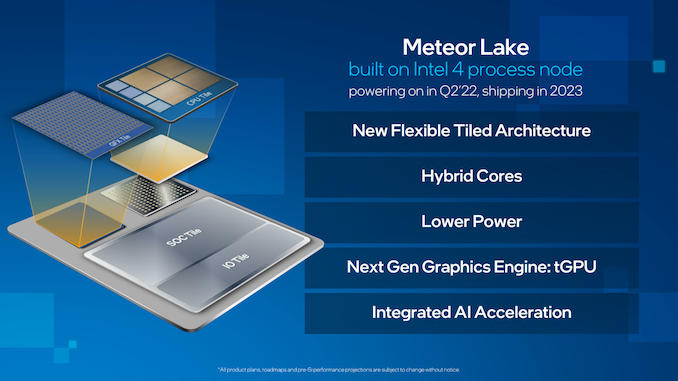
Alongside Intel’s regular earnings report yesterday, the company also delivered a brief up on the state of one of their most important upcoming products, Meteor Lake. Intel’s first chiplet/tile-based SoC, which completed initial development last year, has now completed power-on testing and more. The news is not unexpected, but for Intel it still marks a notable milestone, and is important proof that both Meteor Lake and the Intel 4 process remain on track.

Meteor Lake, which is slated to be the basis of Intel’s 14th generation Core processors in 2023, is an important chip for the company on several levels. In terms of design, it is the first chiplet-based (or as Intel likes to put it, “disaggregated”) mass-market client SoC from the company. Intel’s roadmap for the Core lineup has the company using chiplet-style SoCs on a permanent basis going forward, so Meteor Lake is very important for Intel’s design and architecture teams as it’s going to be their first crack at client chiplets – and proof as to whether they can successfully pull it off.

Meanwhile Meteor Lake is also the first client part that will be built on the Intel 4 process, which was formerly known as Intel’s 7nm process. Intel 4 will mark Intel’s long-awaited (and delayed) transition to using EUV in patterning, making it one of the most significant changes to Intel’s fab technology since the company added FinFETs a decade ago. Given Intel’s fab troubles over the past few years, the company is understandably eager to show off any proof that its fab development cycle is back on track, and that they are going to make their previously declared manufacturing milestones.

As for this week’s power-on announcement, this is in-line with Intel’s earlier expectations. At the company’s 2022 investor meeting back in February, in the client roadmap presentation Intel indicated that they were aiming for a Q2’22 power-on.

In fact, it would seem that Intel has slightly exceeded their own goals. While in a tweet put out today by Michelle Johnston Holthaus, the recently named EVP and GM of Intel’s Client Computing Group, announced that Meteor Lake had been powered on, comments from CEO Pat Gelsinger indicate that Meteor Lake is doing even better than that. According to Gelsinger’s comments on yesterday’s earnings call, Meteor Lake has also been able to boot Windows, Chrome, and Linux. So while there remains many months of bring-up left to go, it would seem that Meteor Lake’s development is proceeding apace.

But that will be a story for 2023. Intel will first be getting Raptor Lake out the door later this year. The Alder Lake successor is being built on the same Intel 7 process as Alder Lake itself, and will feature an enhanced version of the Alder Lake architecture.


from AnandTech https://ift.tt/jZSUbGR
via IFTTT

Thursday, 28 April 2022

Intel Reports Q1 2022 Earnings: Improved Enterprise Sales Buoy Weaker Client Revenue

https://ift.tt/wTvDGBW

Kicking off our coverage of the first earnings season of the year for the tech industry, we as always start with Intel. The blue-hued blue-chip company is the first out of the gate to report their results for the first quarter of 2022, with Intel reporting something of a mixed quarter. With revenue down on a yearly basis – thanks in large part to softer client sales – Intel is no longer on a hot streak of setting records. At the same time, however, the company has dialed back its lofty expectations accordingly, and as a result was still able to slightly edge out its Q1 guidance.

For the first quarter of 2022, Intel booked $18.4B in revenue, a drop of 7% from the year-ago quarter. Buffering the company against this revenue drop on a GAAP basis has been an improvement in both operating income and net income, both of which benefitted from some one-off restructuring and investment gains (McAfee equity sale). As a result, Intel booked $8.1B in net income on a GAAP basis, which is a 141% improvement on the year. Otherwise, stripping things back to non-GAAP financials, things more closely mirror the overall revenue picture with a 35% decline in income.


from AnandTech https://ift.tt/gP8eWSs
via IFTTT
Related Posts Plugin for WordPress, Blogger...