Tuesday, 10 January 2023

Nvidia RTX 4090 laptop GPU price revealed – and it’s seriously expensive

https://ift.tt/WPe4wSG

Nvidia’s RTX 4090 laptop GPU was revealed at CES 2023, but if you want this power-packed graphics card, how much will it cost you? The unsurprising answer is a small fortune, going by the price of an upgrade to the RTX 4090 on an XMG gaming laptop.

VideoCardz spotted that in a YouTube video from Jarrod’sTech, pricing is listed for the various RTX 40 Series graphics card options that buyers can choose from when purchasing XMG’s Neo 16, an incoming gaming portable packing Intel’s Core i9-13900HX Raptor Lake CPU (and a whole load of other high-end goodies).

The base model of the Neo 16 comes with the RTX 4060, retailing at €2,199 (around $2,360, £1,940, AU$3,420). If you want to upgrade that to the RTX 4090, the cost is a whopping €1,687 (around $1,810, £1,490, AU$2,630).

XMG’s prices for other Nvidia Lovelace GPUs come to a relatively palatable €375 (around $400, £330, AU$580) for the RTX 4070, but then the RTX 4080 is pitched at €1,050 (around $1,130, £930, AU$1,640).

The Neo 16, and other RTX 40 Series laptops, will be out in February.


Analysis: Pushing the boundaries of pricing (again)

Nvidia’s newly revealed GPUs are pricey, you say? Well, who’d have believed it…

Of course, the fact that the RTX 4090 is expensive in its laptop incarnation is hardly a shock, and again looking at the desktop pricing, the RTX 4080 also being a big financial ask is similarly predictable.

If we consider the total cost of the RTX 4090 going by XMG’s pricing, the cost of the upgrade is almost €1,700 as mentioned, but for the total theoretical price, we must also consider that you’re already paying for the RTX 4060 in the entry-level model’s price tag – so we can bung that on top.

Meaning that the RTX 4090 laptop GPU must come close to two grand in Euros, and that’s about the asking price for the a desktop RTX 4090 (at major German retailer MindFactory, at the time of writing). So, one way to look at this is the laptop version of this GPU is just as expensive as the desktop incarnation’s eye-watering price tag.

And of course, the laptop take on the Lovelace flagship isn’t nearly as performant as the desktop card – it draws a lot less wattage, of course, at 150W TGP (plus a 25W dynamic boost) – but what you’re paying for here is the ability to fit as much power as possible into a relatively small case (a laptop chassis).

Still, the question remains – do you really want to fork out that much for a notebook graphics card? One that has the same CUDA Core count as the RTX 4080 desktop, and likely similar performance to that card (in a best-case scenario, it’s perhaps a bit slower in the main). You can bet there are folks out there already reaching for their wallets, though…


from TechRadar: computing components news https://ift.tt/FMWGqfg
via IFTTT

Monday, 9 January 2023

The AMD Ryzen 9 7900, Ryzen 7 7700, and Ryzen 5 5 7600 Review: Zen 4 Efficiency at 65 Watts

https://ift.tt/WPe4wSG

In Q3 of last year, AMD released the first CPUs based on its highly anticipated Zen 4 architecture. Not only did their Ryzen 7000 parts raise the bar in terms of performance compared with the previous Ryzen 5000 series, but it also gave birth to AMD's latest platform, AM5. Some of the most significant benefits of Zen 4 and the AM5 platform include support for PCIe 5.0, DDR5 memory, and access to the latest and greatest of what's available in controller sets. 

While the competition at the higher end of the x86 processor market is a metaphorical firefight with heavy weaponry, AMD has struggled to offer users on tighter budgets anything to sink their teeth into. It's clear Zen 4 is a powerful and highly efficient architecture, but with the added cost of DDR5, finding all of the components to fit under tighter budget constraints with AM5 isn't as easy as it once was on AM4.

AMD has launched three new processors designed to offer users on a budget something to get their money's worth, with performance that make them favorable for users looking for Zen 4 hardware but without the hefty financial outlay. The AMD Ryzen 9 7900, Ryzen 7 7700, and Ryzen 5 7600 processors all feature the Zen 4 microarchitecture and come with a TDP of just 65 W, which makes them viable for all kinds of users, such as enthusiasts looking for a more affordable entry-point onto the AM5 platform.

Of particular interest is AMD's new budget offering for the Ryzen 7000 series: the Ryzen 5 7600, which offers six cores/twelve threads for entry-level builders looking to build a system with all of the features of AM5 and the Ryzen 7000 family, but at a much more affordable price point. We are looking at all three of AMD's new Ryzen 7000 65 W TDP processors to see how they stack up against the competition, to see if AMD's lower-powered, lower-priced non-X variants can offer anything in the way of value for consumers. We also aim to see if AMD's 65 W TDP implementation can shine on TSMC's 5 nm node process with performance per watt efficiency that AMD claims is the best on the market.


from AnandTech https://ift.tt/PDv2q8n
via IFTTT

Friday, 6 January 2023

Microsoft and AMD want to make Ryzen 7000 X3D CPUs run games faster in Windows 11

https://ift.tt/6xT5MNs

AMD and Microsoft are collaborating to ensure that the new design of the high-end Ryzen 7000 X3D processors which Team Red just revealed at CES 2023 works well enough in Windows 11, and is speedy enough for gaming.

If you recall, AMD unveiled a trio of new X3D models at CES: the Ryzen 7 7800X3D, plus the Ryzen 9 7900X3D and 7950X3D (with 8, 12 and 16-cores respectively).

In the case of the latter two Ryzen 9 models, they have two CCDs, meaning two separate chiplets that carry the processor cores, the twist being that only one of those CCDs actually has 3D V-Cache memory atop it. The idea is that this CCD can be used for gaming, or other apps where that cache will be advantageous, while the other CCD – the ‘bare’ chiplet with nothing on top – can be clocked higher, offering advantages to tasks where the cache isn’t so impactful (but speedier boost clocks will be).

This fresh design complication is something that needs to be catered for on the software front, then, and that’s exactly what AMD is doing.

As Tom’s Hardware reports, AMD is working with Microsoft to implement optimizations for Windows in conjunction with a new AMD chipset driver, with the aim of being able to determine if any given game would benefit from the cache, and then ensure that it is running in the V-Cache-topped CCD. And vice versa for those games which will be better served by the higher boost speed of the other CCD.

If you were wondering if the latter ‘bare’ chiplet can still access the V-Cache on the other chiplet, well, AMD tells us that yes, it can – but the catch is that this isn’t a fast process or at all optimal (but may still be useful in rare cases).

So, there’s quite a balancing act going on under the hood for these top-end Ryzen 7000 X3D chips.

One other interesting point raised by Tom’s is that while the new Ryzen X3D models will allow for Precision Boost Overdrive and the Curve Optimizer for juicing up performance – which wasn’t possible with the original 3D V-Cache CPU, the 5800X3D – manual overclocking (directly ramping up voltage) still won’t be allowed with the Zen 4 models.


Analysis: Getting things right could take a bit of time

There are already some worries floating around about these Windows optimizations for the Ryzen 9 7900X3D and 7950X3D, as you might imagine. What if AMD and Microsoft struggle to get them running smoothly? Should we expect teething problems at the launch of these X3D chips?

Those are questions which can’t be answered without the aid of a crystal ball, of course, but if there are any stumbling blocks in the initial implementation with some games, hopefully they’ll be ironed out soon enough.

And we should also bear in mind that Microsoft has had to perform tuning for new processor designs from Intel when the chip giant brought in its hybrid tech with Alder Lake. Working to ensure the different types of performance and efficiency cores were used correctly and ran to the best of their respective potential in Windows is a task Microsoft has previously tackled, and one that took a bit of time to get everything running really smoothly.

For AMD, the proof will be in the pudding, and how we see these top-end Ryzen 7000 X3D processors actually perform across a bunch of games when they’re released in February. We can’t wait – and we’re also very keen to learn the pricing for these V-Cache models, as that’s something AMD hasn’t shared yet (which is a little worrying, but we’re not expecting the 12 and 16-core models to be remotely cheap, of course).

Via Wccftech


from TechRadar: computing components news https://ift.tt/3jSyxZr
via IFTTT

A Lighter Touch: Exploring CPU Power Scaling On Core i9-13900K and Ryzen 9 7950X

https://ift.tt/4f3VOwS

One of the biggest running gags on social media and Reddit is how hot and power hungry CPUs have become over the years. Whereas at one time flagship x86 CPUs didn't even require a heatsink, they can now saturate whole radiators. Thankfully, it's not quite to the levels of a nuclear reactor, as the memes go – but as the kids say these days, it's also not a nothingburger. Designing for higher TDPs and greater power consumption has allowed chipmakers to keep pushing the envelope in terms of performance – something that's no easy feat in a post-Dennard world – but it's certainly created some new headaches regarding power consumption and heat in the process. Something that, for better or worse, the latest flagship chips from both AMD and Intel exemplify.

But despite these general trends, this doesn't mean that a high performance desktop CPU also needs to be a power hog. In our review of AMD's Ryzen 9 7950X, our testing showed that even capped at a these days pedestrian 65 Watts, the 7950X could deliver a significant amount of performance at less than half its normal power consumption.

If you'll pardon the pun, power efficiency has become a hot talking point these days, as enthusiasts look to save on their energy bills (especially in Europe) while still enjoying fast CPU performance, looking for other ways to take advantage of the full silicon capabilities of AMD's Raphael and Intel's Raptor Lake-S platforms besides stuffing the chips with as many joules as possible. All the while, the small form factor market remains a steadfast outpost for high efficiency chips, where cooler chips are critical for building smaller and more compact systems that can forego the need for large cooling systems.

All of this is to say that while it's great to see the envelope pushed in terms of peak performance, the typical focus on how an unlocked chip scales when overclocking (pushing CPU frequency and CPU VCore voltages) is just one way to look at overall CPU performance. So today we are going to go the other way, and to take a look at overall energy efficiency for users – to see what happens when we aim for the sweet spot on the voltage/frequency curve. To that end, today we're investigating how the Intel Core i9-13900K and AMD Ryzen 9 7950X perform at different power levels, and to see what kind of benefits power scaling can provide compared to stock settings.


from AnandTech https://ift.tt/QhEUizt
via IFTTT

Thursday, 5 January 2023

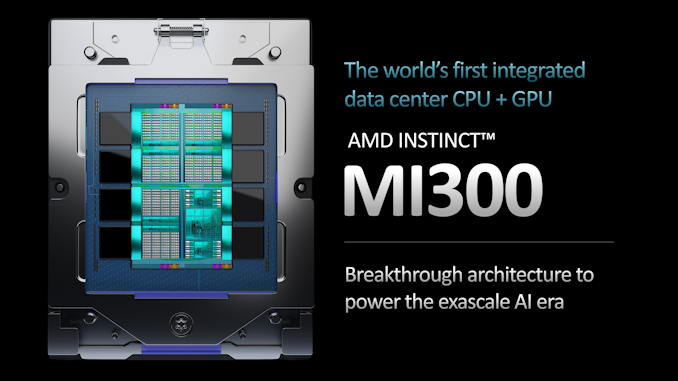
CES 2023: AMD Instinct MI300 Data Center APU Silicon In Hand - 146B Transistors, Shipping H2’23

https://ift.tt/dgaBqTw

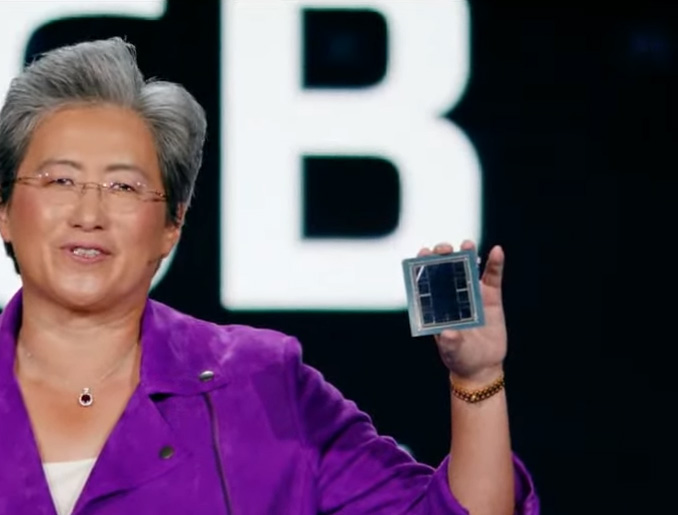
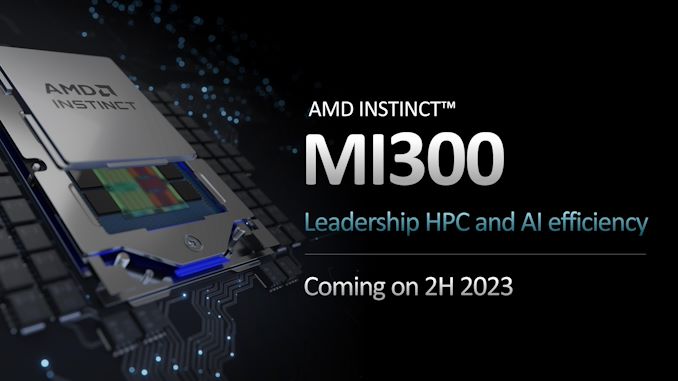
Alongside AMD’s widely expected client product announcements this evening for desktop CPUs, mobile CPUs, and mobile GPUs, AMD’s CEO Dr. Lisa Su also had a surprise up her sleeve for the large crowd gathered for her prime CES keynote: a sneak peak at MI300, AMD’s next-generation data center APU that is currently under development. With silicon literally in hand, the quick teaser laid out the basic specifications of the part, along with reiterating AMD’s intentions of taking leadership in the HPC market.

First unveiled by AMD during their 2022 Financial Analyst Day back in June of 2022, MI300 is AMD’s first shot at building a true data center/HPC-class APU, combining the best of AMD’s CPU and GPU technologies. As was laid out at the time, MI300 would be a disaggregated design, using multiple chiplets built on TSMC’s 5nm process, and using 3D die stacking to place them over a base die, all of which in turn will be paired with on-package HBM memory to maximize AMD’s available memory bandwidth.

AMD for its part is no stranger to combining the abilities of its CPUs and GPUs – one only needs to look at their laptop CPUs/APUs – but to date they’ve never done so on a large scale. AMD’s current best-in-class HPC hardware is to combine the discrete AMD Instinct MI250X (a GPU-only product) with AMD’s EPYC CPUs, which is exactly what’s been done for the Frontier supercomputer and other HPC projects. MI300, in turn, is the next step in the process, bringing the two processor types together on to a single package, and not just wiring them up in an MCM fashion, but going the full chiplet route with TSV stacked dies to enable extremely high bandwidth connections between the various parts.

The key point of tonight’s reveal was to show off the MI300 silicon, which has reached initial production and is now in AMD’s labs for bring-up. AMD had previously promised a 2023 launch for the MI300, and having the silicon back from the fabs and assembled is a strong sign that AMD is on track to make that delivery date.

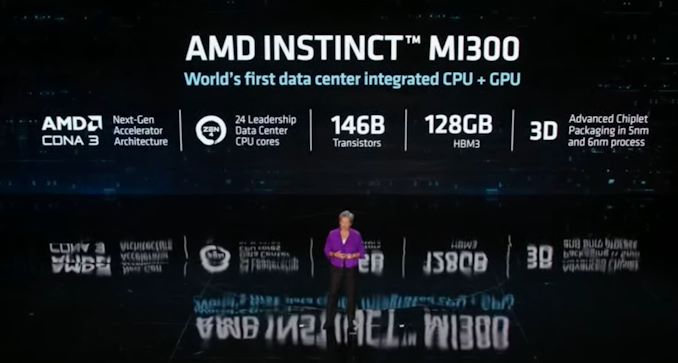
Along with a chance to see the titanic chip in person (or at least, over a video stream), the brief teaser from Dr. Su also offered a few new tantalizing details about the hardware. At 146 billion transistors, MI300 is the biggest and most complex chip AMD has ever built – and easily so. Though we can only compare it to current chip designs, this is significantly more transistors than either Intel’s 100B transistor Xeon Max GPU (Ponte Vecchio), or NVIDIA’s 80B transistor GH100 GPU. Though in fairness to both, AMD is stuffing both a GPU and a CPU into this part.

The CPU side of the MI300 has been confirmed to use 24 of AMD’s Zen 4 CPU cores, finally giving us a basic idea of what to expect with regards to CPU throughput. Meanwhile the GPU side is (still) using an undisclosed number of CDNA 3 architecture CUs. All of this, in turn, is paired with 128GB of HBM3 memory.

According to AMD, MI300 is comprised of 9 5nm chiplets, sitting on top of 4 6nm chiplets. The 5nm chiplets are undoubtedly the compute logic chipets – i.e. the CPU and GPU chiplets – though a precise breakdown of what’s what is not available. A reasonable guess at this point would be 3 CPU chiplets (8 Zen 4 cores each) paired with possibly 6 GPU chiplets; though there's still some cache chiplets unaccounted for. Meanwhile, taking AMD’s “on top of” statement literally, the 6nm chiplets would then be the base dies all of this sits on top of. Based on AMD’s renders, it looks like there’s 8 HBM3 memory stacks in play, which implies around 5TB/second of memory bandwidth, if not more.

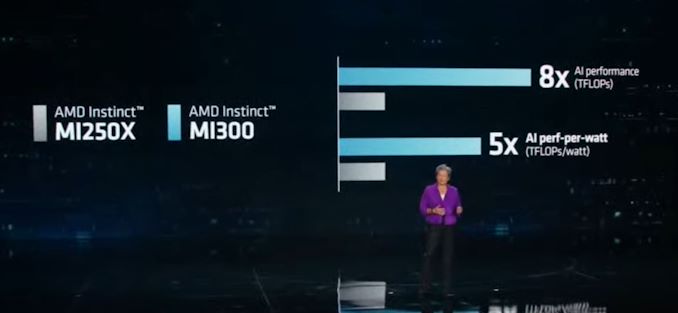
With regards to performance expectations, AMD isn’t saying anything new at this time. Previous claims were for a >5x improvement in AI performance-per-watt versus the MI250X, and an overall >8x improvement in AI training performance, and this is still what AMD is claiming as of CES.

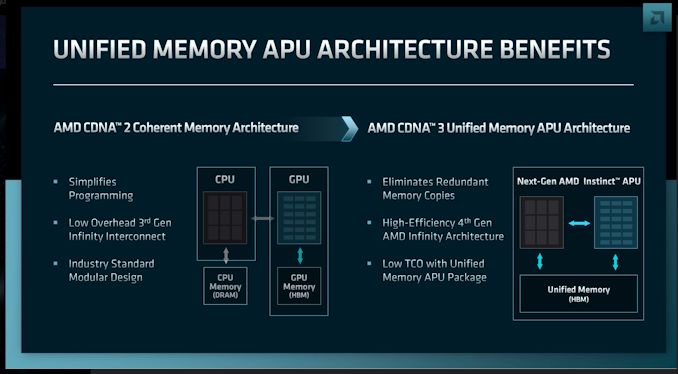
The key advantage of AMD’s design, besides the operational simplicity of putting CPU cores and GPU cores on the same design, is that it will allow both processor types to share a high-speed, low-latency unified memory space. This would make it fast and easy to pass data between the CPU and GPU cores, letting each handle the aspects of computing that they do best. As well, it would significantly simplify HPC programming at a socket level by giving both processor types direct access to the same memory pool – not just a unified virtual memory space with copies to hide the physical differences, but a truly shared and physically unified memory space.


AMD FAD 2022 Slide

When it launches in the later half of 2023, AMD’s MI300 is expected to be going up against a few competing products. The most notable of which is likely NVIDIA’s Grace Hopper superchip, which combines an NVIDIA Armv9 Grace CPU with a Hopper GPU. NVIDIA has not gone for quite the same level of integration as AMD is, which arguably makes MI300 a more ambitious project, though NVIDIA’s decision to maintain a split memory pool is not without merit (e.g. capacity). Meanwhile, AMD’[s schedule would have them coming in well ahead of arch rival Intel’s Falcon Shores XPU, which isn’t due until 2024.

Expect to hear a great deal more from AMD about Instinct MI300 in the coming months, as the company will be eager to show off their most ambitious processor to date.


from AnandTech https://ift.tt/oWtCzhu
via IFTTT

Wednesday, 4 January 2023

Intel CPU mystery unfolds as 6GHz flagship skips CES and suddenly goes on sale

https://ift.tt/Ciq8gc9

Intel’s Core i9-13900KS didn’t appear at CES 2023, but rather mysteriously the supercharged Raptor Lake flagship has popped up at a European retailer (briefly) and has also been spotted in China (before being swiftly pulled down in this case, too).

VideoCardz reports that the Core i9-13900KS was seen at a Chinese retailer, JD (as highlighted by @wxnod on Twitter), and before it was taken down, an enterprising soul managed to capture the spec listing and official pictures of the box (which look genuine enough – but still, we need to be careful around the authenticity of any leak).

See more

The packaging appears to be the same as the existing flagship processor, the 13900K, using a silver wafer case – which is as expected – with the only change being the addition of ‘Special Edition’ to the box. (As the 13900KS is basically a limited edition of the 13900K which consists of higher quality silicon that can be clocked faster – with a boost speed of 6GHz right out of the box in this case).

The specs also show the base TDP (power usage) of the 13900KS to be 150W, as previously rumored (it’ll use a lot more power than this when boosting with the pedal to the metal, though, naturally).

The Core i9-13900KS was also sighted at LDLC, a French retailer, priced at €950, but that listing has again been yanked down. For comparative pricing, the 13900K costs €770 at LDLC, meaning the KS model is €180 or 23% more expensive than the base version of the flagship.

While this could be placeholder pricing from LDLC, in theory, it would mean that in the US, the 13900KS could retail at just over $700, which is about in line with what happened with Alder Lake and the 12900KS – so that perhaps lends a little more credibility to this leak.

Whatever the case, a Special Edition processor is obviously never going to be cheap, and don’t forget, Intel likely has price hikes inbound for Raptor Lake (as they’re already coming for Alder Lake).


Analysis: The case of the missing 13900KS

Going by previous chatter on the grapevine (add your own skepticism, again), the Core i9-13900KS is supposed to debut on January 12, which is why we expected to see the turbocharged Raptor Lake flagship appear at CES 2023, a week in advance of that – because it was known that Intel was set to reveal a bunch of new 13th-gen processors at the show. Now, Team Blue did indeed unveil new Raptor Lake chips, but the 13900KS wasn’t one of them.

So this omission caused some scratching of heads, and the affair gets even more mysterious with these separate appearances of the Core i9-13900KS at retailers. Granted, the product listings were swiftly removed in both cases as noted, but this seems to suggest the usual case of retailers jumping the gun a bit, and that the refreshed Raptor Lake flagship will still go on sale if not next week, then sometime very soon.

Although that makes it seem rather odd that Intel didn’t want to show off the 13900KS at CES, doesn’t it? Unless Team Blue is planning a very low-key launch and just a simple announcement for the processor. That could be the case, though we’d imagine Intel would want to make something of a fuss over the first chip to hit 6GHz out of the box – so maybe the release date of the 13900KS has slipped, and these retailers are way off the mark with their listings.

We’ll learn the truth soon enough, but remember that Intel has already promised that this chip will arrive early in 2023, and there was certainly a wide expectation that this meant January.


from TechRadar: computing components news https://ift.tt/HgEATju
via IFTTT

Tuesday, 3 January 2023

Intel Announces Non-K 13th Gen Core For Desktop: New 65 W and 35 W Processors

https://ift.tt/Ciq8gc9

When Intel launches a new family of desktop processors, it typically unleashes its high-end unlocked SKUs first, including the K and KF models. Not only does this give users a glimpse of its performance enhancements throughout its product development cycle and roadmap in the best possible light, but it also allows enthusiasts and high-end performance junkies to get their hands on the latest and most potent processors from the very beginning of the product cycle.

For the rest of the consumer market, Intel has finally pulled the proverbial trigger on its non-K series SKUs, with sixteen new Raptor Lake-S series processors for desktops. Varied across a mixture of bare multiplier locked SKUs such as the Core i9-13900 and Core i7-13700 with a TDP of 65 W, Intel has also announced its T series models with a TDP of just 35 W for lower powered computing, including the Core i9-13900T. Furthermore, Intel has launched its Core i3 series family, offering decent performance levels, albeit with just performance (P) cores and no efficiency (E) cores, at a more affordable price starting from $109.


from AnandTech https://ift.tt/G9Au1eq
via IFTTT
Related Posts Plugin for WordPress, Blogger...