Thursday, 2 November 2023

Samsung's Next-Gen 3nm and 4nm Nodes on Track for Mass Production in 2H 2024

https://ift.tt/RVt89UA

Samsung is set to start making chips using its 2nd Generation 3nm-class (SF3) manufacturing technology as well as performance-enhanced version of its 4nm-class (SF4X) fabrication process in the second half of next year, the company told its investors this week. Both production nodes are expected to significantly improve competitive positions of the company as they will enable it to build new types of products.

"We will strengthen our technology competitiveness through the 2H [2023] mass production of the 2nd generation 3nm process as well as the 4th generation 4nm process for HPC," a statement by the company reads. "The market is forecast to shift to growth thanks to a rebound in mobile demand and continued growth in HPC demand."
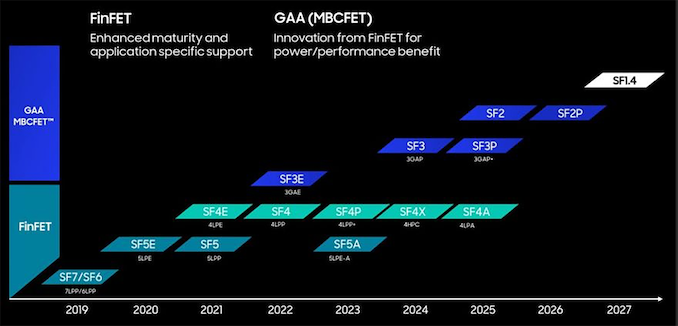
Samsung's forthcoming SF3 process technology is a major upgrade to its existing SF3E production node, which, based on the available knowledge, is only used to make small chips for cryptocurrency mining. Samsung asserts that the SF3 will offer greater design versatility by allowing for different gate-all-around (GAA) transistor's nanosheet channel widths within the same cell type. 

Although Samsung does not make direct comparisons between SF3 and SF3E, it says that SF3 offers major improvements over SF4 (4LPP, 4nm-class, low power plus), which includes a 22% increase in performance at equivalent power and complexity, or alternatively, a 34% reduction in power consumption at the same frequency and transistor count, along with a 21% reduction in logic area. In general, it is expected that SF3 will be a better option for complex designs than SF3E, though it will enter high-volume production in the second half of 2024.

In the meantime, Samsung Foundry's 4nm-class generation nodes continue to evolve. The company gearing up to launch its SF4X (4HPC, 4 nm-class high-performance computing) process technology, tailored for high-performance applications such as CPUs and GPUs used in data centers. This one is going to be SF's first process node in recent years that has been specifically designed for high-performance computing (HPC) applications.

Samsung's SF4X process technology promises to deliver a 10% improvement in performance along with a 23% reduction in power consumption. While Samsung has not disclosed the baseline for this comparison, it is likely in reference to their standard SF4 (4LPP) process. This enhancement is achieved through a redesign of the transistor's source and drain regions, following a reassessment of their performance under potentially high-stress conditions, the application of advanced transistor-level design-technology co-optimization (T-DTCO), and the implementation of a new middle-of-line (MOL) architecture.

With refined MOL architecture, SF4X is expected to achieve a silicon-validated minimum operating voltage (Vmin) for CPUs at 60mV, reduce the variability in the off-state current (IDDQ) by 10%, ensure stable high voltage (Vdd) operation above 1V without compromising performance, and enhance process margin for SRAM.


from AnandTech https://ift.tt/ZA0mBjO
via IFTTT

AMD Unveils Ryzen 7040U Series with Zen 4c: Smaller Cores, Bigger Efficiency

https://ift.tt/tQo3ZMb

In May, AMD unveiled their Ryzen 7040U series of CPUs designed for thin and light notebooks, which they codenamed 'Phoenix.' Initially, AMD announced four Zen 4-based CPUs for the ultra-portable notebook market, with the Ryzen 7 7840U (8C/16T) and Ryzen 5 7640U (6C/12T) both leading the charge with AMD's integrated Ryzen AI, which is AMD's first-generation NPU for on-chip AI and inferencing.

Fast forward a few months, and AMD is unveiling an additional two new Ryzen 7040U series processors. But there's a twist: these chips are using their smaller and highly optimized Zen 4c cores. Although AMD's more petite Zen 4c core initially debuted with the launch of their EPYC 97x4 'Bergamo' processors for native cloud deployments, server chips were never going to be the only place AMD used their compact cores. Zen 4c was already silently released in the consumer market as part of the Ryzen Z1 (non-extreme) CPU used in ASUS's ROG Ally handheld (2x Zen 4 + 4x Zen 4c), and now Zen 4c is getting a proper welcome in the consumer market with its use in a set of Ryzen laptop chips.

The first of the two new Ryzen 7040U processors with Zen 4c is the Ryzen 5 7545U, which coincidentally shares similar specifications to the existing Ryzen 7540U processor. The critical difference is that the Ryzen 5 7545U uses two full-fat Zen 4 cores with four of the smaller Zen 4c cores, which is an interesting implementation, to say the least. The second is the Ryzen 3 7440U, a direct successor to the...well, processor with the same name, the Ryzen 3 7440U, which has the exact specifications, with the only difference coming in using three Zen 4c cores, with just one Zen 4 core.

There's some nuance to pick apart with AMD's decision to use Zen 4c within their mobile platforms, as AMD highlighted at the launch of Bergamo that the 'c' in Zen 4c stands for 'Cloud,' and it's interesting to see AMD opting to integrate Zen 4c in a primarily low-end consumer segment. There are very notable differences between Zen 4 and Zen 4c, which makes things interesting, to say the least, especially when comparing the two core architectures and their intended use cases.


from AnandTech https://ift.tt/N7DMf0t
via IFTTT

Wednesday, 25 October 2023

Qualcomm Snapdragon Tech Summit Live Blog: Compute Spotlight

https://ift.tt/8gyzkwe

We're here in sunny Hawaii for day two of Qualcomm's annual Snapdragon Summit.

Yesterday, of course, was the company's prime keynote, where they announced their forthcoming Snapdragon X Elite SoC for laptops, as well as the Snapdragon 8 Gen 3 for smartphones. As well, the company gave us our first look at their Oryon CPU architecture, which will be driving the X Elite, and eventually Qualcomm's smartphones, automotive chips, and more.

For day two of their event, today Qualcomm is going to take us through the technical side of their new chips, revealing a bit more about how they work and what new features and abilities have been added in this generation. So please join us for our live blog coverage of Qualcomm's technical track disclosures.


from AnandTech https://ift.tt/m10bpKR
via IFTTT

Tuesday, 24 October 2023

Qualcomm Previews Snapdragon X Elite SoC: Oryon CPU Starts in Laptops

https://ift.tt/8gyzkwe

While Qualcomm has become wildly successful in the Arm SoC market for Android smartphones, their efforts to parlay that into success in other markets has eluded them so far. The company has produced several generations of chips for Windows-on-Arm laptops, and while each has incrementally improved on matters, it’s not been enough to dislodge a highly dominant Intel. And while the lack of success of Windows-on-Arm is far from solely being Qualcomm’s fault – there’s a lot to be said for the OS and software – silicon has certainly played a part. To make serious inroads on the market, it’s not enough to produce incrementally better chips – Qualcomm needs to make a major leap in performance.

Now, after nearly three years of hard work, Qualcomm is getting ready to do just that. This morning, the company is previewing their upcoming Snapdragon X Elite SoC, their next-generation Arm SoC designed for Windows devices. Based on a brand-new Arm CPU core design from their Nuvia subsidiary dubbed “Oryon”, the Snapdragon X Elite is to be the tip of the iceberg for a new generation of Qualcom SoC designs. Not only is it the heart and soul of Qualcomm’s most important Windows-on-Arm SoC to date, but it will eventually be in smartphones and a whole lot more.


from AnandTech https://ift.tt/oVGzBYL
via IFTTT

Nvidia and AMD’s rumored plans to make Arm-based PC CPUs could turn the laptop world upside down

https://ift.tt/alwf7bZ

Nvidia is planning to make Arm-based processors to challenge Intel’s dominance in the world of Windows PCs, according to a new report – as is AMD.

Reuters has the scoop with this one – add an appropriate dose of caution as ever with rumors – and on the Nvidia side, the report cites two sources familiar with the purported plans.

Apparently Nvidia is ‘quietly’ designing these new CPUs which will presumably go in laptops (using Windows on Arm) – and likely also desktops too – as part of Microsoft’s scheme to encourage chip makers to use Arm-based processors.

After all, Microsoft has doubtless been watching Apple have its own very successful venture, shifting to in-house Arm chips and away from Intel with Macs, and Nadella’s company wants a piece of that action.

As the Reuters report points out, in the three years since Apple kicked off with the launch of the M1, it has nearly doubled its PC market share according to preliminary Q3 figures from analyst firm IDC.

Microsoft’s scheme has apparently also caught the attention of AMD, and Team Red will apparently make Arm-based processors in the same vein as Nvidia, again if the word of two separate sources proves correct.

We’re told that both Nvidia and AMD could have PC chips out in quite swift fashion, perhaps even as soon as 2025.


Analysis: A worrying prospect for Intel

Windows on Arm has struggled to make any meaningful impact whatsoever, thus far, with existing Qualcomm chips as the engine of devices running the OS. Nvidia and AMD entering the stage could be a turning point, though, in producing peppier chips, and that’s clearly what Microsoft is hoping for.

Obviously it’s not quite as simple as ‘ooh, let’s do what Apple does’ with faster, better and more efficient silicon, as marrying the hardware and software sides of the equation is a very different problem for Microsoft and would-be partners Nvidia and AMD.

Apple, of course, has complete control over its hardware and software stack, which is a considerable advantage in terms of getting everything working in harmony and producing the best results. And the results produced with the M1 and M2 SoCs (with the M3 to follow next year most likely) have been remarkable to say the least.

Microsoft’s other issue would be persuading developers to code for Windows on Arm, when Intel chips remain dominant – and Team Blue wouldn’t be easy to dislodge. (Interestingly, Microsoft has just implemented an advisory service to help devs create apps for Windows on Arm).

Clearly, this potential development will worry Intel. Apple’s MacBooks are forging forward with those Arm-based chips, as noted. With the M1 and M2 boasting serious power-efficiency chops, this is, unsurprisingly, something Intel has turned to focus on – Meteor Lake laptop processors (due in December) have been designed to major in the efficiency department. (And Raptor Lake Refresh desktop CPUs feel like an afterthought in comparison).

So, laptops may be Intel’s fortress, but the assault from Apple is being taken seriously, and further competition from possibly Nvidia and AMD in a couple of years’ time is not going to help Team Blue.

If both Nvidia and AMD get behind Windows on Arm in laptops (and yes, chips for desktop PCs could also be made, of course, as mentioned at the outset – but notebooks would be the major drive presumably), then maybe it will become a more potent force in the computing world. We still have trouble believing that, in all honesty, but the addition of two big players in the form of Teams Green and Red could swing it, if anything will…

You might also like


from TechRadar: computing components news https://ift.tt/qOHTf1J
via IFTTT

Could Nvidia scrap the RTX 4080 graphics card? New rumor suggests it might

https://ift.tt/3RkGFYQ

Nvidia might be mulling scrapping the RTX 4080 graphics card, if a fresh rumor pans out – but clearly this is one we should regard with a large amount of skepticism.

For starters, the source of the rumor is IT Home (via Tom’s Hardware), a Chinese tech site with a somewhat patchy record, with the actual speculation itself coming from Bopantang news.

According to the source cited, the RTX 4080 graphics card may be ‘discontinued’ – note that it’s may, rather than a firm assertion – and Nvidia could effectively replace it with the RTX 4080 Super (or 4080 Ti, whichever naming scheme Team Green plumps for).

Essentially, the incoming RTX 4080 refresh is going to replace the existing RTX 4080, or that’s the contention.

IT Home recently put forward the rumor – one heard elsewhere – that Nvidia has three new models of Lovelace graphics cards inbound, also pointing to Benchlife (another Chinese source) which believes one will be an RTX 4080 Super with 20GB of GDDR6X VRAM.


Analysis: How realistic is the idea of canceling the 4080?

Well, there’s been a persistent buzz that sales of the RTX 4080 have been an uphill struggle for Nvidia, of course, ever since the graphics card was launched. A near vertical struggle, in fact, and the timing of this report is interesting, because YouTube leaker Moore’s Law is Dead (MLID) – a prominent source of GPU (and CPU) rumors – noted that his retail sources are saying RTX 4080 sales are really, really bad in his latest video.

So, you might think that there could be some weight to the idea that Nvidia is mulling a cancelation of the RTX 4080, rather than watching it limp on. Although MLID’s theory is that Nvidia may push up the price of the RTX 4090 – to follow what’s happening in China (where the GPU will be imminently banned, so demand is unsurprisingly surging) – in order to make the RTX 4080 seem more attractive (and hold its MSRP better).

Mind you, we’re not talking about a complete cancelation of the RTX 4080, and we presume the source of the above rumor isn’t, either (though that isn’t made clear – maybe the source is). But we presume Nvidia would run an effective cancelation, winding down production to next to nothing, rather than actually nothing.

As we’ve theorized before, it would surely seem too embarrassing for Team Green to outright cancel the RTX 4080 – admitting it was a mistake effectively – when Nvidia already ‘unlaunched’ the other initial 4080 variant (12GB model). It starts to look like Nvidia doesn’t know what it’s doing in that case, making multiple blunders, or at least that’s the way we see it.

Also, other rumor-mongers have not mentioned any canceling of cards, and certainly MLID believes the RTX 4080 will run alongside the new Super or Ti spin – and RTX 4070 refreshes – if only to make them look good value, relatively speaking, when they launch. (Assuming the 4080 goes up in price as is Nvidia’s purported intention, according to MLID).

IT Home’s source also expects RTX 4080 prices to go up, but not due to any strategic maneuvering with RTX 4090 pricing – rather, simply because with production being wound down, 4080 stock is going to be thin on the ground soon enough.

Time will tell, and add huge amounts of seasoning with all this speculation. It’s becoming pretty clear that Nvidia has some fresh would-be contenders to grab a spot on our best graphics cards list, but as to what they are, or how the Lovelace range is going to be rejigged – well, the likelihood is that Team Green may not have made those final decisions yet.

You might also like


from TechRadar: computing components news https://ift.tt/NkFPUwH
via IFTTT

Monday, 23 October 2023

The Thermaltake Toughpower GF A3 750W PSU Review: Mid-Range 750W PSU With 12VHPWR

https://ift.tt/pEdKIaV

Thermaltake is a company based in Taiwan that specializes in designing and manufacturing computer hardware components and accessories. Established in 1999, the company's product range includes thermal solutions such as CPU coolers and cases and power supply units, keyboards, and mice. Thermaltake operates globally and has a presence in multiple markets, serving a customer base that ranges from casual computer users to hardware enthusiasts. The company's products are subject to various industry certifications and standards.

Known for its diverse portfolio, ranging from cases and coolers to power supply units (PSUs), the company has a reputation for merging aesthetics with functionality. Among the lineup of their power supplies, the Toughpower GF A3 750W PSU stands as a prominent offering aimed at enthusiasts who demand a balanced mix of reliability, performance, and energy efficiency.

As PSUs are the backbone of any computing system, providing stable and efficient power is paramount. Thermaltake's Toughpower GF A3 750W PSU aims to do just that while adding modularity and aesthetic appeal into the mix. It is designed to target the bulk of advanced PC builders, which means it will also have to compete against myriads of similar products for a piece of that saturated market pie. In this review, we will dissect this power supply's features, performance, and overall value proposition to determine whether it meets modern PC builds' demands.


from AnandTech https://ift.tt/Q7gY6Zc
via IFTTT
Related Posts Plugin for WordPress, Blogger...