Friday, 10 November 2023

Is AMD close to revealing new Ryzen 9000 CPUs? We doubt it

https://ift.tt/08oTE5W

We’ve caught a glimpse of AMD’s Ryzen 9000 range, or at least a mention of it, purportedly in an Alienware advert.

Tom’s Hardware brought our attention to the leaked image which shows an Alienware desktop PC with text indicating that it has an ‘AMD Ryzen 9000 Series’ chip inside.

See more

Predictably, some folks have been pretty quick to jump to the conclusion that this means next-gen Zen 5 chips called Ryzen 9000 are coming, and maybe sooner than expected. And that AMD will skip over the Ryzen 8000 name (sort of – we’ll come back to that later).

However, we must be very skeptical about the image for a number of reasons, not the least of which is that it comes from the Chiphell forums (not the most reliable source in our experience).

So next up, let’s mull over the other reasons to approach this one with caution, and decide exactly how much weight we can give this apparent leak.


Analysis: Fake or mistake? Or could it be real?

The first thought that may occur to you is that this is a fake – that was certainly the case for us. As mentioned, Chiphell isn’t our favorite trusted source by any means, and there’s something about the ad that feels a bit off.

Alternatively, it could be a genuine piece of Alienware marketing which someone has blighted with a typo, so it shouldn’t read ‘Ryzen 9000’ at all. It wouldn’t be the first time something like this has happened.

For a moment, let’s put those two obvious concerns aside and assume that it’s authentic. Isn’t it simply too early for next-gen Ryzen 9000 CPUs to be even floating around in early work for ads? And wouldn’t it be Ryzen 8000, anyway?

On the second point, well, AMD could be reserving Ryzen 8000 for APUs and skipping it for desktops, moving straight to Ryzen 9000 with the latter. This happened with Ryzen 6000, which was APUs, where desktop CPUs went from the 5000 Series to 7000, so it’s not without precedent. Some might say it’s even quite likely.

As to whether it’s just too early to be seeing anything on next-gen Zen 5, yes, there’s some merit to that line of thinking we’d say. From the balance of rumors we’ve heard in the latter part of this year, Zen 5 is likely to debut around the middle of 2024. However, some chatter has indicated the CPUs could come earlier next year. And if we run with that idea, this leak could herald an AMD announcement of Ryzen 9000 CPUs at CES 2024, with a launch of these challengers for our best processors roundup happening a couple of months later.

That said, we haven’t witnessed much in the way of leakage around Zen 5 chips – what we have seen has been pretty lightweight spillage – so that leads us to believe it’s a real reach to assume they’re near being revealed. All in all, we’re not convinced by this leaked pic, and we’d advise staying on the skeptical side for sure – but it may well be correct that Zen 5 desktop turns out to be Ryzen 9000.

You might also like


from TechRadar: computing components news https://ift.tt/VR5v9Yl
via IFTTT

Thursday, 9 November 2023

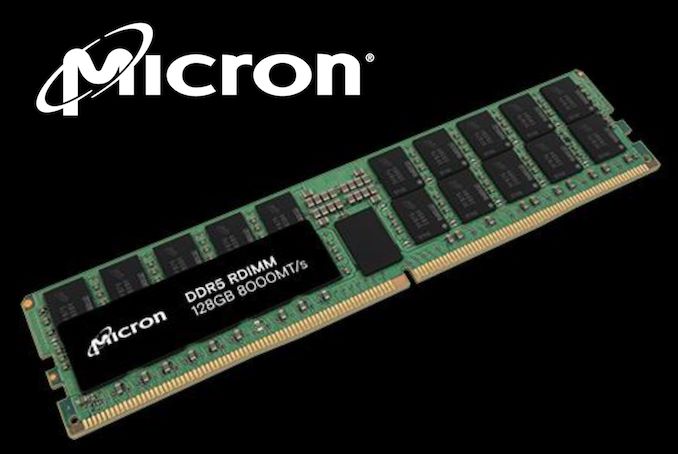
Micron Introduces 128 GB DDR5-8000 RDIMMs with Monolithic 32 Gb Dice

https://ift.tt/htVeAoa

The path to high-capacity RDIMMs for servers has primarily been through 3D stacking (3DS) of DRAM dice using Through-Silicon Vias (TSVs). However, this has presented significant challenges in packaging (driving up the cost), and has also not been efficient in terms of energy consumption. The demand for large memory capacity RDIMMs is being primarily driven by the sudden emergence of large-language models (LLMs) for generative AI and increasing CPU core counts. Both of these require significant amount of DRAM to keep pace with performance requirements. Keeping these in mind, Micron is introducing 128 GB DDR5 RDIMMs capable of operating at up to 8000 MT/s today, with mass-production slated for 2024.

Micron has recently started fabricating 32 Gb monolithic DDR5 dice using its proven and mature 1β technology. The new dice have a 45%+ increase in bit density, and are capable of reaching up to 8000 MT/s while also operating with much more aggressive timing latencies compared to the standard JEDEC specs. The company is claiming that it improves energy efficiency by as much as 24% compared to the competition's 3DS TSV offerings, and the faster operation can also help in faster AI training times. Avoiding 3DS TSV allows Micron to optimize the data input buffers and critical I/O circuits better, while also reducing the pin capacitance on the data lines. These contribute to the reduced power and improved speeds.

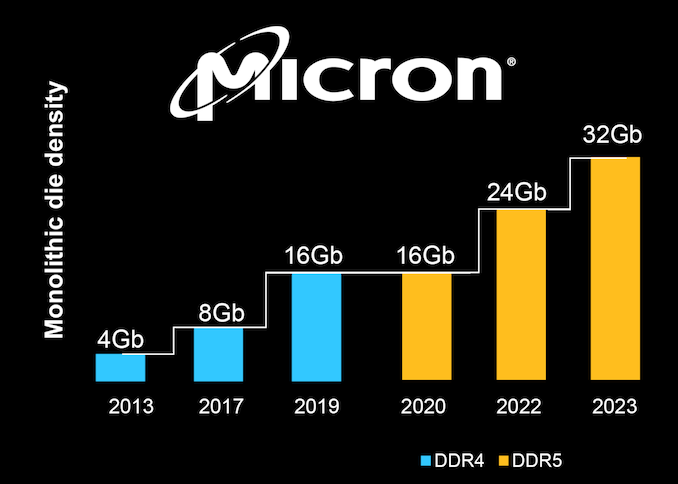
Micron has been doubling its monolithic die density every 3 years or so, thanks to advancements in CMOS process as well as improvements in array efficiency. The company sees a clear path to 48 Gb and 64 Gb monolithic dice in the future with continued technological progress. Micron is also claiming that its 1β node has reached mass production ahead of the competition, and that it has had the fastest yield maturity in the company's history. Dual-die packages and tall form-factor (TFF) modules using 1β DRAM are expected to enable 1TB modules in the near future.

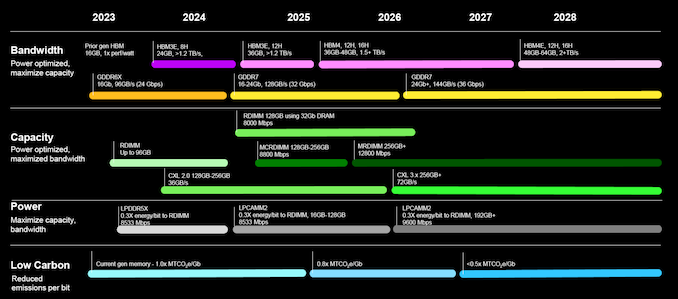
Along with the announcement of the 128 GB RDIMMs using 1β technology, the company also laid out its roadmap for upcoming products. HDM and GDDR7 are expected to dominate bandwidth-hungry applications, while RDIMMs, MCRDIMMs, and CXL solutions are in the pipeline for systems requiring massive capacity. LPDDR5X, and LPCAMM2 solutions going up to 192 GB are expected to make an appearance in power-sensitive systems as early as 2026.


from AnandTech https://ift.tt/f2vpJPS
via IFTTT

Wednesday, 8 November 2023

Best CPUs for Gaming Holiday 2023

https://ift.tt/SF8kBy7

As we prepare to move into the holiday period, the tinsel, glitz, and fanfare of festivities are on their way, but the CPU market looks pretty solid as we round out the end of the year. Intel recently launched their latest 14th Gen Core family to the market, with the Core i9-14900K spearheading things with 6.0 GHz out of the box. While impressive on paper, there's AMD's Ryzen 7000 series to contend with, with competitiveness at the top end of the market scorching right now, and that's not a pun. Stock levels look good on processors at popular retailers such as Amazon and Newegg, and many motherboards/DDR5 memory are floating around to satisfy demand. The CPU market, on the whole, looks strong as we move into the final stages of 2023.

Looking at a wider and broader overview of the current CPU market, the top end is dominated by the new Intel Core i9-14900K (8P+16E/32T) and AMD's Ryzen 9 7950X (16C/32T). An honorable mention does need to be made regarding the Core i9-13900K (8P+16E/32T), which, although it hails from Intel's previous 13th Gen family, is nearly identical to the new 14900K bar a bump to core frequencies. All three of these processors are similarly matched in compute performance, whereas the only 'real' gain separating them is in AVX-512/AVX2 workloads, as AMD's Ryzen 7000 does support these instruction sets. Other than that, it's very competitive at the top.


from AnandTech https://ift.tt/xXrKipy
via IFTTT

Buyers of AMD Ryzen 7000 CPUs and RX 7000 GPUs get a free copy of Avatar: Frontiers of Pandora

https://ift.tt/tPqNWke

AMD is running another freebie game offer for those who are purchasing one of its current-gen processors or graphics cards.

Buyers of selected Radeon RX 7000 GPUs and Ryzen 7000 CPUs can avail themselves of a fresh bundle that provides a free copy of Avatar: Frontiers of Pandora alongside the hardware.

Wait a minute, you might be thinking – Ubisoft’s game isn’t out yet – and you’d be right there.

Avatar: Frontiers of Pandora comes out on December 7, so you won’t be able to play the game until then.

Note that only certain participating (major) retailers will carry the bundle, and when you get the GPU or CPU, you’ll need to put it in the PC where the code for the free game will be used.

The promotion ends on December 30, 2023, and you must redeem your serial code to get the game by January 27, 2024, or it’ll no longer be valid.

There’s also the small matter of Avatar-themed AMD RX 7900 XTX graphics cards with a custom shroud, and 500 of these have been made. They won’t be sold, but instead dispersed via various giveaways and promotions here and there from AMD and Ubisoft.

Naturally, it’s also worth bearing in mind that we should see some great deals on the best graphics cards out there, from AMD, Intel, and Nvidia, for Black Friday soon.


Analysis: Taking the baton from Starfield

The Avatar: Frontiers of Pandora bundle replaces the existing Starfield offering, and as you may realize, it’s part of the regular procession of game bundles that GPU makers throw in to give an extra incentive to buy their products.

How good will Avatar: Frontiers of Pandora be? Obviously, we don’t know yet, and won’t know until its release in a month. But it looks promising, taking cues from Far Cry and offering a two-player online co-op mode to lend some additional depth (co-op experiences are always very welcome in our books).

If you’re hankering after one of those Avatar-inspired RX 7900 XTX GPUs, then you best keep an eye out on all the usual social channels for AMD and Ubisoft for when giveaways pop up. Or you could also keep watch on eBay, where we’ll inevitably see somebody selling these limited-edition graphics cards at some point.

Via Wccftech

You might also like


from TechRadar: computing components news https://ift.tt/lqmFI1U
via IFTTT

Tuesday, 7 November 2023

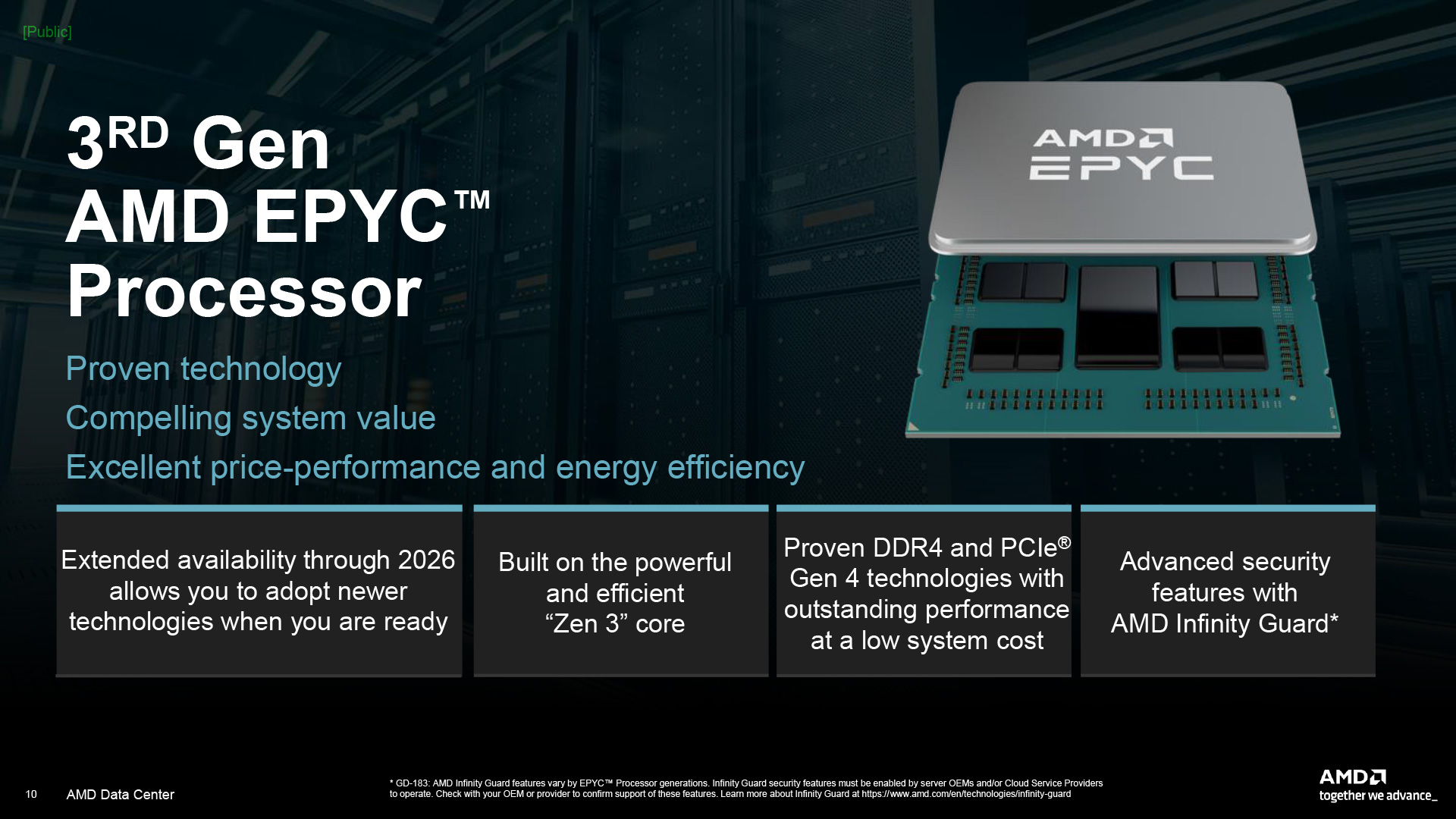
AMD's EPYC 7003 "Milan" Receives Extended Lifecycle: Availability To 2026 With 6 New SKUs

https://ift.tt/4uIrcoG

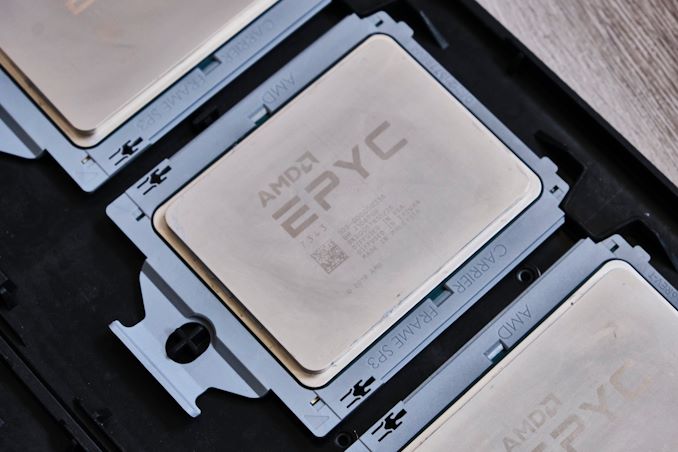
AMD has sent word over this morning that the company is extending the product lifecycle for their previous-generation EYPC 7003 “Milan” family of server CPUs. The company will now be offering the Zen 3-based CPUs through at least 2026, and as part of that extension plan, has already launched a further 6 SKUs. With these changes, Milan is effectively being repositioned as a budget server platform for AMD, offering AMD’s past tech at a discount to cost-weary customers.

First launched in early 2021, AMD’s EPYC 7003 “Milan” platform is based on the company’s Zen 3 architecture, offering chips with up to 64 CPU cores, 8 channels of DDR4 memory, and PCIe 4.0 connectivity. The platform has since been superseded by AMD’s numerous Zen 4-based EPYC 9004/8004 server platforms – Genoa, Bergamo, and Siena – but for continuity and support reasons, the Milan platform is still being offered to customers. And now, it seems, it will be for even longer than AMD was first expecting.

As of today, AMD is extending the availability of the Milan platform to 2026. All the while, the company is repositioning the platform as their newest budget offering, pitching it at customers who are on the trailing-edge of server technology and need a proven platform to upgrade to, but for whatever reason aren’t ready to upgrade to the 4th generation EPYC platforms. In practice, AMD is trying to entice Intel Xeon Scalable customers who are looking to replace their aging servers, but aren’t ready or eager to move on to 4th gen Xeon Scalable (Sapphire Rapids).

Competitively, Milan doesn’t offer much of note with regards to performance or features compared to AMD and Intel’s contemporary platforms. But for customers already invested in it and who need the ability to repair or bring online additional matching systems over the next couple of years, it will remain in service.

Meanwhile, the company is also re-launching 6 new Milan SKUs to underscore its position as a budget platform. All of these chips were first released by AMD back in September without much fanfare, but now that AMD is extending Milan’s availability to 2026, they are using the moment to spotlight their existence.

AMD EPYC 7003 Milan New SKUs
AnandTech Core/
Thread
Base
Freq
1T
Freq
L3
Cache
PCIe Memory TDP
(W)
cTDP
(W)
Price
(1KU)
7663P 56 112 2000 3500 256MB 128 x 4.0 8 x DDR4-3200 240 225-280 $3,139
7643P 48 96 2300 3600 256MB 225 225-240 $2,722
7303 16 32 2400 3400 64MB 130 120-150 $604
7303P 16 32 2400 3400 64MB 130 120-150 $594
7203 8 16 2800 3400 64MB 120 120-150 $348
7203P 8 16 2800 3400 64MB 120 120-150 $338

The 6 new chips are a bit of an eclectic mix. The top two SKUs – the 56-core 7663P and 48-core 7643P – are 1P-only versions of existing Milan chips at a lower price. Meanwhile the 7303 and 7203 parts are new, with AMD offering ultra-budget server chips with just 16 and 8 cores respectively. The 7203/7203P are true entry-level chips by server standards, with just 8 CPU cores, 64MB of L3 cache, and peak clockspeed well below AMD’s only other 8 core Milan (72F3). However, all of these chips come with the full I/O and memory channels supported by the Milan/SP3 platform, allowing AMD to position them as alternatives to the more limited EPYC 8004 Siena platform.


from AnandTech https://ift.tt/u4Rkd7L
via IFTTT

Apple M3 Ultra CPU might blow away M3 Max – but we won’t find out for a long time yet

https://ift.tt/jLpfhRw

Apple’s M3 Ultra chip could be quite some way off even though the company launched a clutch of fresh silicon right out of the gate this time around.

This is according to Mark Gurman, who drops some info on the future Apple SoC in his newsletter for Bloomberg (as noticed by 9to5Mac).

As you likely saw, Apple launched the vanilla M3 alongside M3 Pro and M3 Max processors, with the latter two being a surprise (normally there’d be a gap between the release of the basic model and these turbocharged spins on the SoC).

Gurman notes the reason for this triple launch was that Apple needed to have the Pro and Max variants for use in the high-end MacBook Pros that the company unleashed at its recent ‘Scary Fast’ event.

The well-known leaker further explains that there’s only a certain amount of 3nm silicon available for Apple to use, most of which goes towards the high-demand iPhone, so the company needed lower volume products for the new M3 chips – pricey MacBooks, in other words.

Gurman then notes that the Mac Studio and Mac Pro are even slower selling products, but they would need a successor to the M2 Ultra – and this hasn’t yet gone into ‘broad testing’ we’re told.


Analysis: An ultra-long wait, then?

In other words, Apple is still a long way off releasing an M3 Ultra, and even though we got the M3 Pro and Max immediately, it’s likely going to be a long wait before we see an Ultra spin on the new silicon.

When the M3 Ultra arrives, if Apple sticks to its current way of doing things, the chip is likely to be very impressive, as it’ll presumably be a pair of M3 Max SoCs bolted together (as is the case with the M2 Ultra). And that current top-end offering, the M3 Max, is nicely peppy already, whereas the M3 Pro is not that much of an improvement over the M2 Pro, so Apple is favoring making the gap wider between its middling and high-end silicon, it seems.

A new Mac Studio is underway at Apple, Gurman tells us, but the next M3 products – arriving in 2024 – should be MacBook Air models (13-inch, 15-inch) and a revamped Mac mini. Notably, the leaker doesn’t say that a Mac Pro is in the works, even, so that could be even further out than any Mac Studio.

You might also like


from TechRadar: computing components news https://ift.tt/YIpbKTJ
via IFTTT

Sunday, 5 November 2023

Leaked benchmark suggests Apple’s M3 Pro CPU isn’t nearly as ‘scary fast’ as M3 Max

https://ift.tt/Po7pLmC

Apple’s new M3 Pro is not that much faster than its predecessor, if an early (leaked) benchmark is to be believed (so apply skepticism appropriately as we head into this story).

This comes from Vadim Yuryev of YouTube channel Max Tech, who tweeted (as flagged by MacRumors) to point out a spilled benchmark of the M3 Pro (the only version of the new SoC, which has 12-cores).

See more

The Geekbench 6 result shows the M3 Pro – seemingly inside a new MacBook Pro 14-inch – hitting scores of 3,035 for single-core and 15,173 for multi-core.

Compare that to the M2 Pro variant with 12-cores and we see that while the M3 Pro has a good lead of 14% for single-core, when it comes to multi-core, the new SoC is just 6% faster.

Of course, that’s not a huge difference, and as a generational uplift, it’s about as small as you could get away with.

While both chips are 12-core processors as noted, the M3 Pro obviously benefits from a new architecture and more advanced manufacturing process (3nm) – but the M2 Pro benefits from having a split of 8 performance cores and 4 efficiency cores, whereas the M3 Pro has 6 of each type.

With a pair of extra performance cores, it seems that the old M2 Pro narrows the gap quite considerably – at least in certain scenarios.


Analysis: Don’t leap to conclusions yet

There are key points to bear in mind here. Firstly, this is just a leak, so as mentioned we should be skeptical around it. Secondly, if true, it’s still just a single benchmark, and not necessarily representative of other results we’ll see, or indeed real-world performance for the M3 Pro.

Still, this is a disappointing early hint that the M3 Pro might underwhelm at least in some respects. Particularly as with the M3 Max, Apple seems to have pushed the chip to be seriously fast (scary fast, even), to be more or less equivalent to the M2 Ultra CPU in fact (add salt again, as these are also leaked benchmarks we’ve seen for the Max).

So, there’s seemingly a pretty big gap between the M3 Pro and M3 Max, more so than with the previous generation of Apple’s silicon. And as you might imagine, some folks have been quick to jump on this as a possible tactic to get buyers of Macs to fork out for M3 Max models, rather than M3 Pro, pushing up Apple’s profits as a result.

It is still early to be drawing any such conclusions, though, and we really need to get these new laptops in ourselves and do some thorough testing before we can discern the true relationship, performance-wise, among Apple’s clutch of M3 chips.

You might also like


from TechRadar: computing components news https://ift.tt/9FOWJks
via IFTTT
Related Posts Plugin for WordPress, Blogger...