https://ift.tt/eA8V8J
A team of academics from four US universities have discovered a new side-channel attack that takes advantage of the speculative execution feature in modern processors to recover data from users' CPUs. Speculative execution is the same CPU function exploited by the Meltdown and Spectre flaws ...
from Google Alert - CPU processor https://ift.tt/2unUOOV
via IFTTT
Tuesday, 27 March 2018

AMD Ryzen 7 2700X is faster and much cheaper than 1800X
https://ift.tt/eA8V8J
The benchmarks of AMD's highly anticipated second-generation Ryzen 2700X processors have just leaked. The new CPU is straightforward and is expected to be released in mid-April. Ryzen 7 2700X is AMD's new 8-core flagship processor for the AM4 socket. It replaces both the Ryzen 7 1700X and ...
from Google Alert - CPU processor https://ift.tt/2GxACPu
via IFTTT
The benchmarks of AMD's highly anticipated second-generation Ryzen 2700X processors have just leaked. The new CPU is straightforward and is expected to be released in mid-April. Ryzen 7 2700X is AMD's new 8-core flagship processor for the AM4 socket. It replaces both the Ryzen 7 1700X and ...
from Google Alert - CPU processor https://ift.tt/2GxACPu
via IFTTT
GIGABYTE's ThunderXStation with Dual Cavium ThunderX2 Arm SoCs
https://ift.tt/eA8V8J
... a dual-socket motherboard supporting Cavium's ThunderX2 SoCs featuring up to 64 custom Armv8 cores with four-way SMT as well as 16 DDR4 memory channels (1DPC, 8 channels per SoC) when two CPUs are installed. A dual-processor ThunderXStation comes with two PCIe Gen3/OCP x16 slots, ...
from Google Alert - CPU processor https://ift.tt/2pIqbyf
via IFTTT
... a dual-socket motherboard supporting Cavium's ThunderX2 SoCs featuring up to 64 custom Armv8 cores with four-way SMT as well as 16 DDR4 memory channels (1DPC, 8 channels per SoC) when two CPUs are installed. A dual-processor ThunderXStation comes with two PCIe Gen3/OCP x16 slots, ...
from Google Alert - CPU processor https://ift.tt/2pIqbyf
via IFTTT
Coffee Lake S: New informations about Intel's eight-core processor
https://ift.tt/eA8V8J
The table leaked from 3DMark does not reveal much for the new processors at the moment. For example, CPU's TDP, cache, or boost clock is not mentioned, but on the other we learn how Hyper Threading supports, and there will be 1 physical processor, 8 cores and 16 logical processors. Which means ...
from Google Alert - CPU processor https://ift.tt/2GxAu2s
via IFTTT
The table leaked from 3DMark does not reveal much for the new processors at the moment. For example, CPU's TDP, cache, or boost clock is not mentioned, but on the other we learn how Hyper Threading supports, and there will be 1 physical processor, 8 cores and 16 logical processors. Which means ...
from Google Alert - CPU processor https://ift.tt/2GxAu2s
via IFTTT
Intel Corporation (NASDAQ:INTC) to Beat Rival Advanced Micro Devices, Inc. (NASDAQ:AMD) with ...
https://ift.tt/eA8V8J
Intel Corporation (NASDAQ:INTC) is all set to unveil a new eight core mainstream processor in the later part of 2018 to beat its rival Advanced Micro Devices, Inc. (NASDAQ:AMD). It is a good news for the PC enthusiasts from the trusted Chip maker. Intel has introduced a 6 core processor, an increase ...
from Google Alert - CPU processor https://ift.tt/2pJVTLn
via IFTTT
Intel Corporation (NASDAQ:INTC) is all set to unveil a new eight core mainstream processor in the later part of 2018 to beat its rival Advanced Micro Devices, Inc. (NASDAQ:AMD). It is a good news for the PC enthusiasts from the trusted Chip maker. Intel has introduced a 6 core processor, an increase ...
from Google Alert - CPU processor https://ift.tt/2pJVTLn
via IFTTT
GIGABYTE's ThunderXStation with Dual Cavium ThunderX2 Arm SoCs
https://ift.tt/2ukcbAk
from AnandTech https://ift.tt/2pJqZ5H
via IFTTT
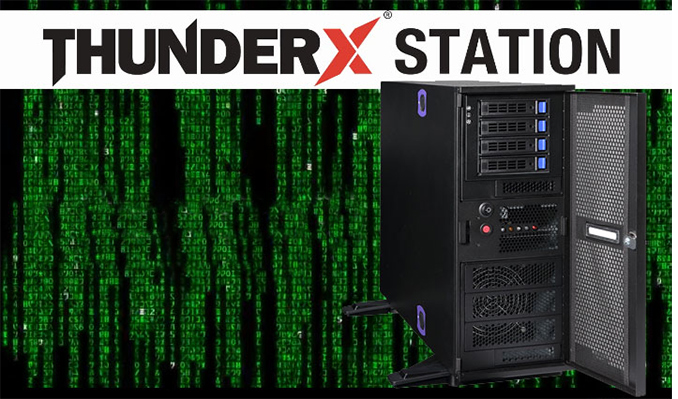
GIGABYTE this month introduced its ThunderXStation workstation based on two Cavium ThunderX2 processors featuring Armv8 architecture. The machine is primarily aimed at software developers porting or developing various applications to Armv8 platforms. The ThunderXStation is already available in the US.
GIGABYTE's ThunderXStation (W281-T90) comes in 4U tower and is based on a dual-socket motherboard supporting Cavium’s ThunderX2 SoCs featuring up to 64 custom Armv8 cores with four-way SMT as well as 16 DDR4 memory channels (1DPC, 8 channels per SoC) when two CPUs are installed. A dual-processor ThunderXStation comes with two PCIe Gen3/OCP x16 slots, four PCIe Gen3 slots (two x16 and two x8), four M.2 (NVMe/PCIe 3.0 x4) slots for SSDs, two U.2/SATA 2.5” bays for SSDs/HDDs, two 10 GbE/GbE QLogic NICs, NVIDIA’s GeForce GT 710 GPU, an 800 W redundant PSU and so on.
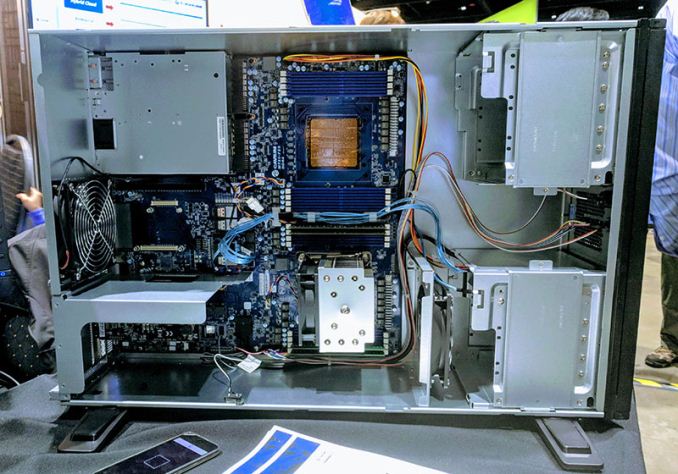
Image from ServeTheHome from OCP Summit 2018
From hardware standpoint, the ThunderXStation looks rather versatile: it supports various expansion slots, enabling developers to use various add-on cards, accelerators, and storage devices required by their applications. The system also has an Aspeed AST2500 server management chip to bring it even closer to target machines that will run the ThunderX2.
The ThunderXStation ships with Ubuntu 17.10 OS, but can come with CentOS 7.4 or OpenSUSE, if required. It also comes with preinstalled software development tools, including gcc 7.2, LLVM, gdb, Golang, OpenJDK 9.0, HHVM, Python, PHP, Ruby etc. The OS supports KVM and Docket to enable developers to test their apps in hypervisor-based or containerized environments. The machine ships with open sources graphics drivers, primarily because it comes with a GeForce GT 710 graphics card (so, open source drivers should be reasonably good for such an old architecture).
| GIGABYTE's ThunderXStation | |
| Preliminary Specifications | |
| CPU | Dual or single Cavium ThunderX2 2.2 GHz CPU with 32 cores |
| GPU | NVIDIA GeForce GT 710 |
| Memory | 8 × DDR4-2666 DIMM slots per CPU |
| Storage | 2 × M.2 slots for PCIe/NVMe SSDs |
| 2 × 2.5" SATA/U.2 bays | |
| Wireless | unknown/none |
| Ethernet | 1 × Gigabit Ethernet, can be outfitted with 10 GbE cards |
| PCIe | 1 × PCIe Gen 3/OCP x16 per CPU 2 × x16/x8/x4/x1 and x8 per CPU |
| Display Outputs | 1 × D-Sub for management Others via discrete graphics |
| Audio | unknown |
| USB | 4 × USB 3.0 Type-A |
| PSU | 800 W redundant |
| OS | Ubuntu 17.10. CentOS 7.4 or OpenSUSE |
One of the reasons why contemporary Armv8 SoCs are rarely used in datacenters is lack of software support. Developers need to recompile their programs for Arm, but since very few have access to hardware and appropriate tools, the software porting process is proceeding very slowly. GIGABYTE’s ThunderXStation will enable more parties to work on server programs for Arm platforms. This is similar to how Intel approached the Xeon Phi ecosystem, by launching a tower equivalent with a Knights Landing machine with the Xeon Phi chip as the host for development work.
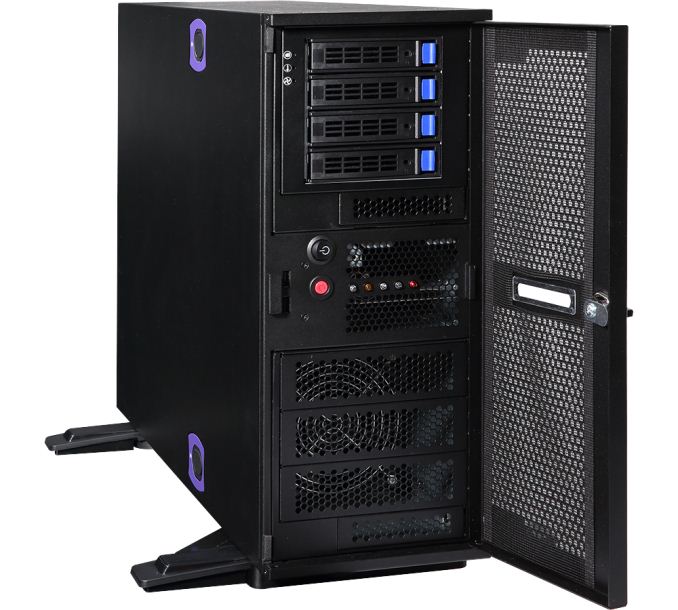
The Armv8-based workstation for software developers is now available from PhoenicsElectronics in the U.S. GIGABYTE does not publish pricing of the ThunderXStation, but we have reached out to PhoenicsElectronics and will update the story once we get more information on the matter.
Related Reading
- Marvell to Acquire Cavium for $5.5 Billion, Augmenting Marvell's CPU, Networking, & Security Assets
- Investigating Cavium's ThunderX: The First Arm Server SoC With Ambition
- AppliedMicro's X-Gene 3 SoC Begins Sampling: A Step in Arm's 2017 Server Ambitions
- MACOM Sells AppliedMicro’s X-Gene CPU Business
- Arm Challenging Intel in the Server Market: An Overview
- Supermicro Releases Intel Xeon Phi x200 (KNL) Systems: Servers and a Developer Mid-Tower
Sources: Cavium, ThunderXForums, Liliputing


from AnandTech https://ift.tt/2pJqZ5H
via IFTTT
Marvell Launches New SSD Controllers And RAID-Capable NVMe Switch
https://ift.tt/2IVVjmB
from AnandTech https://ift.tt/2pHY4zP
via IFTTT

At OCP Summit last week, Marvell unveiled a new generation of NVMe SSD controllers and a unique NVMe switch that blurs the lines between a standard PCIe switch and a traditional RAID controller.
The most straightforward of Marvell's three new NVMe products is the 88SS1098 "Zao" NVMe SSD controller. With 8 NAND channels and a PCIe 3 x4 host interface, the 88SS1098 is the direct successor to the 88SS1093 "Eldora" and 88SS1092 "Eldora Plus" controllers for high-end client SSDs and low-end enterprise NVMe SSDs. Performance increases will be enabled primarily by the introduction of Marvell's fourth-generation LDPC error correction engine with improved throughput, and by a 50% increase in the maximum supported NAND interface speed. The new controller also adds a fourth ARM Cortex-R4 CPU core. The DRAM controller has been upgraded to support LPDDR4, which should help reduce power consumption of M.2 NVMe SSDs. Up to 8GB of DRAM is supported, matching the 88SS1092's primary advantage over the 88SS1093 that is limited to 2GB of DRAM.
A number of new enterprise-oriented features have been added to Marvell's latest NVMe controllers. The PCIe host interface can be operated as a dual-port pair of PCIe 3 x2 links for high availability. SR-IOV virtualization support is included with support for up to 64 virtual instances of the controller. The new NVMe Streams and IO determinism features are supported, allowing drives to offer improved performance and endurance under mixed workloads when the host system's NVMe drivers support those features. Even without streams and IO determinism, latency QoS is improved by the migration of more controller functionality from the CPU cores to dedicated fixed-function hardware, and better support for suspending in-progress NAND program operations to perform a quicker read operation. The new controllers support a total of 132 queue pairs of up to 256 I/O commands in flight, so the controller can handle intense workloads and won't require host systems to share queues between CPU cores. QLC NAND is officially supported.
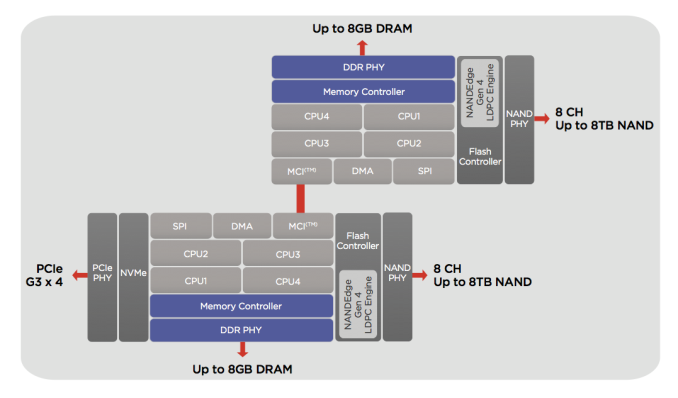
Marvell 88SS1088 Block Diagram
The high-end alternative in Marvell's new controller generation is the new 88SS1088 controller. This is a dual-chip controller solution, essentially a pair of 88SS1098 controllers with a dedicated 4GB/s link between them. Only one of the two controller chips connects to the host system so drives based around the 88SS1088 solution will still be limited to a PCIe 3 x4 interface or dual-port PCIe 3 x2. However, the total supported DRAM and NAND is doubled, allowing for 16GB of DRAM and 16TB of NAND spread across a total of 16 channels.
Drives using this dual-chip controller solution will appear to the host system as a single NVMe device and the host system will not have to implement its own software RAID-0 as required by products like the Intel P3608 that are essentially two separate SSDs sharing one circuit board. Performance from the 88SS1088 controller will be a bit higher than the 88SS1098 but the PCIe link will be a significant bottleneck at high queue depths. It is likely that the dual-chip design of the 88SS1088 puts it at a disadvantage relative to a monolithic single-die 16-channel controller design, but without a wider host interface the difference is unlikely to matter, and the 88SS1088 should be more economical than a massive native 16-channel controller. Marvell claims the 88SS1098 can deliver up to 700k random read IOPS and sequential reads of up to 3.6 GB/s, and the 88SS1088 can do about 800k random read IOPS.
The 88S1098 and 88SS1088 use a common architecture for firmware, so drive makers can easily re-use most of their firmware code between those two controllers and future controllers in this generation from Marvell. No other controllers have been announced yet, but Marvell is certain to introduce at least one low-end controller for entry-level client SSDs, and larger controllers are also a possibility if the 88SS1088's dual-controller design isn't enough to satisfy high-end enterprise demand.
Introducing NVMe Switches
In addition to a new generation of NVMe SSD controllers, Marvell has introduced a new category of NVMe chipset. The new Marvell 88NR2241 Intelligent NVMe Switch can replace some uses of PCIe switches: it has a PCIe x8 host interface, and up to four NVMe SSDs can be connected behind the switch. Unlike a regular PCIe switch, the SSDs behind the 88NR2241 switch are not individually accessible to the host system. Instead, the switch itself implements the NVMe 1.3 protocol and provides abstraction of the individual SSDs behind the switch. The storage of each of the individual SSDs can be presented to the host system as a separate namespace on the switch's NVMe controller, or the storage can be pooled with RAID 0,1 and 10 modes. Because the switch is the endpoint for NVMe transactions with the host system, it can provide advanced features that may not be supported by the individual SSDs, such as redundant dual-port support, multiple namespaces, SR-IOV virtualization, and NVMe-MI management support. The 88NR2241 implements the NVMe protocol but doesn't do any of the hard work of NAND flash management, so it is a very low-overhead intermediary and does not require any external DRAM. It may add slightly more latency than a simple PCIe switch would, but that extra latency is unlikely to matter to flash-based SSDs. Marvell has measured random read speeds of 1.6M IOPS and sequential speeds of 6.4GB/s using a PCIe 3 x8 host interface.
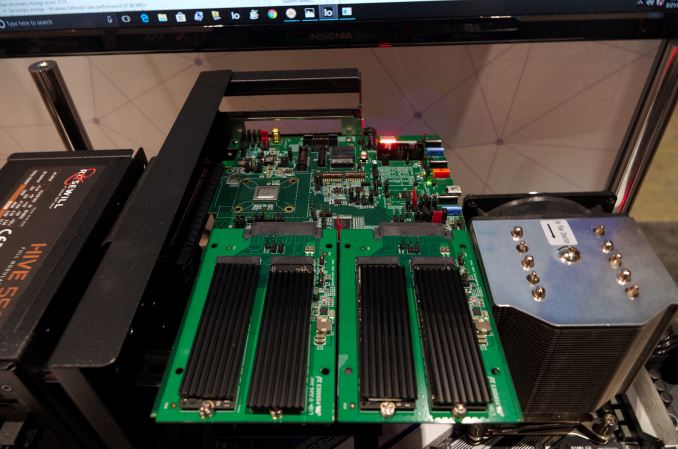
Marvell 88NR2241 development board
The Marvell 88NR2241 can work in front of any standard NVMe SSDs, even those using competitors' controllers. One use case Marvell envisions is creating enterprise-grade storage solutions out of consumer-class NVMe controllers and SSDs. The Marvell 88NR2241 has relatively small port and lane counts compared the large fan-out PCIe switches used in many servers, and Marvell's switch is not aimed at entirely replacing those large switches. Instead, the 88NR2241 is likely to be used in smaller hot-swappable storage modules that may still connect to a fan-out switch, or directly to the CPU on platforms that have plenty of PCIe lanes. The 88NR2241 may be used with several SSD controllers on larger SSD form factors like the new EDSFF Long cards derived from the Intel Ruler, or on PCIe add-in cards as either a HBA with cables to SSDs, or with several SSD controllers on the same card. Smaller form factors like the Samsung NF1 and M.2 are unlikely to have enough room for the 88NR2241 to be worthwhile.
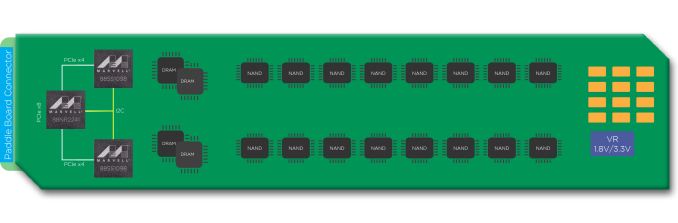
Potential layout for EDSFF Long SSD using Marvell 88NR2241 (not to scale)
Hardware RAID for NVMe has not been as popular as for drives using SATA and SAS interfaces. Part of the problem has been a dearth of controllers that can provide RAID functionality without imposing a performance bottleneck that eliminates the advantages of NVMe. Some recent top of the line RAID controllers from Broadcom/Avago/LSI can bond groups of four of their SAS/SATA links to connect to NVMe SSDs, but this leaves them with a disappointing port count and a few other inconvenient limitations. The Marvell 88NR2241 doesn't address all the demand for NVMe RAID capabilities (especially without RAID5/6 support), but it is a big step forward. Its compatibility with existing NVMe host drivers will make it very easy to deploy from a software perspective. Marvell didn't discuss future plans for other NVMe switches, but it is likely that they are planning larger variants to go after more of the traditional PCIe switch market and some of the SAS/SATA HBA market.

from AnandTech https://ift.tt/2pHY4zP
via IFTTT
Subscribe to:
Posts (Atom)
