Tuesday, 29 August 2023

Intel’s Meteor Lake CPUs will use AI to make your laptop battery last longer

https://ift.tt/VU4yiRG

Intel’s incoming Meteor Lake processors will mean better battery life for laptops that have these CPUs inside, thanks to Team Blue bringing the power of AI to bear on power management with these mobile chips.

PC World reports that Intel is heavily focused on AI not just with Meteor Lake in terms of having a VPU on the chips (a visual processing unit to help supercharge AI workloads), but that artificial intelligence also factors ‘heavily’ into power states for notebooks here.

Specifically, Intel revealed at the recent Hot Chips conference that Meteor Lake, as well as its future best CPUs, are going to employ AI to make some crucial decisions about exactly when to shift between high power (performance) and low power (idling) states.

As Intel explained in the talk at Hot Chips, the trick is how the CPU can switch between those states as efficiently as possible, in what Team Blue calls Dynamic Voltage and Frequency Scaling (or DVFS for short).

That DVFS-related decision making was revamped way back with Skylake processors (in 2015), when Intel introduced Speed Shift, a tech that intelligently shifted between high and low power CPU states based on standardized estimates for tasks (like opening a web page, for example, or any common workload).

Now, Intel has brought AI to bear so that this algorithm can, in the example given, predict how the user will open the web page, use it, then close it and move on.

As PC World makes clear, the difference is instead of a rougher estimate of how these common tasks work, and how best to tune power usage as a result, the algorithm has taught itself in a more in-depth way to hone the shift to result in lower power consumption.


Analysis: This isn’t just about power-saving – but responsiveness, too

This may sound like nitty-gritty details, but the overall effect could be sizeable indeed. Add up all those little power savings over every single task you carry out in a laptop session – lots and lots of them – and your battery is (hopefully) going to last appreciably longer.

Efraim Rotem, an Intel Fellow, and responsible for client SoC architecture at the company’s Design Engineering Group, reckons that the move with Meteor Lake could save 15% more energy than before (energy being work over time, divided by the power used, rather than just straightforward power consumption).

Not to mention that this helps to fine-tune the responsiveness of the system, too, in everyday tasks. Rotem estimates that in this regard, Meteor Lake ushers in an up to 35% improvement in responsiveness, no less, making these portables more likely to rank higher on our best laptops list.

Note that this is ‘up to’ and also that the AI smarts won’t apply to everything you do on your laptop. Thus far, the AI has only been trained on certain scenarios, and won’t train itself based on the way you use your computer as an individual – although that personalization is entirely possible as an avenue for the future. Exciting times indeed.

We’ll get the full lowdown at the launch of Meteor Lake processors at Intel’s Innovation event next month, and we’ll be hearing more about AI then, for sure.

You might also like


from TechRadar: computing components news https://ift.tt/28ywJPX
via IFTTT

Raptor Lake Refresh price rumor is worrying – could AMD’s Zen 5 CPUs leave Intel in the dust?

https://ift.tt/VU4yiRG

Intel’s Raptor Lake Refresh processors could witness a price hike with the initial launch of the K series models (that can be overclocked) for the 14th-gen.

Tom’s Hardware spotted that well-known leaker @momomo_us shared pre-release pricing from an unknown online retailer.

See more

Given that we aren’t told the source – though it’s obviously an obscure retail outlet somewhere – and the fact that these could well be placeholder listings, as is always the case with pre-release pricing, we must be extra-cautious here (even more so than usual with a rumor).

If the pricing is correct, the Core i9-14900K, Core i7-14700K, and Core i5-14600K are all set to be cranked up by about 15% for pricing compared to the equivalent Raptor Lake models. The actual price hikes vary slightly between 14% and 16%, but average out to 15%.

That would be a significant jump, of course, and would leave the 14900K flagship costing $695 in the US.

This comes alongside a recent leak showing that Raptor Lake Refresh may not be that much of a leap in performance, to potentially rub salt into the wounds.

If that spillage is correct, Intel’s inbound 14th-gen processors – which are expected to turn up in October – might only offer a 3% performance gain compared to Raptor Lake CPUs on average.

Analysis: Handing the CPU crown to AMD?

So, all this paints a rather worrying picture of a diminished value proposition with Raptor Lake Refresh, right? Well, it’s not quite that simple.

For starters, that performance leak we just mentioned comes with caveats. It shows single-core performance, and multi-core will see better gains, especially for the 14700K, which is expected to add four efficiency cores compared to the 13700K, so should be a much more meaningful upgrade.

Taking that nugget of info about the 14700K, it might make sense that this chip will get a price hike. But does it make sense that the 14600K would get the same level of price increase, given that it’ll be relatively unexciting in comparison? We’d argue not, and we’d expect a more modest increase for this mid-range CPU in all honesty, if it’s to make the cut for the likes of our best processor list.

This fact – and the source – casts doubt on this rumor for us. But we can’t rule out the possibility that even though the retailer may be bandying placeholder pricing around, it might still have heard a signal from Intel (or elsewhere in the industry) to expect price increases.

Intel’s 14th-gen has always been labeled as a simple refresh, and as such, was never going to be about big performance leaps. However, if Team Blue mixes very modest uplifts with price hikes, that’s not going to make for a particularly appetizing new range of processors.

Furthermore, bearing in mind that this is what Intel will have on the CPU table most of next year, with its following generation – Arrow Lake – likely not turning up until late in 2024, Raptor Lake Refresh is going to be facing off against Ryzen 8000. AMD’s next-gen CPUs, based on Zen 5, are rumored to potentially be looking at a release date of Q3 2024, which is very likely going to be before Arrow Lake.

And that could be a serious problem for Intel, particularly if the value proposition of Raptor Lake Refresh seems wonky.

A final observation: this is the second set of 14th-gen product listings we’ve spotted (the first didn’t provide any pricing), and that indicates something in itself – that perhaps Raptor Lake Refresh will arrive a bit sooner than expected.

You might also like


from TechRadar: computing components news https://ift.tt/kVrmzJ3
via IFTTT

Monday, 28 August 2023

Hot Chips 2023: Intel Details More on Granite Rapids and Sierra Forest Xeons

https://ift.tt/VU4yiRG

With the annual Hot Chips conference taking place this week, many of the industry’s biggest chip design firms are at the show, talking about their latest and/or upcoming wares. For Intel, it’s a case of the latter, as the company is at Hot Chips to talk about its next generation of Xeon processors, Granite Rapids and Sierra Forest, which are set to launch in 2024. Intel has previously revealed this processors on its data center roadmap – most recently updating it in March of this year – and for Hot Chips the company is offering a bit more in the way of technical details for the chips and their shared platform.

While there’s no such thing as an “unimportant” generation for Intel’s Xeon processors, Granite Rapids and Sierra Forest promise to be one of Intel’s most important updated to the Xeon Scalable hardware ecosystem yet, thanks to the introduction of area-efficient E-cores. Already a mainstay on Intel’s consumer processors since 12th generation Core (Alder Lake), with the upcoming 6th generation Xeon Scalable platform will finally bring E-cores over to Intel’s server platform. Though unlike consumer parts where both core types are mixed in a single chip, Intel is going for a purely homogenous strategy, giving us the all P-core Granite Rapids, and the all E-core Sierra Forest.

As Intel’s first E-core Xeon Scalable chip for data center use, Sierra Forest is arguably the most important of the two chips. Fittingly, it’s Intel’s lead vehicle for their EUV-based Intel 3 process node, and it’s the first Xeon to come out. According to the company, it remains on track for a H1’2024 release. Meanwhile Granite Rapids will be “shortly” behind that, on the same Intel 3 process node.


from AnandTech https://ift.tt/cCzLaZK
via IFTTT

Sunday, 27 August 2023

Retailer listings suggest Intel’s next-gen CPUs could arrive sooner than expected

https://ift.tt/VWNxCqa

Intel’s next-gen processors have been spotted listed by a retailer earlier than we anticipated, given the widely rumored launch date of (later in) October.

As Tom’s Hardware reports, Telemart, a Ukrainian retailer, listed a bunch of ‘K’ series Raptor Lake Refresh processors on its store (models which are unlocked and can be overclocked, and are expected to be the first products Intel wheels out).

The Core i9-14900K, Core i7-14700K and Core i5-14600K were the models listed – that and their KF variants, which don’t have integrated graphics. There’s no pricing info at this point, but we did see some listed specs which align with what the rumor mill has suggested in the past.

Namely that these 14th-gen CPUs will be 200MHz faster than their predecessors for boost speed (in most cases, anyway – with perhaps an exception or two dropping down to a mere 100MHz increase).

Furthermore, the 14700K is shown as the only chip which increases the core count, with Intel throwing in an extra four efficiency cores, again as rumored multiple times in the past. (Those efficiency cores are the low-power ones, so won’t make a major difference – but they will help as extra muscle for tougher multi-core tasks, and certainly, this CPU will be a strong candidate for our best processor list).

Analysis: Proceed very cautiously

Of course, these Raptor Lake Refresh CPUs are not available to pre-order, or even priced with placeholders – but their very appearance suggests that maybe Intel’s on-sale date could be a touch closer than we thought.

Currently, the expectation on the grapevine is for an October launch for 14th-gen processors, and likely a mid-to-late timeframe during that month. Seeing listings now, some two months ahead of that purported release schedule, might be a hint that next-gen models could turn up earlier in October.

Or it could just be a retailer accidentally-on-purpose jumping the gun to grab some limelight – as is always a possibility, especially when more minor retailers spill these kind of leaks (this isn’t Best Buy or Newegg, after all). So, we’d add a whole heap of caution – a double helping – here.

Time will tell, but it’s fair enough to say that this is at least a hint that Intel’s Raptor Lake Refresh processors might just turn up a bit sooner than expected – or certainly that they’re on track. At least the first batch of ‘K’ models anyway, as the other non-K processors (the ones that can’t be overclocked) aren’t expected until the start of next year.

These are on-sale dates, remember – the initial announcement of Raptor Lake Refresh will come earlier, in theory at Intel’s Innovation event (on September 28), just a month from now.

You might also like


from TechRadar: computing components news https://ift.tt/p7z8nQG
via IFTTT

Friday, 25 August 2023

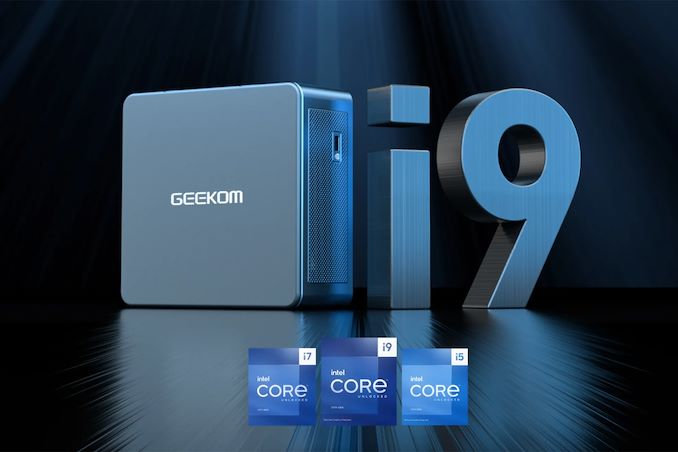
GEEKOM Mini IT13 Packs Core i9 into 4x4 NUC Chassis: 14-Cores NUC

https://ift.tt/kiUSwzl

While Intel's classic 4x4 NUCs have been pretty powerful systems capable of handling demanding workloads, the company never cared to install its top-of-the-range CPUs into its compact PCs. GEEKOM apparently decided to fix this and this week introduced its Mini IT13: the industry's first 4x4 desktop with an Intel Core i9 processor, offering with 14 CPU cores inside. 

The Mini IT13 from GEEKOM measures 117 mm × 112 mm × 49.2 mm, making it as small as Intel's classic NUC systems. Despite its compact size, it can pack Intel's mobile-focused 14-core Core i9-13900H (6P+8E cores, 20 threads, up to 5.40 GHz, 24 MB cache, 45W) that comes with integrated Xe graphics processing unit with enhanced performance (Xe-LP, 96 EUs or 768 stream processors at up to 1.50 GHz). 

To maintain consistent performance of the CPU and avoid overheating and performance drops of even under significant loads, the system employs a blower-style cooler, which produces up to 43.6 dBA of noise, so the machine is not exactly whisper quite to say the least.

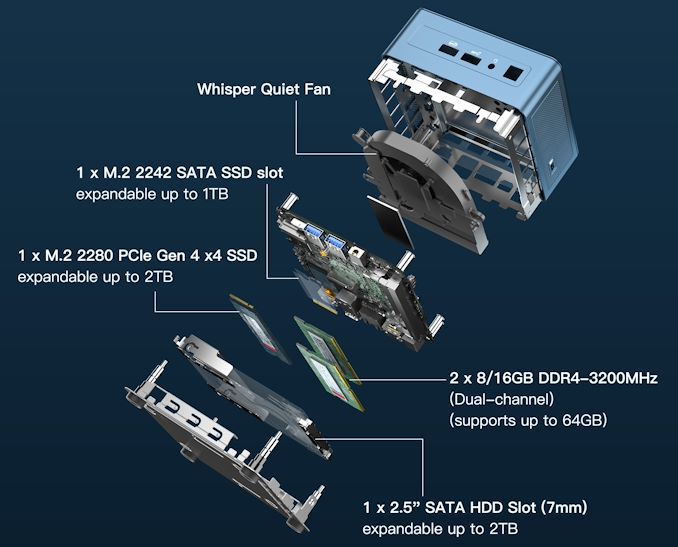
The compact PC supports  up to 64 GB of DDR4 memory through two SODIMMs, an M.2-2280 with a PCIe 4.0 x4interface and an M.2-2242 SSD with a SATA interface, and an additional 2.5-inch HDD or SSD for more extensive storage.

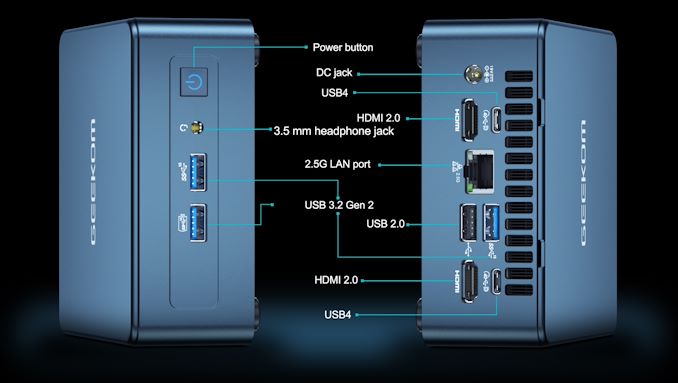
As far as connectivity is concerned, the GEEKOM Mini IT13 comes with a Wi-Fi 6E+ Bluetooth 5.2 module, a 2.5 GbE port, two USB4 connectors, three USB 3.2 Gen2 ports, one USB 2.0 Type-A connector, two HDMI 2.0 outputs (in addition to two DPs supported through USB4), an SD card reader, and a TRRS audio jack for headphones. 

Although GEEKOM does not directly mention it, the USB4 ports potentially allow to connect an external graphics card in an eGFX enclosure and make the Mini IT13 a quite decent gaming machine. Meanwhile, even without an external graphics card, the unit can support up to four displays simultaneously.

Interestingly, the GEEKOM IT13 machine does not cost an arm and a leg. The cheapest version with Core i5-13500H, 16 GB of RAM, and a 512 GB SSD can be purchased for $499, whereas the most expensive model with Core i9-13900H, 32 GB of memory, and 2 TB of solid-state storage costs $789.


from AnandTech https://ift.tt/pvVEjFK
via IFTTT

Thursday, 24 August 2023

Intel Core i7-14700K may be the only next-gen CPU worth buying if this leak’s right

https://ift.tt/wt3X9ns

Intel’s Raptor Lake Refresh line-up could have a standout CPU in the squad, and a bunch of very run-of-the-mill teammates, if a new leak pans out.

VideoCardz noticed that MSI accidentally shared what’s apparently a product training video (on YouTube) for its Intel motherboards, which imparts an overview of Team Blue’s 14th-gen chips, covering performance levels too.

Firstly, that’s a major faux pas to say the least. And secondly, it doesn’t make for comfortable viewing, at least not for anyone who has hopes that Raptor Lake Refresh will pull out some solid gains over current-gen Intel processors.

We’re told that Raptor Lake Refresh processors will be on average about 3% faster than Raptor Lake. In other words, most next-gen CPUs will only be slightly quicker than what we have now.

The exception is the Core i7-14700K, which will be 17% faster in multi-threading, according to MSI’s leaked briefing for staff. That’s in line with rumored 15% gains for the 14700K, and MSI also observes that the reason is Intel has upgraded the 14700K with four more efficiency cores than its predecessor – again, something that has been heavily rumored at this point.

Analysis: Take a beat

This is rather disappointing in all honesty, although we shouldn’t jump the gun as we can’t put too much weight on a single leak. 

Is it genuine? It looks that way, though we can’t see the video now to check (it’s been made private, as the clip should have been in the first place). Has MSI got some of this info wrong, perhaps? Maybe. We don’t know, and we won’t know until we get some Raptor Lake Refresh processors in for testing ourselves to compare to current Raptor Lake chips.

Of course, Raptor Lake Refresh has had somewhat reined-in expectations from the off, seeing as it’s always been billed as just a simple refresh. But some rumors have indicated that, as well as a strong 14700K that’s a candidate for the best processors list, some other 14th-gen chips might offer impressive gains too. For example, the 14600K has been suggested to be a pacey offering as well in the past. Maybe that leak is wrong, though.

We’d certainly expect more than a 3% average improvement for Intel’s next-gen CPUs. Although MSI doesn’t actually frame this as single-core or multi-core, so perhaps it’s the former (the 17% uptick for the 14700K clearly mentions multi-core). And from that perspective, 3% may not be terrible (some CPUs will still offer a bit more than that, of course – and maybe a fair bit more for multi-core, we can hope).

All this is even more reason to not be leaping to conclusions yet, but as it stands, this leak does not get us excited for Intel’s Raptor Lake Refresh processors.

You might also like


from TechRadar: computing components news https://ift.tt/OAMucNX
via IFTTT

Tuesday, 22 August 2023

Synopsys Surpasses $500M/Year in AI Chip Revenue, Expects Further Rapid Growth

https://ift.tt/1Ujbp7c

Demand for generative artificial intelligence (AI) applications is so high that NVIDIA's high-performance compute GPUs like A100 and H100 are reportedly sold out for quarters to come. Dozens of companies are developing AI-oriented processors these days and, like the gold rushes of old, the tool suppliers are some of the biggest winners. As part of their Q3 earnings report, Synopsys, one of the leading suppliers of electronic design automation (EDA) tools and chip IP, disclosed that it's already booked over half of a billion of dollars in AI-related revenue in the last year.

"AI chips are a core value stream for Synopsys, already accounting on a trailing 12-month basis for well over $0.5 billion," said Aart J. de Geus, the outgoing chief executive of Synopsys, at the conference call with analysts and investors (via SeekingAlpha). "We see this growth continuing throughout the decade."

Rising demand for diverse generative AI applications is propelling the AI server market's growth, going from $30 billion in 2023 to an impressive $150 billion by 2027, according to the head of Foxconn. The market for AI processors is poised to expand at a similar pace, and Synopsys is projecting it to exceed $100 billion by 2030.

"Use cases for AI are proliferating rapidly, as are the number of companies designing AI chips," said de Geus. "Novel architectures are multiplying, stimulated by vertical markets, all wanting solutions optimized for their specific application. Third parties estimate that today's $20 billion to $30 billion market for AI chips will exceed $100 billion by 2030."

AI processors are set to become a sizable part of the semiconductor market in general. In fact, sales of AI chips may account for 10% of the whole semiconductor market several years down the road. Furthermore, they will be a major driver for the semiconductor market growth as they will enable new types of applications, such as self-driving vehicles.

"In this new era of 'smart everything,' these chips in turn drive growth in surrounding semiconductors for storage, connectivity, sensing, AtoD and DtoA converter, power management," said the head of Synopsys. "Growth predictions for the entire semi market to pass $1 trillion by 2030 are thus quite credible."

Perhaps the most amusing part about Synopsys earning over $500 million on AI chips in about a year is that a significant part of the company's revenue comes from AI-enabled EDA tools. Essentially, the company is selling EDA software that uses artificial intelligence to develop artificial intelligence chips.

Sources: Synopsys, SeekingAlpha.


from AnandTech https://ift.tt/zlLGhtW
via IFTTT
Related Posts Plugin for WordPress, Blogger...